

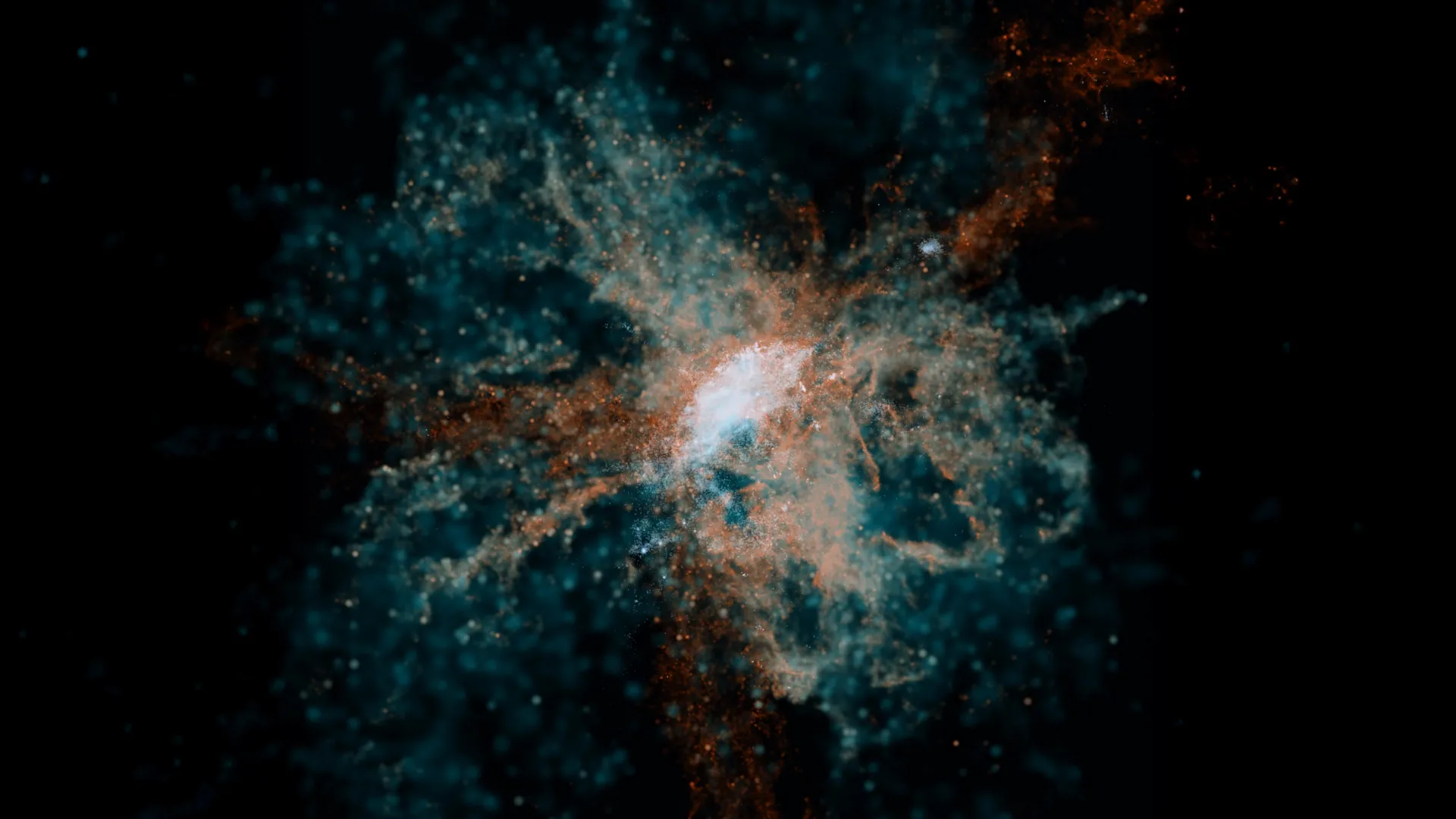
A team of researchers at the University of Arizona has published findings in Nature Astronomy suggesting that the early universe was chemically enriched sooner than previously understood. Observations from roughly 500 million years after the Big Bang reveal that primordial galaxies were already producing and dispersing heavy elements such as carbon, oxygen, and silicon into surrounding space, challenging the conventional assumption that the cosmos remained predominantly pristine during this period.
The study utilized NASA’s James Webb Space Telescope to examine three extremely distant galaxies whose light traveled over 13 billion years to reach Earth. By analyzing absorption patterns in the light emitted by these galaxies, researchers identified evidence of heavy elements escaping outward into intergalactic space. The absorption signatures displayed a blueshift relative to the galaxies’ own redshift, indicating outward motion of gas carrying these heavier elements away from their sources.
The research demonstrates that chemical enrichment through what astronomers call baryon cycling—the exchange of material between galaxies and their surroundings—was already occurring during the Epoch of Reionization. This early dispersal process contradicts earlier expectations that such material cycling would develop only after galaxies matured. The chemical signatures observed around these infant galaxies resembled those found around substantially older galaxies billions of years later, suggesting similar enrichment mechanisms operated across cosmic timescales.
The findings have implications for understanding Population III stars, hypothetical first-generation stars thought to have formed from pristine hydrogen and helium before heavy elements spread throughout the cosmos. If nearby space was chemically enriched rapidly during the early universe, truly pristine environments suitable for Population III star formation may have disappeared quickly, potentially explaining why such objects remain difficult to observe in astronomical records.
Article Attribution | Read More at Article Source
Article summary produced by Claude AI