

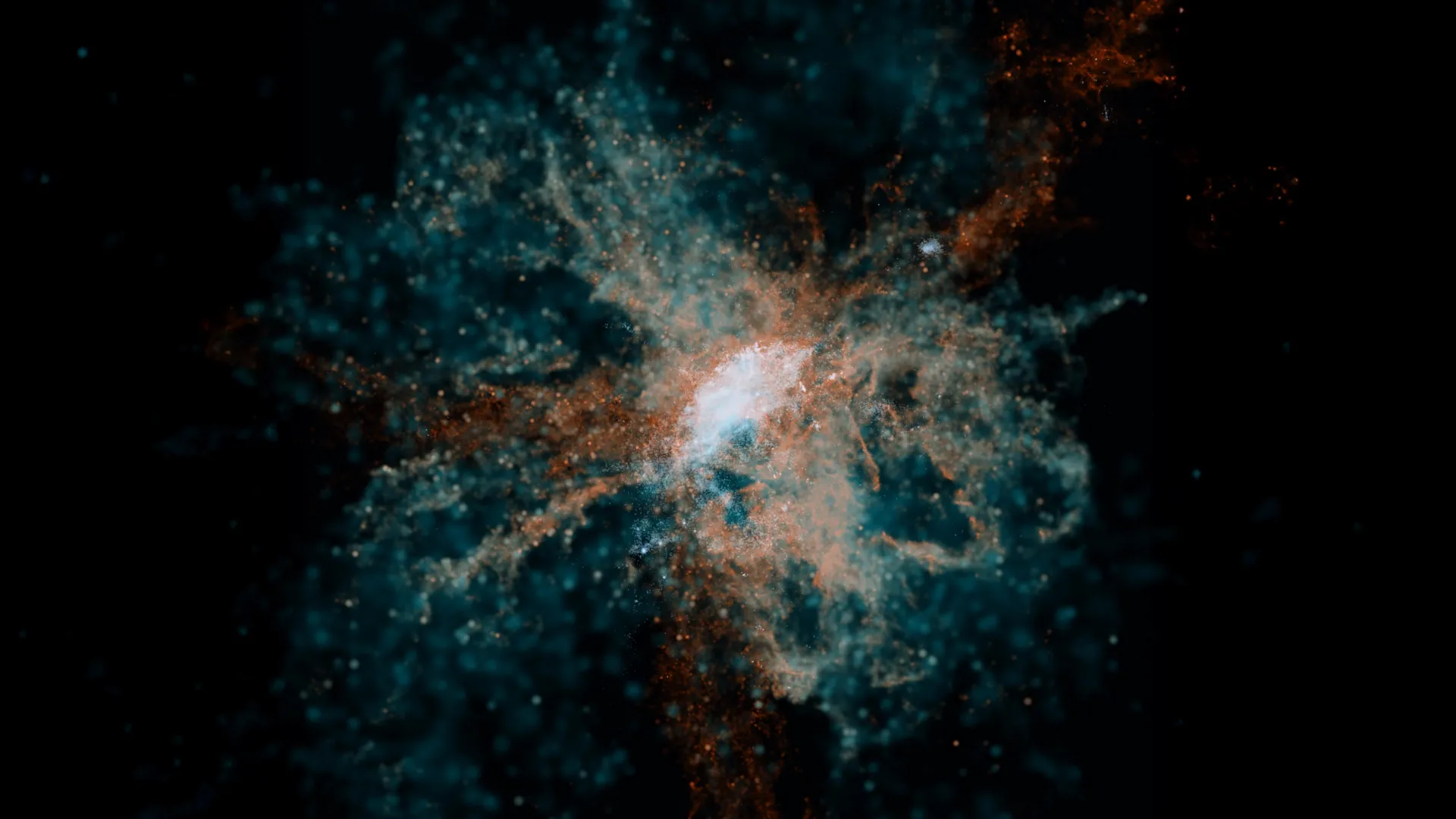
Approximately 500 million years after the Big Bang, when the universe was roughly 3% of its current age, some of the first stars and galaxies had begun to form and shine. Astronomers had generally assumed that gas surrounding these young galaxies remained nearly pristine, composed primarily of hydrogen and helium, the dominant elements of the early cosmos.
A new study led by researchers at the University of Arizona and published in Nature Astronomy challenges this understanding. The research indicates that early galaxies were already producing and dispersing heavier elements such as carbon and oxygen into surrounding space far earlier than scientists had anticipated. The investigation examined three extremely distant galaxies whose light traveled more than 13 billion years to reach Earth, appearing as they did roughly 500 million years after the Big Bang during the Epoch of Reionization.
The observations were made possible by NASA’s James Webb Space Telescope, which used its infrared capabilities to study these ancient galaxies. Researchers analyzed absorption patterns in the light traveling from these galaxies toward Earth. The absorption lines showed blueshifted patterns compared with the galaxies’ own redshift, indicating that gas containing oxygen, carbon, and silicon was moving outward and escaping into intergalactic space. The chemical signatures surrounding these infant galaxies appeared remarkably similar to those found around far more mature galaxies billions of years later in cosmic history.
The findings demonstrate that galaxies are not isolated objects but interact with their surroundings through a process astronomers call baryon cycling, in which material is exchanged with the broader galactic ecosystem. The evidence that this process was already underway so early in cosmic time may help explain the scarcity of Population III stars, the universe’s hypothetical first generation formed from pristine hydrogen and helium. If galaxies began enriching nearby space so quickly, pristine gas may have disappeared too rapidly for these early stars to remain common enough for easy observation.
Article Attribution | Read More at Article Source
Article summary produced by Claude AI