

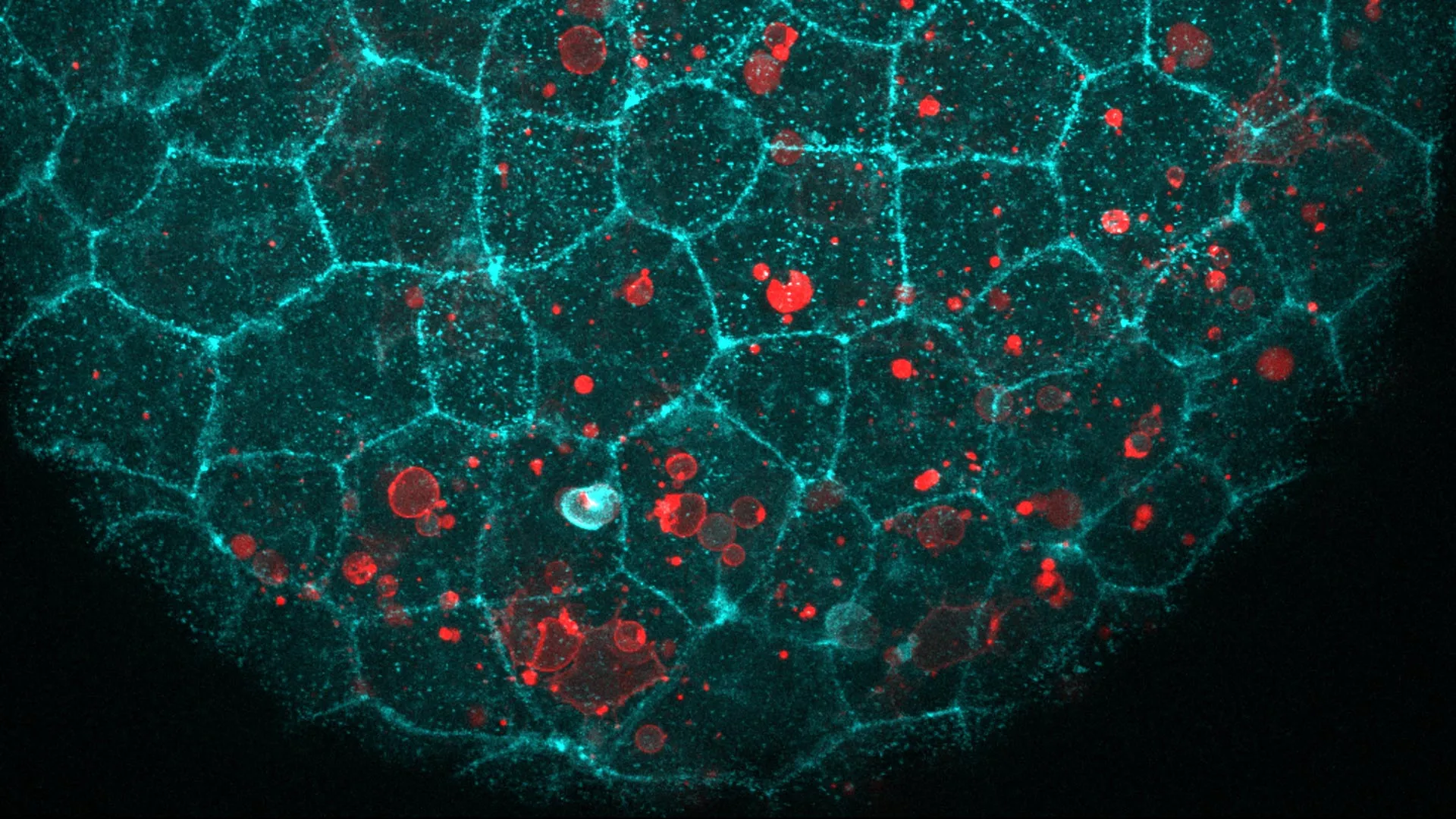
Scientists have identified a previously unknown function of E-cadherin, a protein complex responsible for maintaining structural connections between epithelial cells that line surfaces throughout the body such as skin and airways. In addition to its established role as cellular “glue,” the protein machinery also facilitates the removal of dead cells from tissues, according to findings published in Nature Communications.
A research team led by Verena Ruprecht conducted experiments using living zebrafish and mouse embryos to examine how epithelial tissues interact with dying cells. The investigators tested whether E-cadherin molecules bind to dying cells through the same mechanism used to connect healthy neighboring cells. Two experimental approaches revealed that epithelial tissues successfully engulfed dying cells even when those cells lacked E-cadherin proteins, and similarly consumed marker particles containing death signals but no protein. These findings indicated that the adhesion machinery functions through a recognition mechanism distinct from its cell-to-cell connecting role.
The research documented how epithelial tissues accomplish this cleanup while maintaining their structural integrity. Live imaging showed that individual epithelial cells can behave asymmetrically during the engulfment process, with their lower surfaces stretching around dead cells while upper surfaces facing the external environment remain relatively stable, preserving the tissue barrier. Within the E-cadherin complex, one protein acted as a mechanical connector linking the molecular assembly to the cell’s internal skeleton, while another component functioned as a restraining element on cellular contraction. Notably, removing this restraint did not enhance cleanup efficiency; instead, cells became too rigid to properly remove debris.
Testing in mouse embryos confirmed that blocking E-cadherin prevented removal of dying cells, suggesting the mechanism is conserved across vertebrate species. However, researchers have not yet determined whether this same E-cadherin-dependent process operates in adult tissues. The findings carry potential medical significance because inefficient removal of dying cells contributes to chronic inflammation, indicating that understanding this cellular cleanup mechanism may inform therapeutic approaches to inflammatory conditions.
Article Attribution | Read More at Article Source
Article summary produced by Claude AI