

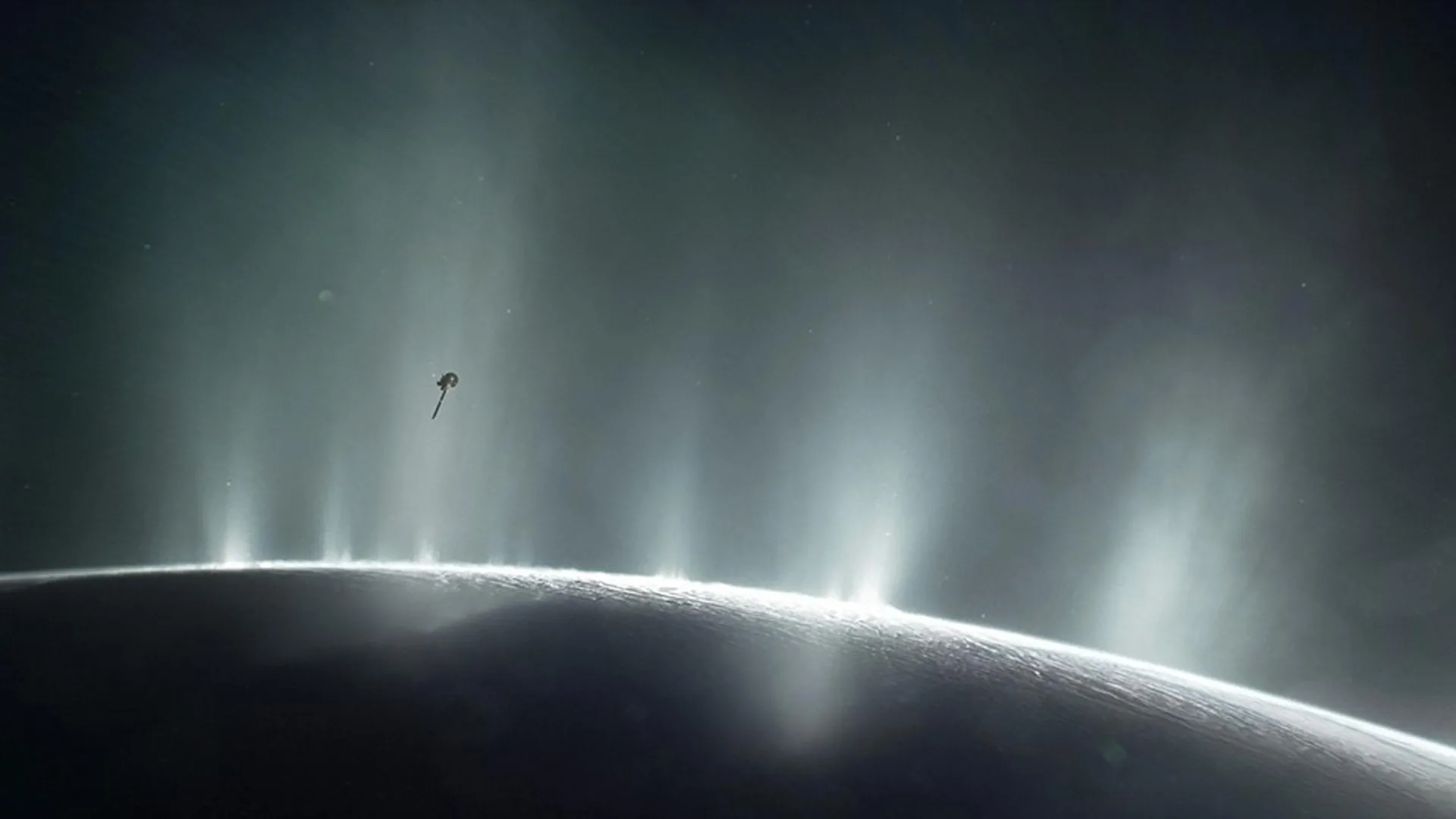
An international research team has identified previously unknown complexity in the ice particles ejected from Saturn’s moon Enceladus, revealing insights into the moon’s subsurface ocean and the processes that transform seawater into space-bound ice grains.
Data collected by NASA’s Cassini spacecraft between 2004 and 2017 revealed that salt-rich ice particles in Saturn’s E-ring, which originates from Enceladus, display remarkably diverse chemical compositions. Researchers examined 961 measurements of these particles and found that some grains were enriched in sodium chloride while others contained higher concentrations of carbonates, phosphates, or potassium chloride. Notably, chloride and carbonate rarely appeared together in the same particles, a pattern that contradicted the expectation that all grains would show similar salt mixtures if derived from a uniform ocean.
To explain this puzzle, scientists at the Earth-Life Science Institute conducted laboratory experiments freezing ocean-like droplets under different conditions. These experiments demonstrated that the speed at which droplets freeze determines how salts distribute within them. When droplets approximately 200 micrometers in size froze slowly, at rates of roughly 10 Kelvin per minute or slower, salts separated into distinct regions. Faster freezing preserved more uniform chemical mixtures. This finding suggested that Cassini’s observations could be explained if ocean droplets froze gradually and then fragmented, with each piece containing different salt compositions.
The research implies that seawater spray within Enceladus’s subsurface vent system moves more slowly than previously theorized. Droplets may travel through complicated fracture networks deep within the ice, gradually freezing as they advance. Closer to the surface, accelerating gas flow causes frozen droplets to break apart against narrow icy channels, creating smaller fragments that escape into space. Each fragment preserves different chemical regions from its parent droplet, explaining the compositional diversity observed by Cassini.
The findings have broader implications for future exploration and astrobiology research. As droplets freeze and separate, certain compounds become concentrated in individual ice grains, potentially making chemical analysis easier during future missions. Additionally, the concentration process occurring within liquid brine pockets during freezing could have significance for prebiotic chemistry, the chemical reactions potentially preceding life emergence. Since ejected material eventually returns to Enceladus’s surface, these freezing and concentration cycles could repeat multiple times, creating conditions that may support or have supported habitability in the moon’s ocean.
Article Attribution | Read More at Article Source
Article summary produced by Claude AI