

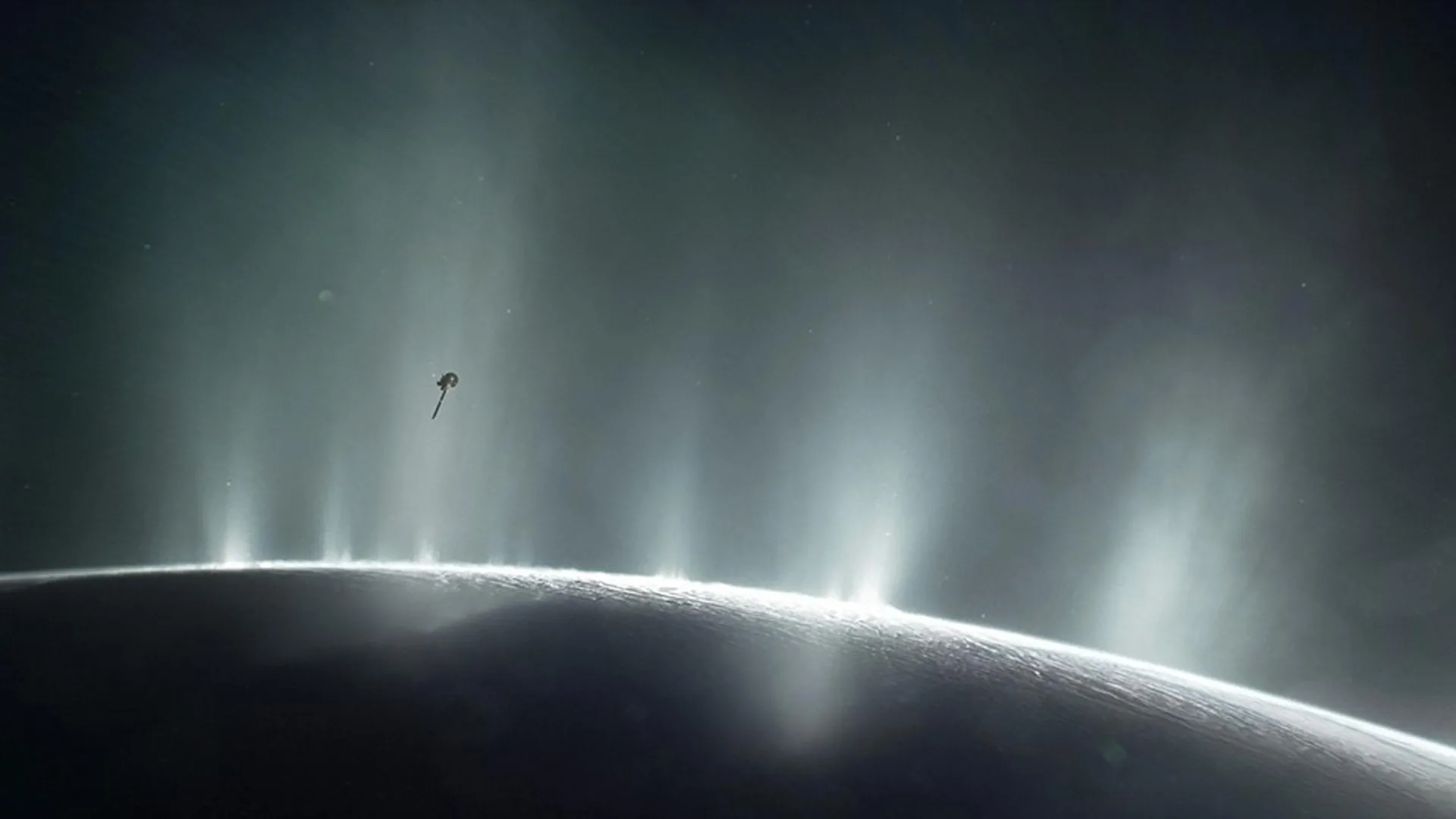
An international research team has provided new insights into the chemical composition of ice particles erupting from Saturn’s moon Enceladus. Between 2004 and 2017, NASA’s Cassini spacecraft collected measurements of individual ice particles in Saturn’s E-ring, which is continuously replenished by material from Enceladus. Analysis of 961 mass spectra revealed that salt-rich particles, known as Type 3 particles, displayed dramatic variations in their chemical makeup—some were rich in sodium chloride while others contained higher amounts of carbonates, phosphates, or potassium chloride. Notably, chloride and carbonate rarely appeared together in the same particles, presenting a puzzle about how such different compositions could originate from the same subsurface ocean.
To address this question, researchers at the Earth-Life Science Institute at the Institute of Science Tokyo conducted laboratory experiments freezing droplets containing the major salts believed to exist in Enceladus’ ocean. The experiments revealed that the speed of freezing plays a critical role in determining salt distribution. When droplets approximately 200 micrometers across froze slowly—at roughly 10 K per minute or less—salts separated into distinct regions. Conversely, rapid freezing kept chemical ingredients more evenly mixed. This finding suggests that the chemical diversity observed by Cassini could emerge from ocean water with a consistent composition.
The research indicates that the journey of water from Enceladus’ subsurface ocean to space may be more complex than previously understood. Rather than freezing quickly upon leaving the ocean, droplets may move slowly through underground vent systems, following intricate pathways through ice fractures. As they descend, gradual freezing allows salts to separate. Closer to the surface, conditions change dramatically—gas accelerates and frozen droplets collide forcefully with icy channel walls, shattering into smaller fragments. Each fragment preserves different salt-rich regions from the original droplet, explaining the chemical diversity detected in space particles.
This discovery carries significant implications for future missions to Enceladus. As droplets freeze and break apart, individual compounds can become concentrated in particular ice grains—a natural sample preparation process. Organic substances may similarly become isolated and appear at elevated concentrations in certain particles, potentially making chemical analysis considerably easier for future spacecraft. Additionally, during slow freezing, small pockets of liquid brine trapped between ice crystals can concentrate salts and organic compounds, processes that may recycle through the moon repeatedly. These mechanisms could have relevance for understanding prebiotic chemistry on Enceladus and assessing the moon’s potential habitability.
Article Attribution | Read More at Article Source
Article summary produced by Claude AI