

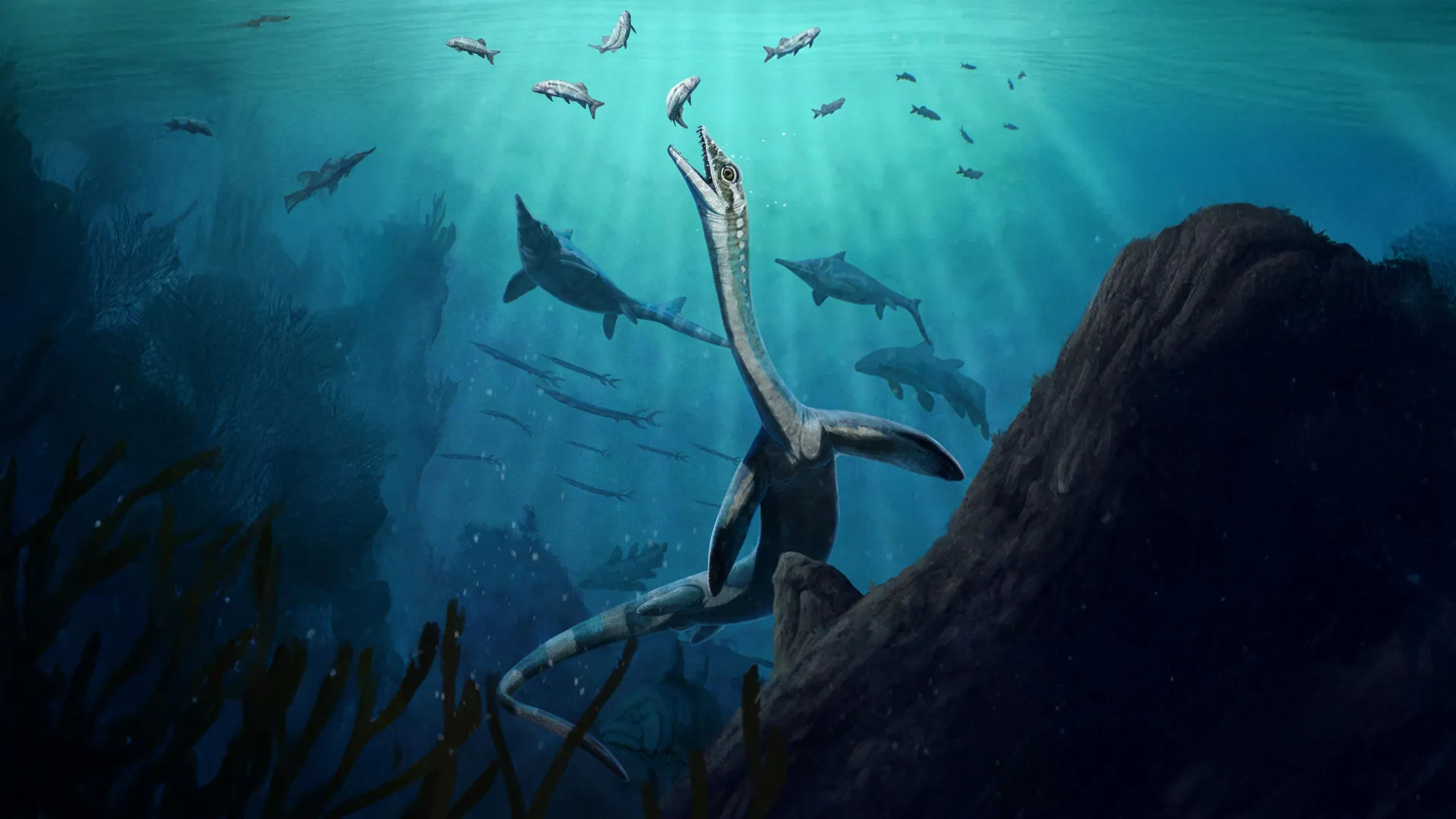
Researchers from institutions across China, Europe, and the United States have identified an exceptionally well-preserved specimen of Austronaga minuta, a long-necked marine reptile that inhabited seas during the Middle Triassic. The fossil, which measures approximately 60 centimeters in length, demonstrates remarkable completeness and includes internal organs rarely found in ancient specimens.
The specimen’s anatomy reveals sophisticated aquatic adaptations despite Austronaga’s evolutionary lineage connecting to land-dwelling archosaurs rather than better-known marine reptile groups like ichthyosaurs. The animal possessed an elongated neck and tail suited for ocean life, with fin-like front legs supporting steering and stabilization, while its reduced hind legs appear to have played a minimal role in swimming. This morphology is particularly noteworthy given the group’s ancestry among land reptiles.
Using advanced analytical methods including ultraviolet photography and mass spectrometry, the research team identified multiple internal structures preserved within the fossil. The digestive system encompasses a large, sac-shaped stomach positioned anteriorly, followed by a liver showing detectable hemoglobin traces, and a relatively straightforward intestinal tract. This arrangement represents the oldest substantially intact digestive system documented in any reptile species.
The internal organs display notably simpler organization than would be expected given Austronaga’s specialized swimming physiology. The specimen possessed a single stomach chamber, contrasting with the two-chambered stomachs characteristic of modern birds and crocodiles, suggesting early archosaur stomachs remained structurally basic before later evolutionary development. The digestive tract composition parallels that found in contemporary fish-eating reptiles.
The findings, published in Science Advances, contribute to understanding the rapid development of ocean adaptations among archosaur relatives and provide insights into the evolutionary trajectory of marine and terrestrial reptile groups during the Triassic period. Researchers indicate that continued discoveries may further illuminate the early evolutionary history of modern reptile lineages.
Article Attribution | Read More at Article Source
Article summary produced by Claude AI