

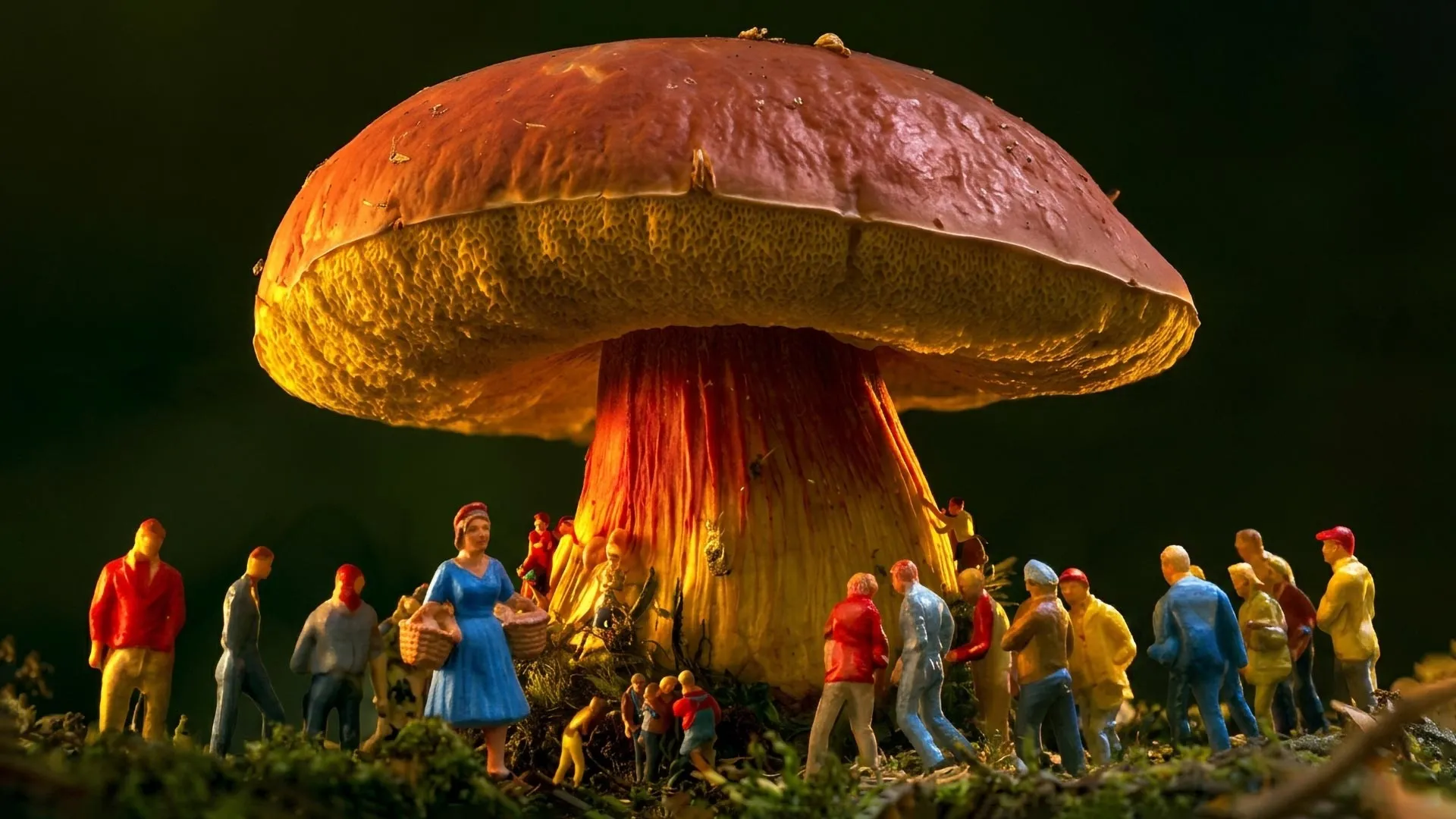
Scientists have traced a century-old phenomenon of miniature human hallucinations to a specific mushroom species, providing biological evidence for what was previously attributed to cultural beliefs. The investigation, conducted by researchers at the University of Utah and published in Mycologia, identifies Lanmaoa asiatica as the fungus responsible for these distinctive visions reported in Southwest China and the northern Philippines. The research represents a significant breakthrough in understanding hallucinations that have puzzled scientists since the 1930s.
Reports of unusual visual experiences after consuming wild mushrooms first surfaced in 1934 when Western researchers learned of the phenomenon in Papua New Guinea. Decades of investigation failed to identify any known psychoactive compounds, leading some scientists to question whether cultural expectations rather than chemistry explained the consistent reports. The mystery was revisited during the 1990s when similar cases emerged in Yunnan, China, and more recently when comparable accounts were documented in the northern Philippines. The third independent geographic report of remarkably similar hallucinations prompted renewed scientific investigation.
Doctoral student Colin Domnauer and mycologist Bryn Dentinger conducted fieldwork in both China and the Philippines, collecting mushroom specimens and interviewing community members. DNA sequencing confirmed that mushrooms locally known as “Jian shou qing” in China and “Sedesdem” in the Philippines were both L. asiatica, establishing the first confirmed link between geographically distant regions experiencing identical hallucinations. While samples from Papua New Guinea could not be obtained due to unfavorable conditions, the genetic evidence from two continents strongly suggests a shared biological mechanism rather than separate cultural influences.
The hallucinations described across all three regions share striking consistency, with people reporting visions of dozens to hundreds of figures typically measuring 3 to 30 centimeters tall. Approximately 90 percent of those affected describe characters resembling elves or clowns wearing colorful clothing, and notably, these figures appear to follow physical rules, walking around obstacles and interacting realistically with their environment. Chemical and genetic analysis revealed that L. asiatica contains no known psychedelic compounds, suggesting the mushroom produces an entirely unfamiliar hallucinogenic substance. Understanding this unknown chemical could advance knowledge of how the brain constructs visual perception and may have implications for studying neurological disorders.
Article Attribution | Read More at Article Source
Article summary produced by Claude AI