

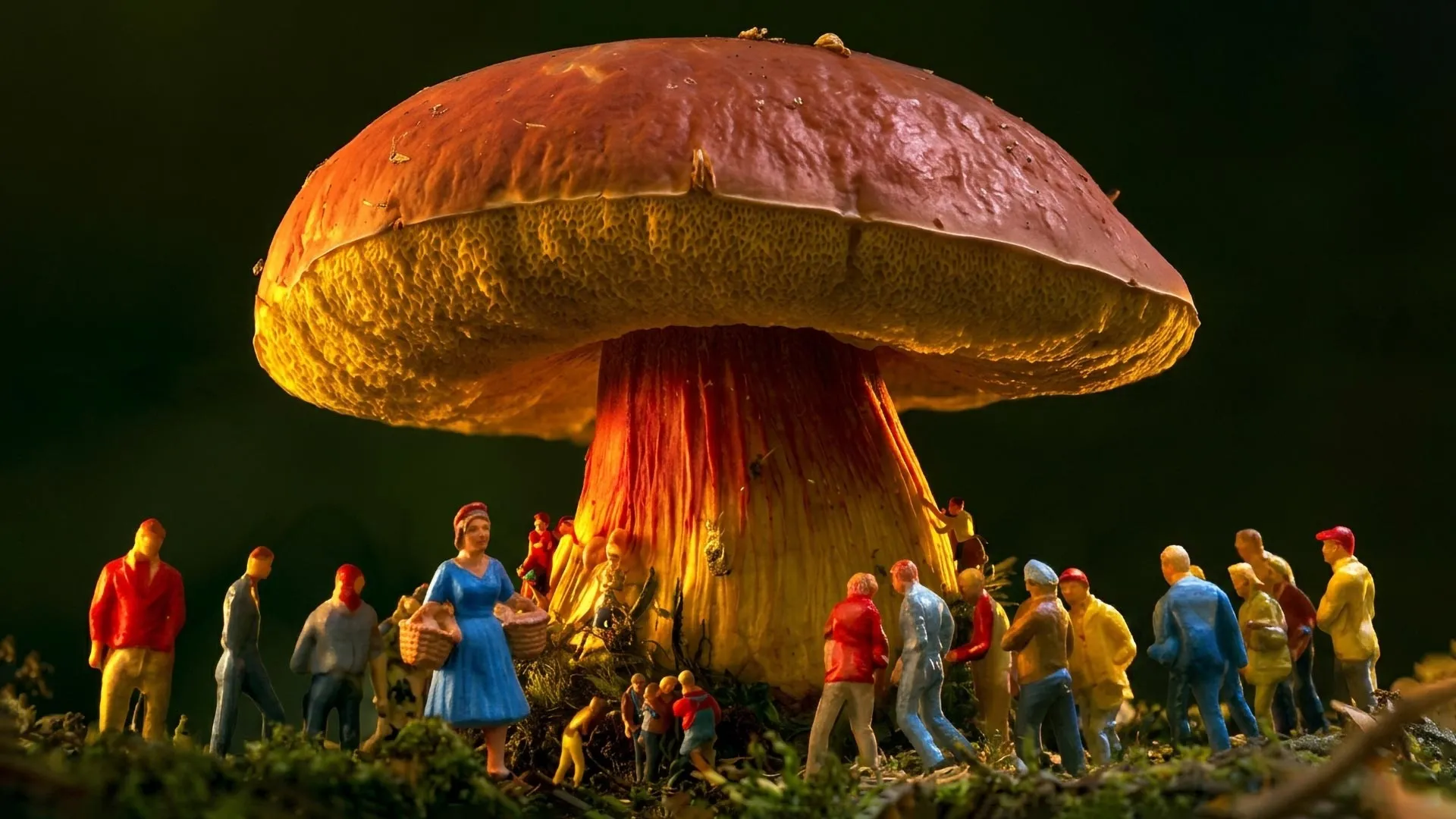
A team of researchers at the University of Utah has identified Lanmaoa asiatica as the mushroom responsible for producing vivid hallucinations of tiny human figures among people in Southwest China and the northern Philippines. The findings, published in the journal Mycologia and conducted by doctoral student Colin Domnauer and mycologist Bryn Dentinger, represent a significant breakthrough in a scientific mystery spanning nearly a century.
The phenomenon dates back to 1934, when Western researchers first documented reports from Papua New Guinea of people experiencing vivid visions of miniature humans after consuming wild mushrooms. Despite investigations throughout the 1950s and 1960s, including examination of samples by Albert Hofmann, the scientist who isolated psilocybin and discovered LSD, no chemical explanation could be identified. Without clear evidence, some researchers began attributing the reports to cultural beliefs rather than biological causes, and scientific investigation largely ceased by the end of that decade. The mystery resurfaced in the 1990s when similar reports emerged from Yunnan, and again in 2024 with accounts from an Indigenous community in the Philippines.
Dmnauer collected mushroom specimens during fieldwork in both Yunnan and the Philippines, conducting interviews with local residents familiar with the mushrooms locally known as “Jian shou qing” and “Sedesdem,” respectively. DNA analysis conclusively established that specimens from both regions belonged to the same species, L. asiatica. This genetic verification, combined with remarkably consistent descriptions of the hallucinations across three geographically separated populations, provided compelling evidence for a shared biological rather than cultural explanation.
People experiencing these hallucinations typically report seeing dozens to hundreds of miniature figures measuring between 3 and 30 centimeters tall. Approximately 90 percent describe figures resembling elves, clowns, or fairy-like characters in brightly colored clothing. The visions display an unusual quality in that the tiny figures appear to follow physical laws, walking around obstacles and interacting realistically with their environment rather than behaving in the chaotic manner typical of many drug-induced hallucinations.
Despite extensive testing using both chemical analysis and genetic sequencing, researchers found no evidence of known psychoactive compounds such as psilocybin. The discovery suggests that L. asiatica produces an entirely unfamiliar hallucinogenic substance, and identifying this compound could advance understanding of neurological disorders and the brain’s visual perception mechanisms.
Article Attribution | Read More at Article Source
Article summary produced by Claude AI