

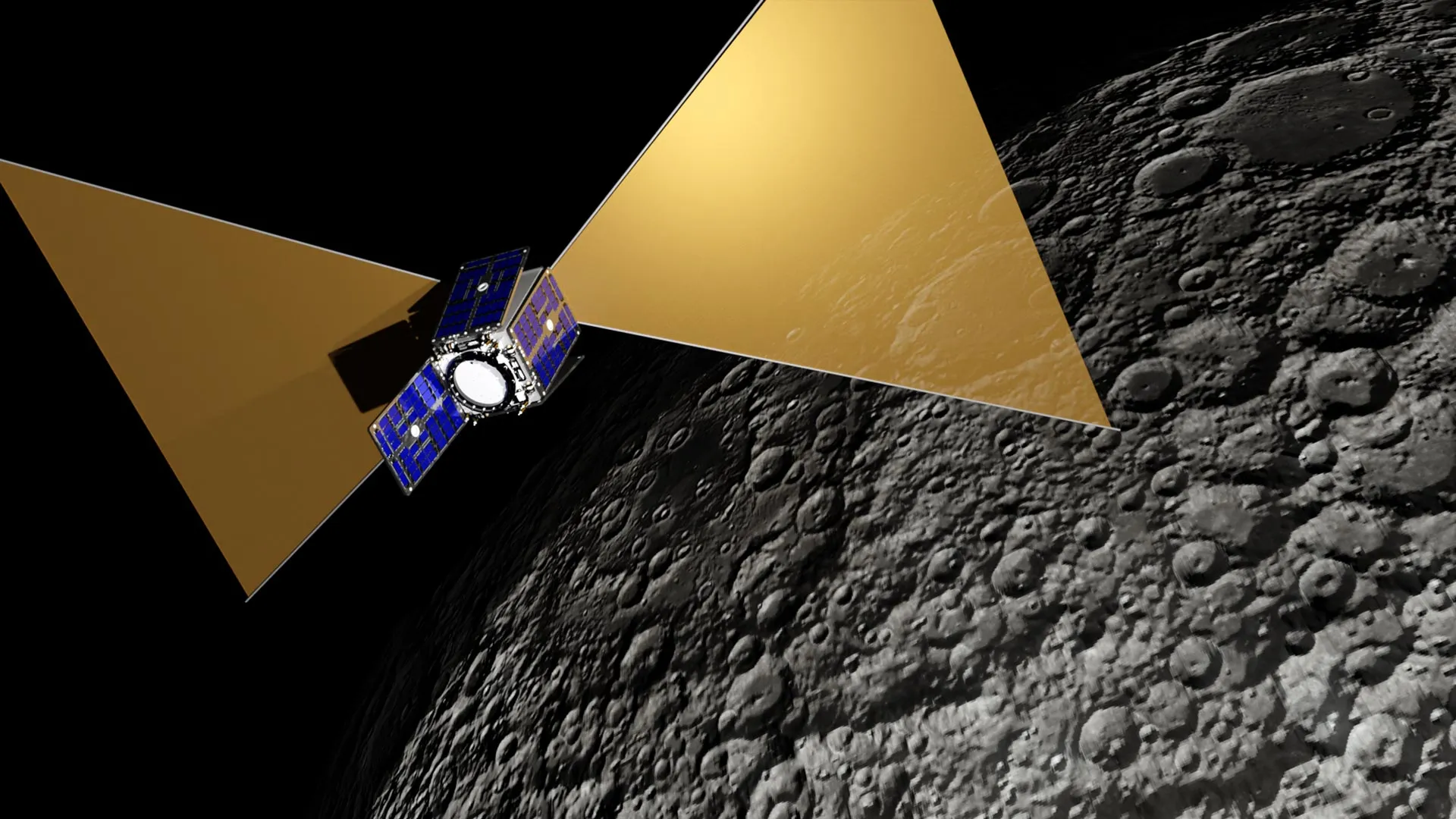
An international research team led by the University of Cambridge is developing a compact spacecraft called CosmoCube to investigate one of the universe’s least-understood periods: roughly 150 million years of cosmic darkness before the emergence of the first stars. The satellite, which is approximately the size of a small carry-on suitcase, represents a novel approach to studying this ancient epoch by positioning itself in lunar orbit where the Moon’s far side can shield its instruments from radio interference generated by Earth.
The primary objective of the CosmoCube mission involves detecting an extremely faint signal known as the 21-centimeter line, which originates from hydrogen atoms that existed during the period between the Big Bang’s afterglow and the onset of stellar fusion. Direct observation of this signal from Earth-based facilities has proven extraordinarily challenging because the planet’s ionosphere blocks the relevant radio frequencies, and transmissions from FM broadcasts, satellites, and telecommunications create significant interference that drowns out the cosmic signal. By positioning the spacecraft behind the Moon during its orbital passes, researchers expect to achieve approximately 40 minutes of interference-free observation during each two-hour orbit, potentially accumulating roughly 1,000 hours of usable data over the mission’s anticipated two-year duration.
Beyond investigating the pre-stellar universe, the mission aims to illuminate the role of dark matter in the formation of early cosmic structures. Scientists hope that observations of hydrogen emissions from this primordial period will clarify how dark matter’s gravitational influence facilitated the assembly of hydrogen into the first stars and galaxies. The spacecraft will observe radio frequencies between 10 and 50 megahertz, a range largely inaccessible to ground-based telescopes, making the lunar environment uniquely valuable for this research.
CosmoCube incorporates advanced miniaturized technology, including a highly integrated radiometer that combines modern analog and digital systems using RF Systems on Chip technology. The spacecraft platform is being developed by Surrey Space Technology Limited, a UK-based manufacturer specializing in small satellite construction. The international collaboration includes academic partners from the United Kingdom, European Union nations, and industry specialists. Researchers anticipate the spacecraft could launch within five years, with the mission targeting a total cost below 50 million Euros and receiving funding support from the UK Space Agency. Mission details have been published in Nature Astronomy.
Article Attribution | Read More at Article Source
Article summary produced by Claude AI