

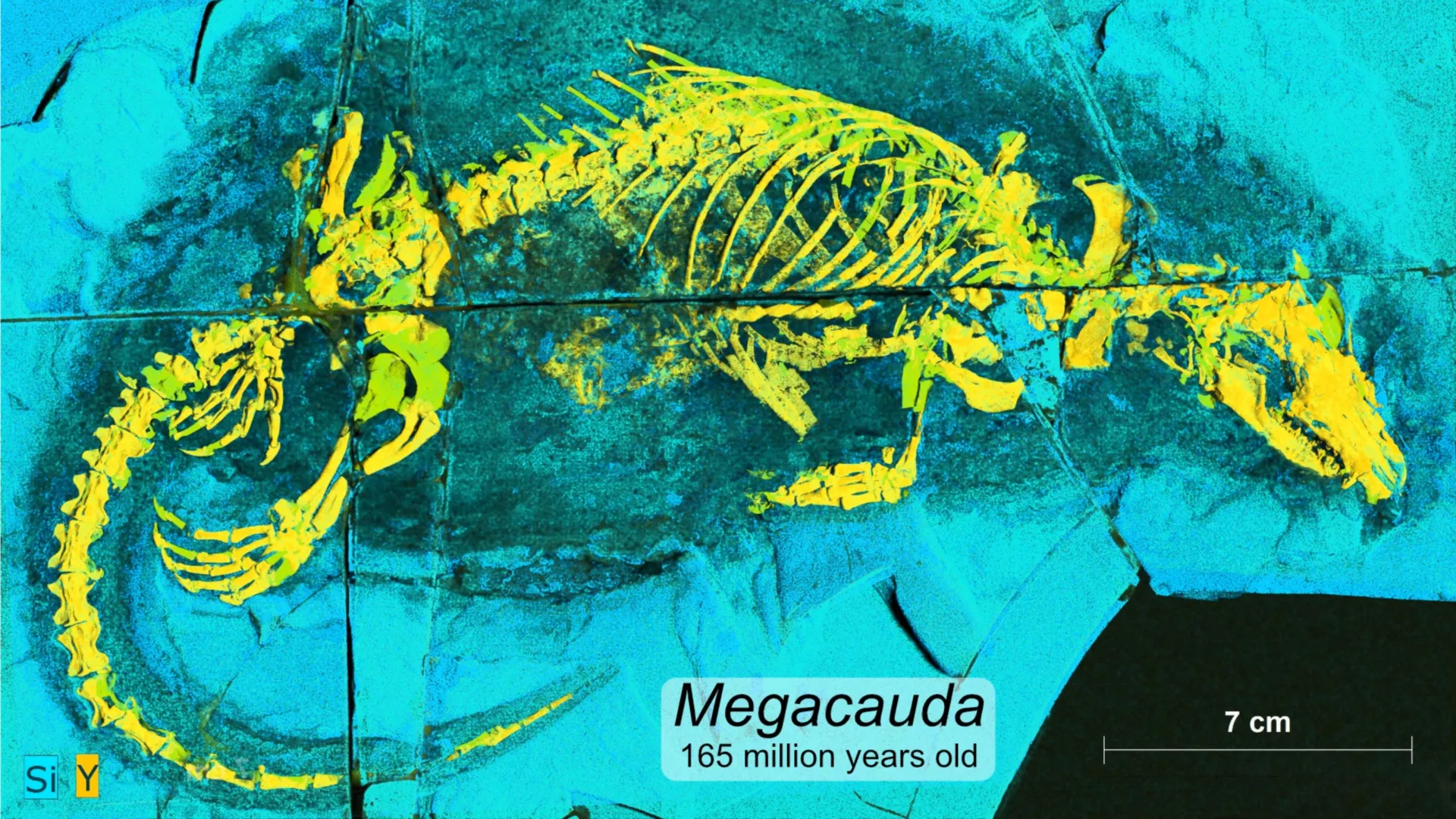
Scientists have identified a previously unknown species of ancient mammal relative that lived approximately 165 million years ago, designated Megacauda sungei. This small aquatic predator, measuring roughly half a meter in length, has provided researchers with significant insights into early mammalian evolution. The fossil was discovered in Inner Mongolia and is now housed in the Paleontological Museum of Liaoning in China. An international team of paleontologists from institutions in China, the United States, and Germany conducted detailed analyses that revealed the specimen’s scientific importance.
The most significant finding concerns the animal’s anatomical structure, particularly evidence of a well-developed soft palate that separated the mouth from the pharynx. According to the research team, this feature represents a crucial evolutionary milestone. The soft palate and associated oral structures enabled more sophisticated swallowing mechanisms that allowed mammals to breathe while consuming food or milk. This adaptation proved essential for nursing offspring and remains a defining characteristic of modern mammals. Researchers emphasize that this anatomical innovation had far-reaching consequences for mammalian development, ultimately facilitating the neurological complexity that led to human intelligence.
Megacauda sungei exhibited specialized adaptations suited to aquatic life. Its morphology resembled modern otters or beavers, with short fur and a broad, flattened tail. The animal propelled itself through water by paddling with its front limbs and undulating its tail, while hind limbs assisted with directional changes. Its dentition featured distinctive backward-curving cusps designed to grip slippery prey, along with specialized canine teeth possessing three roots. These features represent the earliest known evidence of an aquatic lifestyle among mammaliaforms.
At approximately two kilograms, Megacauda sungei was notably large relative to contemporary mammal relatives during the Jurassic Period, when dinosaurs dominated terrestrial ecosystems. The specimen belongs to the docodonts, an extinct group of early mammalian relatives that were particularly prevalent during this geological period. Other known docodont fossils indicate the group occupied diverse ecological niches, with some species adapted to arboreal life, underground burrowing, or aquatic environments. These discoveries demonstrate that early mammalian ancestors rapidly developed specialized body structures and survival strategies during the Jurassic era.
Article Attribution | Read More at Article Source
Article summary produced by Claude AI