

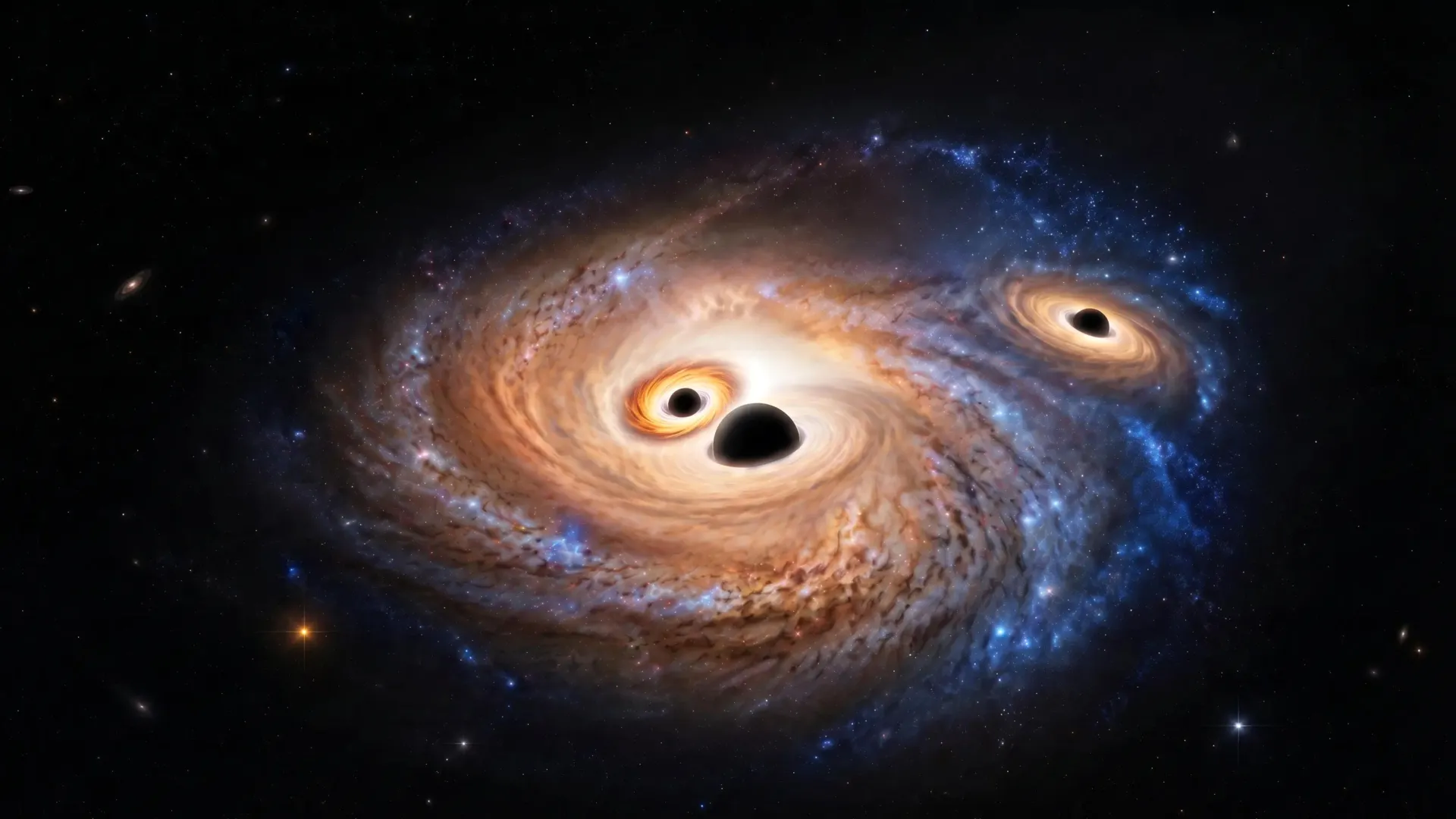
An international research team led by the Max Planck Institute for Extraterrestrial Physics identified three actively accreting supermassive black holes within galaxy J0148-4214, located approximately 12.5 billion light-years from Earth. The discovery represents the first confirmed detection of three active black holes in a single distant galaxy. Because light from this galaxy has traveled for roughly 12.5 billion years to reach Earth, astronomers observe it as it existed approximately 1.2 billion years after the Big Bang. The researchers determined the galaxy’s distance by measuring its redshift value of z=5.02.
The three black holes occupy different regions within the galaxy. Two black holes reside near the galaxy’s center, separated by a projected distance of approximately 620 light-years. The third black hole is located much farther away, roughly 5,500 light-years from the center. These objects were identified through analysis of hydrogen emission patterns in the galaxy’s light. Astronomers detected signatures produced by gas moving at extremely high velocities near the black holes’ powerful gravitational fields. Spectro-astrometry, a precision measurement technique, allowed researchers to distinguish between the two central black holes and map their locations despite being unable to resolve them as separate visual objects.
The three black holes display dramatically different masses, calculated at approximately 80 million, 600,000, and 2 million times the Sun’s mass. Notably, the smallest of the three central black holes exhibits the most aggressive matter accumulation, with an accretion rate that exceeds predictions from standard black hole growth models. The galaxy contains a total stellar mass of approximately 1.3 billion suns, with the black holes representing a significant portion of that total mass.
The two central black holes are expected to merge within the next few hundred million years, a process that would create an increasingly massive black hole. The discovery suggests that black hole mergers may represent a rapid growth pathway in the early universe, potentially explaining how some black holes achieved enormous sizes in a relatively short timeframe. The third black hole could be a remnant of an earlier merger, possibly expelled through gravitational recoil, or it may gradually migrate toward the galaxy’s center.
The findings underscore the capabilities of the James Webb Space Telescope, particularly its integral field spectroscopy mode, which enabled separation of signals that would otherwise appear unified. This technique allowed detection of multiple black holes that might have remained hidden using conventional observational methods, suggesting other distant galaxies may harbor previously undetected multiple black hole systems.
Article Attribution | Read More at Article Source
Article summary produced by Claude AI