

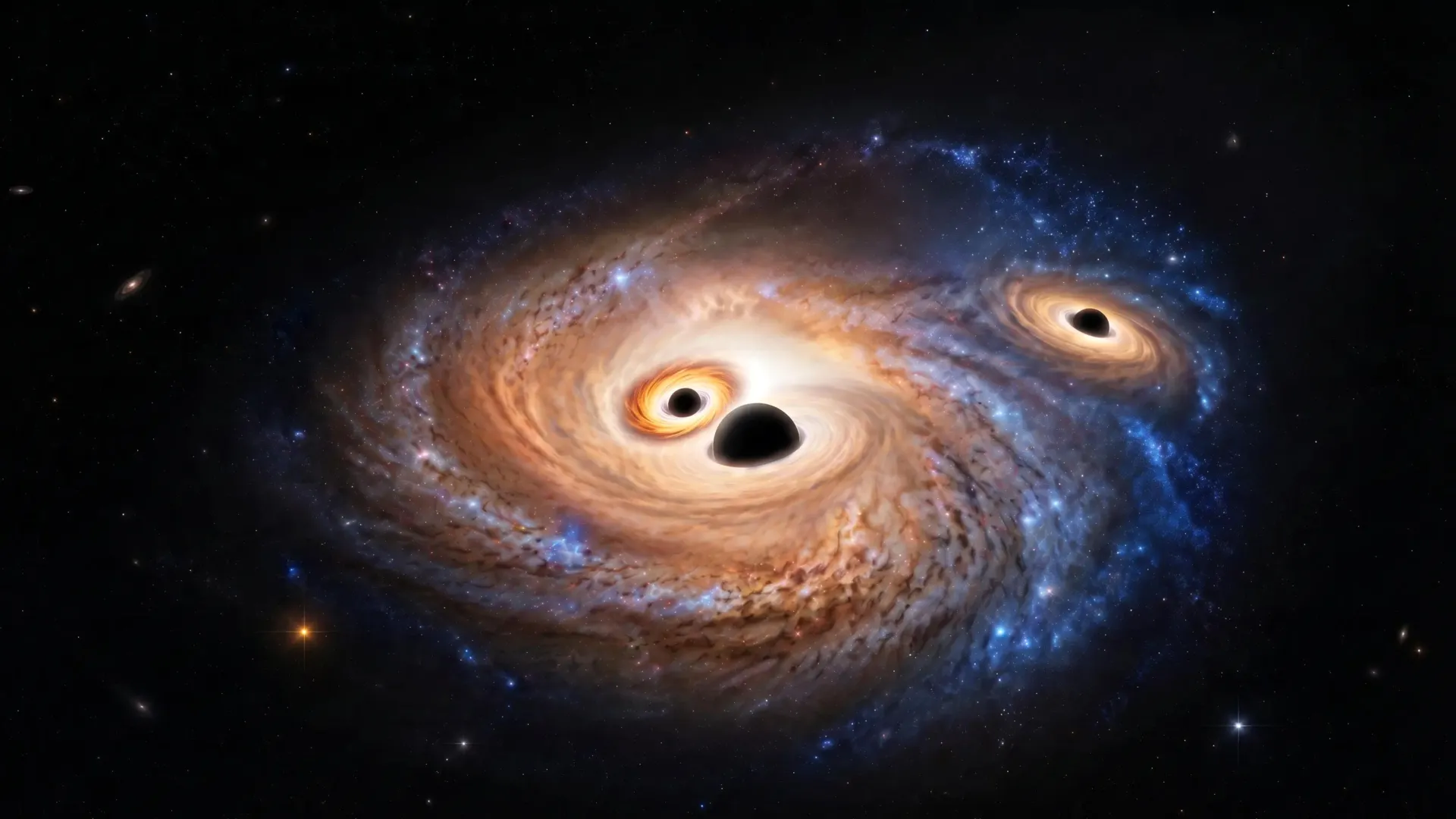
An international research team led by the Max Planck Institute for Extraterrestrial Physics has identified three active supermassive black holes within a single galaxy designated J0148-4214, located more than 12.5 billion light-years away. The detection represents the first confirmed instance of three actively accreting black holes in a distant galaxy and provides significant evidence regarding the formation and interaction of massive black holes during the universe’s earliest epochs. Light from this galaxy has traveled approximately 12.5 billion years to reach Earth, allowing astronomers to observe conditions as they existed roughly 1.2 billion years following the Big Bang.
The three black holes display varying spatial relationships and sizes. Two reside near the galaxy’s center, separated by approximately 620 light-years, while the third is positioned roughly 5,500 light-years from the center. Their masses differ substantially, estimated at approximately 80 million, 600,000, and 2 million times the Sun’s mass respectively. Notably, the medium-sized black hole exhibits an accretion rate that exceeds theoretical maximum growth predictions, suggesting mechanisms that enabled rapid black hole expansion during the early universe’s compressed timeline.
Astronomers employed spectroscopic analysis of hydrogen gas emissions to detect the black holes, identifying characteristic signatures produced by material moving at extreme velocities near these objects. Advanced spectro-astrometry techniques enabled researchers to pinpoint the locations of closely spaced black holes that telescopes cannot visually resolve as separate entities. The observations indicate the two central black holes are expected to merge within several hundred million years, potentially producing an even larger black hole through gravitational coalescence.
The discovery was made possible through the James Webb Space Telescope’s integral field spectroscopy capabilities, which provide detailed spatial information about spectral signatures across galaxies. This technology revealed black holes that would likely have remained undetected using conventional observation methods. The findings suggest that comparable multiple black hole systems may exist in other distant galaxies but have previously escaped detection, implying that black hole mergers may constitute a significant mechanism for rapid growth during the early universe.
Article Attribution | Read More at Article Source
Article summary produced by Claude AI