

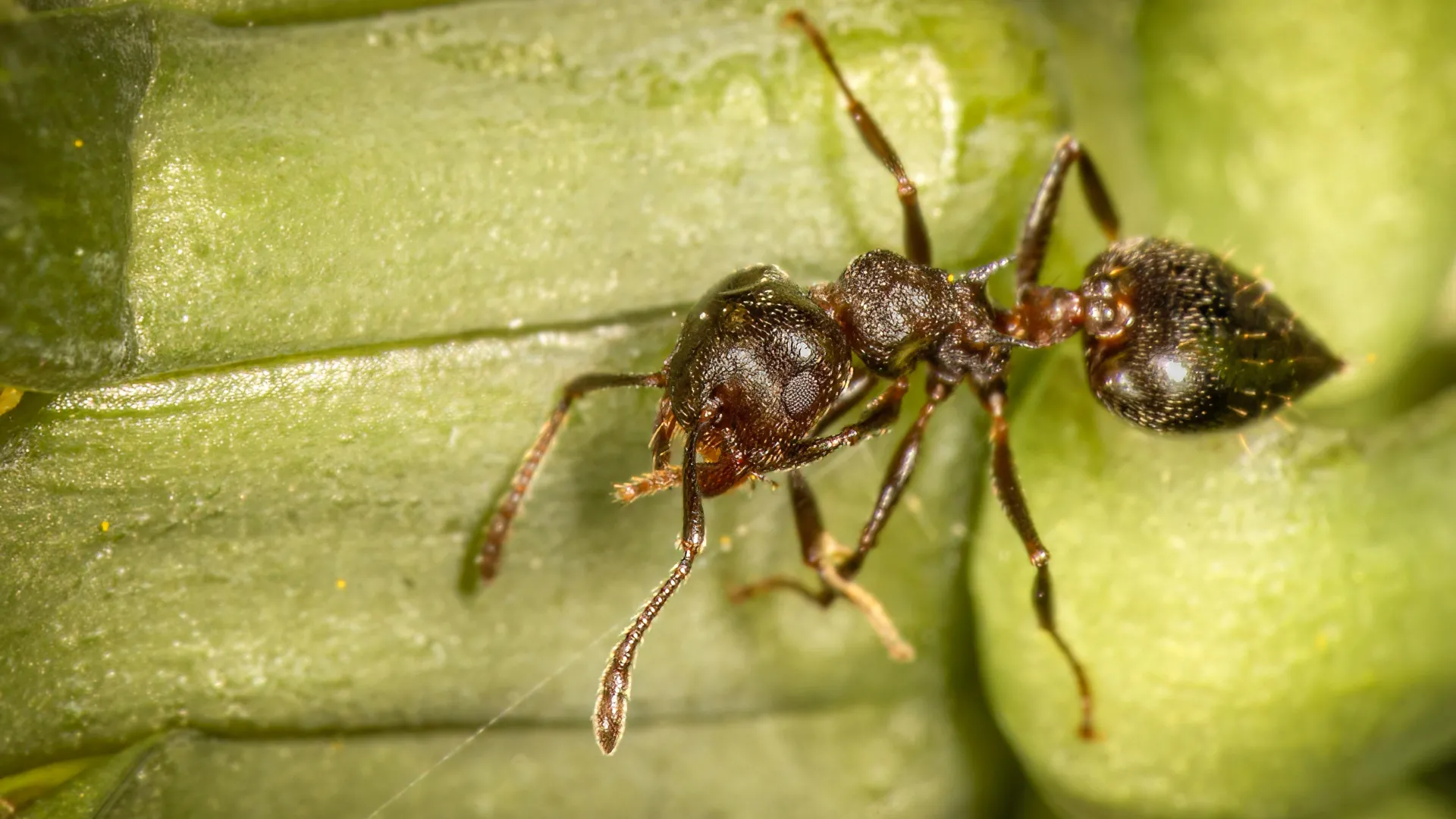
Scientists from Queen Mary University of London, Royal Botanic Gardens Kew, and other institutions have documented a significant disruption to an ancient ecological relationship in the tropical forests of Malaysian Borneo. Their research, published in PeerJ, focuses on Macaranga pearsonii plants and the organisms that inhabit their hollow stem chambers.
For over 10 million years, these plants have hosted colonies of protective ants. The plant structures provide shelter for the ants while also supplying them with nutritious food bodies. In return, the ants defend their host plants from herbivorous insects such as caterpillars. However, researchers have now identified a new occupant: predatory wasps that are increasingly taking over these cavities for entirely different purposes.
When the research team examined young trees in logged forests and oil palm plantations, they found that wasps were using the hollow chambers as nurseries. Adult wasps hunt and paralyze flies, then store them in the plant cavities to feed their developing larvae. The team observed a striking correlation between habitat disturbance and wasp occupation, with plants in oil palm plantations showing significantly higher rates of wasp colonization compared to those in logged forests. Additionally, trees occupied by wasps consistently contained smaller ant colonies, suggesting the wasps may be displacing the ants entirely.
The disruption appears to be connected to human-altered landscapes. The researchers noted that while the origin of this particular wasp species remains uncertain, its spread is clearly linked to disturbed environments. The consequences could extend beyond the immediate ecological players involved. Since Macaranga species are often pioneer plants in forest recovery, the loss of ant protection could impair plant health and potentially hinder broader forest regeneration processes.
Scientists suggest this discovery exemplifies how human activities can subtly destabilize long-established ecological partnerships without causing immediate extinctions. Such disruptions could have long-term evolutionary consequences, potentially altering which plant structures are maintained and which species dominate tropical forests. The findings underscore how ecological systems can begin changing in complex ways before major biodiversity loss becomes apparent.
Article Attribution | Read More at Article Source
Article summary produced by Claude AI