

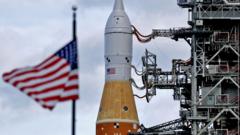
NASA has provided additional details regarding its upcoming Artemis III mission, scheduled to launch in the summer of 2027. Rather than traveling to the Moon, the mission will involve four astronauts conducting operations in low Earth orbit, where they will rendezvous and dock with two prototype lunar landers—one developed by Blue Origin and another by SpaceX. This mission serves as a preparatory step for Artemis IV, targeted for 2028, which will mark the first crewed lunar surface landing since 1972.
The Artemis III mission represents one of NASA’s most complex undertakings to date, involving four astronauts, three separate rocket launches, three spacecraft, and two docking procedures. The 14-day mission, which could extend to 17 days if necessary, will begin with Blue Origin’s New Glenn rocket launching from Florida carrying the Blue Moon prototype lander into low Earth orbit. NASA’s Space Launch System will subsequently launch from Kennedy Space Center with the Orion capsule containing the four crew members. After spending two days verifying their spacecraft, the Orion crew will dock with Blue Moon on flight day three and spend two days examining its systems. On day six, SpaceX’s Starship will launch, with its upper stage serving as a prototype lander, followed by Orion’s undocking from Blue Moon and a subsequent docking with the SpaceX vehicle for a two-hour demonstration.
The mission timeline underwent significant revision in February 2026 after NASA determined that SpaceX’s lunar lander and the in-orbit refueling technology it requires were not sufficiently mature. Rather than further delay the schedule, NASA reconceived Artemis III as a crewed docking rehearsal, allowing critical techniques and equipment to be tested with astronauts aboard before actual lunar operations commence. A March 2026 Government Accountability Office report noted that SpaceX had achieved only limited progress on refueling technology, with initial demonstrations optimistically scheduled for late 2026.
The mission crew will be led by commander Randy Bresnik, with pilot Luca Parmitano from the Italian Space Agency, and American mission specialists Andre Douglas and Frank Rubio. Bob Heintz serves as backup crew. The return journey will test an upgraded heat shield during re-entry. A significant complication emerged on 28 May 2026 when Blue Origin’s Cape Canaveral launch pad sustained severe damage following a rocket explosion during engine testing. NASA has stated confidence that the facility will be operational by December or January 2027 to support the Artemis III timeline.
The broader Artemis program aims to establish sustained human presence on the Moon, with a three-phase Moon Base initiative unveiled in May 2026. Plans include robotic survey missions before 2029, followed by repeated crewed missions expanding the site from 2029 onward, and semi-permanent habitats with extended-duration astronaut stays by the mid-2030s. However, aerospace experts have expressed skepticism regarding the feasibility of NASA’s ambitious schedule, citing concerns about SpaceX Starship lander development pace and the absence of demonstrated in-orbit refueling capabilities.
Article Attribution | Read More at Article Source
Article summary produced by Claude AI