

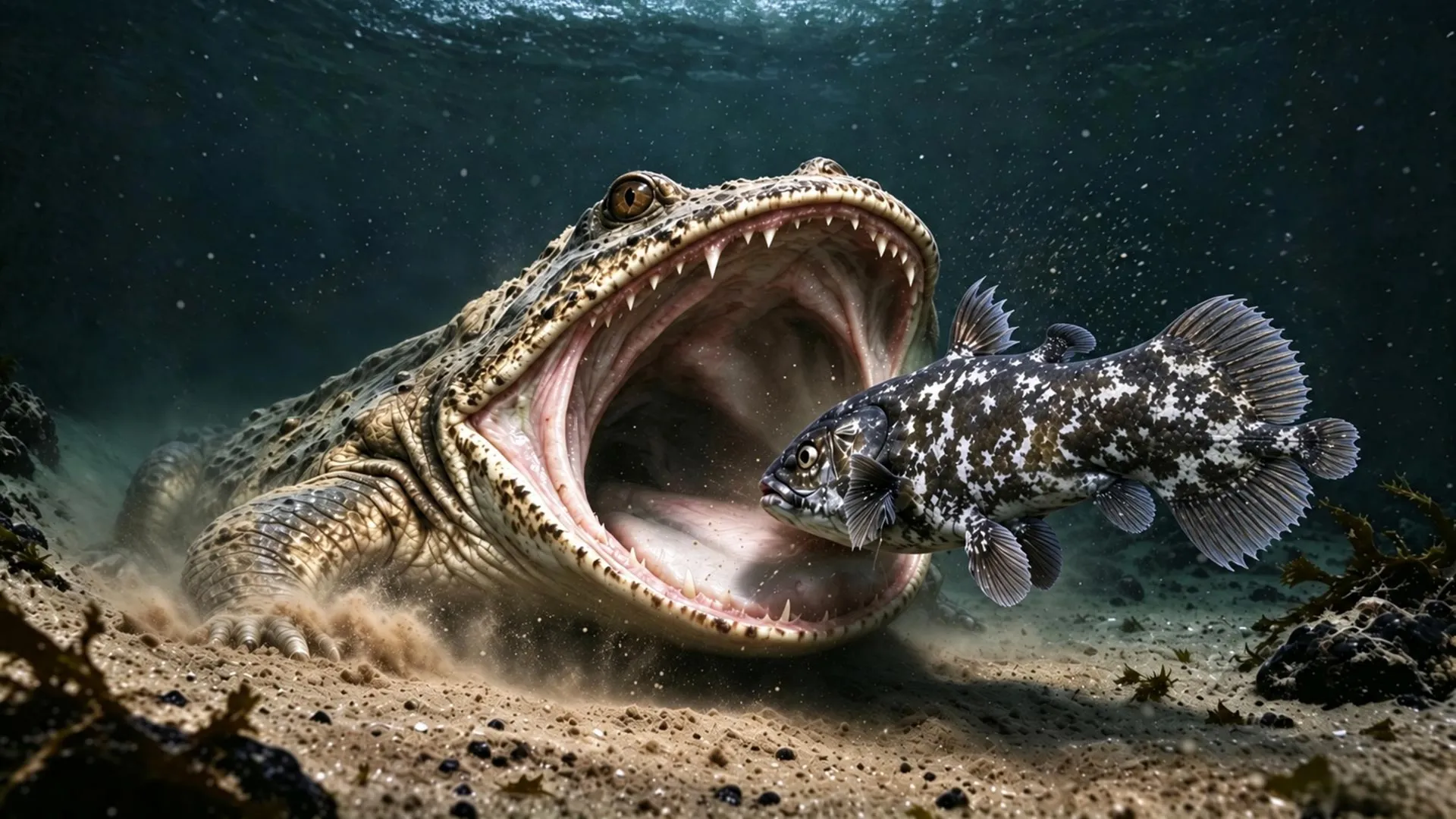
An international research team has identified an ancient amphibian species that inhabited marine environments during the Late Triassic period, according to findings published in Nature Ecology & Evolution. The discovery, based on two well-preserved skeletons from China’s Guizhou Province, reveals an organism named Gerrothorax maritimus that appears to have spent its life in seawater—a behavior no living amphibian species is known to exhibit today. The fossils date back nearly 237 million years and were recovered from sediments that accumulated in a deep ocean setting far from continental landmasses.
The ancient amphibian measured approximately three feet in length and displayed a distinctive body structure quite unlike modern salamanders. Rather than an elongated form, Gerrothorax maritimus possessed a broad, flattened disc-shaped body encased in thick bony armor. Researchers propose that this creature functioned as an ambush predator, remaining stationary on the seafloor until prey items passed within striking distance. The hunting strategy is comparable to modern carpet sharks that capture food through suction mechanisms. Its skull structure and heavy protective plating support this interpretation of its predatory behavior.
A central puzzle surrounding this discovery involves how an amphibian could survive in a marine environment hostile to nearly all contemporary amphibians. The challenge stems from amphibian skin structure, which is notably permeable and allows both water and gases to pass through it. This permeability creates significant vulnerabilities to salt water despite enabling respiration and hydration processes. The research team proposes that Gerrothorax maritimus may have evolved specialized adaptations to address this problem. Its extensive bony armor may have restricted water movement through the skin, potentially allowing the animal to ingest seawater orally instead of absorbing it through dermal tissues. The presence of gills in related Gerrothorax species suggests a more fishlike mechanism for managing salt balance, with excess sodium potentially eliminated through gill filtration.
Multiple lines of evidence confirm that Gerrothorax maritimus inhabited ocean environments rather than having been transported there after death. The exceptional completeness of both skeletons, particularly the preservation of delicate finger bones, indicates the animals died near their living sites. Carcasses exposed to aerial conditions typically lose limbs before sinking to the seafloor, but these specimens retained such fragile structures. Chemical analysis of strontium isotopes in the fossils matched expected signatures from Late Triassic ocean water, providing independent confirmation of a marine habitat. These findings expand understanding of amphibian evolutionary history and demonstrate that specialized marine adaptations developed in ancient lineages that no longer persist in modern species.
Article Attribution | Read More at Article Source
Article summary produced by Claude AI