

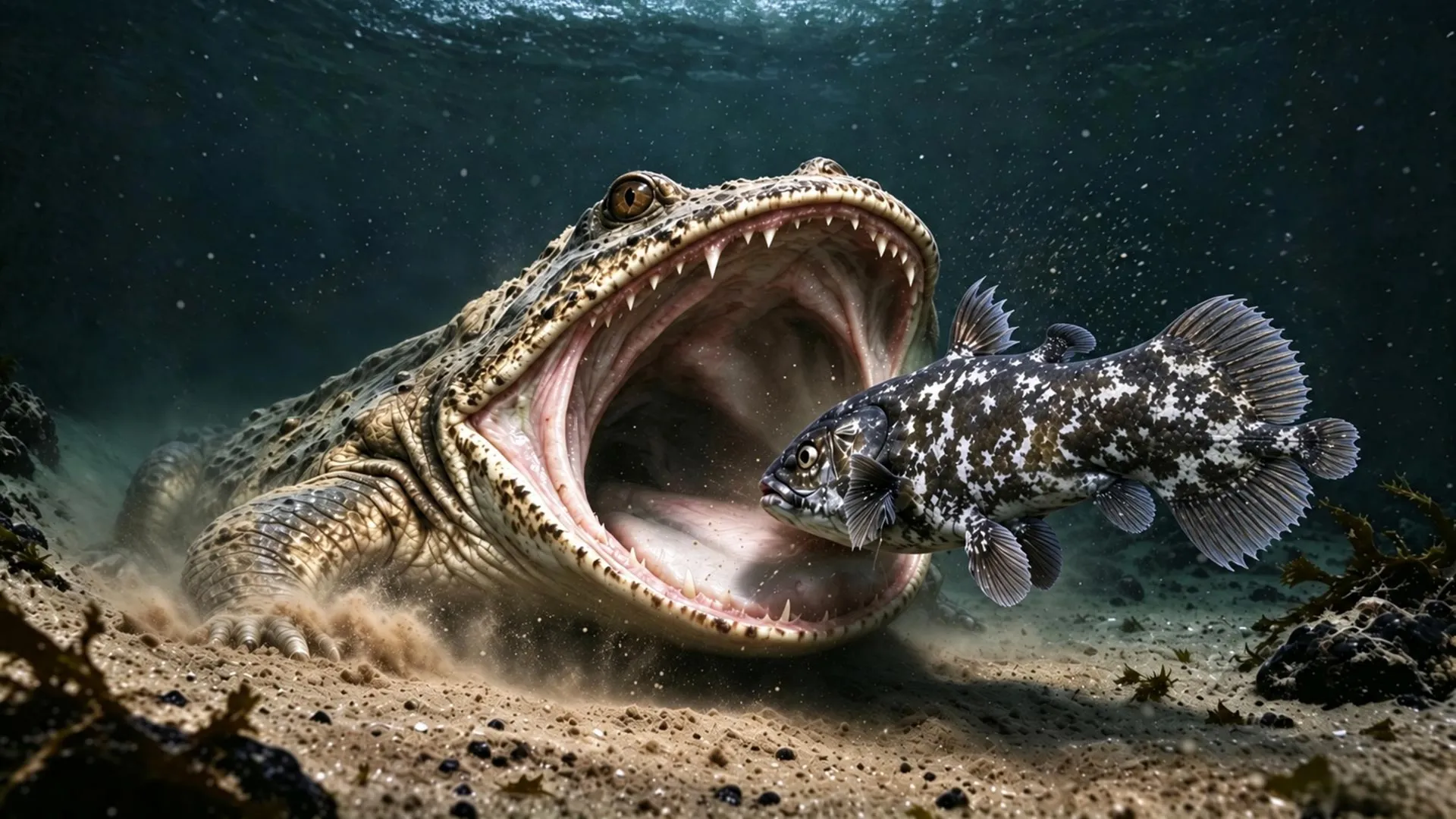
An international research team has identified a previously unknown marine amphibian species from the Late Triassic period, based on two exceptionally preserved fossil skeletons discovered in China’s Guizhou Province. Named Gerrothorax maritimus, the creature lived approximately 237 million years ago in a region that was once submerged beneath an ancient ocean. The findings, published in Nature Ecology & Evolution, represent the first convincing fossil evidence of an amphibian that spent its entire existence in seawater—a capability that distinguishes it from all known modern amphibian species.
The ancient animal measured roughly three feet in length and possessed a distinctive morphology that set it apart from modern salamanders. Rather than displaying the elongated body typical of contemporary amphibians, Gerrothorax maritimus had a broad, flattened disc-shaped form protected by thick bony armor. This robust structure suggests the creature served as an ambush predator that remained stationary on the seafloor, using suction to capture prey that ventured too close, similar to the hunting strategy employed by carpet sharks. The distinctive skull structure combined with its heavy armor provides researchers with insight into how the animal successfully navigated its deep-sea environment.
The survival of an amphibian in saltwater presents a significant biological puzzle, as modern amphibians generally lack the physiological adaptations necessary for marine life. Amphibian skin remains highly permeable, allowing water and gases to pass through—a feature that facilitates respiration and hydration but creates vulnerability to salt exposure. Researchers propose that Gerrothorax maritimus may have evolved compensatory mechanisms, including restricted water movement through its armor-covered skin and the ability to absorb water through its digestive tract rather than directly through its integument. The presence of gills in related species suggests this ancient amphibian may have employed a fish-like approach to salt regulation.
Multiple lines of evidence confirm that Gerrothorax maritimus inhabited a fully marine environment rather than coastal or brackish waters. The complete preservation of delicate skeletal structures, including finger bones, indicates the animals died near their habitat and were not transported significant distances after death. Analysis of strontium isotope ratios in the fossil remains matched signatures consistent with Late Triassic ocean water, providing independent chemical confirmation of their marine origin. Together, these findings demonstrate that at least one amphibian lineage successfully occupied an ecological niche in ancient oceans that remains completely inaccessible to its modern descendants.
Article Attribution | Read More at Article Source
Article summary produced by Claude AI