

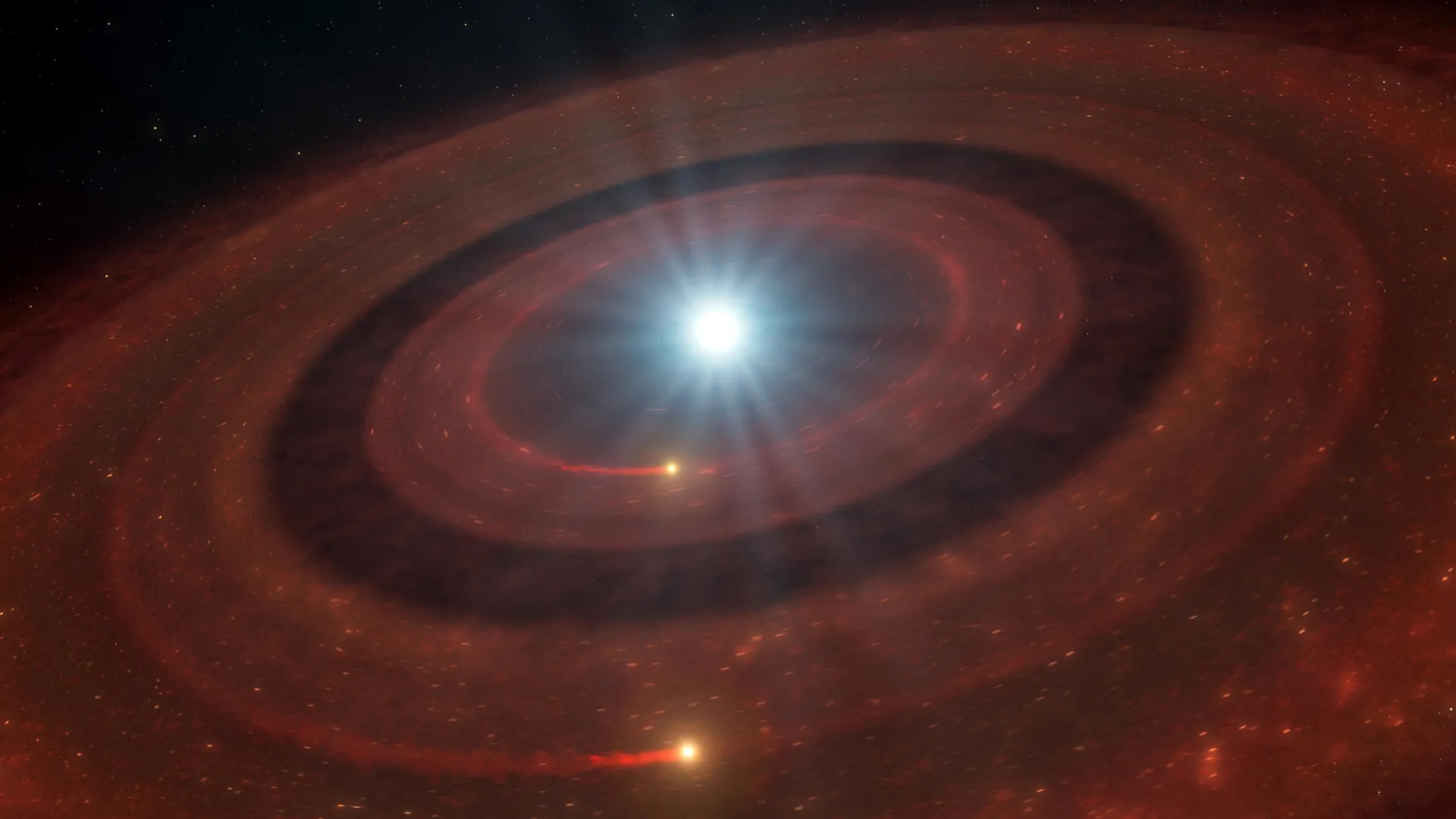
Researchers using the European Southern Observatory’s Very Large Telescope have identified an extraordinary debris system orbiting a white dwarf designated J1328−1450. The discovery represents a significant finding in stellar evolution studies, as the system exhibits two distinct concentric rings of planetary wreckage separated by a clear gap—a configuration that distinguishes it from previously observed debris discs around dead stars.
White dwarfs are extremely dense stellar remnants formed when stars similar to our Sun exhaust their nuclear fuel and reach the final stages of their evolution. During this transformation, the star expands dramatically and sheds its outer layers, leaving behind its exposed core. This process can be catastrophic for nearby planets, as some may be engulfed and destroyed while others experience gravitational disturbances that tear them apart. The resulting debris can form rotating discs around the dead star.
Astronomers believe the unusual double-ring structure around J1328−1450 is maintained by two surviving planetary bodies orbiting at different distances from the star. The inner object is estimated to measure only a few kilometers across, comparable to a typical asteroid. The outer body could be substantially larger, potentially reaching sizes comparable to Pluto or Earth’s Moon. These suspected survivors have not been directly observed, but their gravitational influence likely explains why the debris remains organized into distinct rings rather than forming a continuous disc.
Chemical analysis of the debris reveals important information about the destroyed worlds. Researchers detected calcium, oxygen, magnesium, and iron—elements commonly found in rocky planetary material. Notably, the two rings display different chemical compositions, with the inner ring containing substantial magnesium gas while the outer ring is largely depleted of this element. This compositional difference suggests the rings may contain remnants of separate planets with distinct compositions, or alternatively, material from different layers of a single destroyed world.
The findings offer perspective on the potential future of our own Solar System. Billions of years from now, the Sun will undergo a similar transformation into a white dwarf. While Earth may be destroyed during this process, the observations of J1328−1450 suggest that some objects may survive stellar death and that debris from destroyed planets can persist in complex arrangements around the stellar remnant.
Article Attribution | Read More at Article Source
Article summary produced by Claude AI