

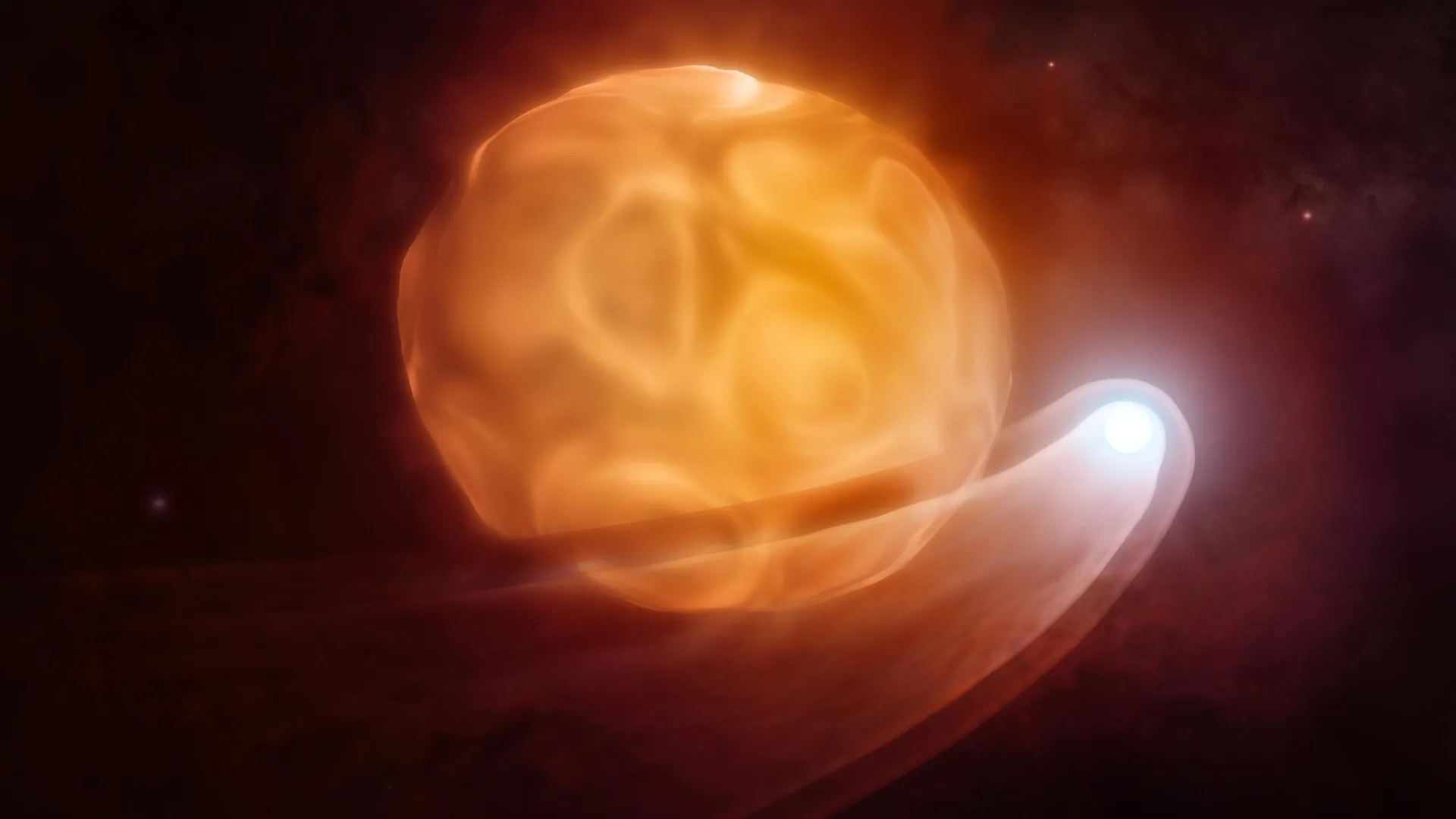
New observations from radio telescopes have revealed surprising activity within the vast atmosphere of Betelgeuse, the massive red supergiant star located in the constellation Orion. Research led by Dr. Lynn D. Matthews at MIT Haystack Observatory, in collaboration with scientists from multiple institutions, analyzed data gathered between 2021 and 2026 using the NSF’s Karl G. Jansky Very Large Array and the Atacama Large Millimeter/submillimeter Array. The study examined seven different radio frequencies to map the structure of Betelgeuse’s outer layers extending several times the star’s radius.
The research confirms that Betelgeuse has largely recovered from the Great Dimming, the dramatic fading event that occurred in late 2019 and early 2020 when the star’s brightness dropped to its lowest recorded level in over a century. The latest measurements indicate the star’s atmosphere has warmed to temperatures more typical of Betelgeuse, with brightness temperatures around 3,500 Kelvin at significant distances from the star’s surface. The recovery provides insight into the mechanisms that may have triggered the original dimming event, which astronomers believe involved the ejection of substantial material that formed obscuring dust.
The observations also revealed a previously suspected but directly unconfirmed feature: an unusually cool atmospheric layer located between Betelgeuse’s visible surface and its higher chromosphere. Using ALMA at its highest frequencies, researchers detected temperatures dropping to approximately 2,200 Kelvin in this region, confirming the long-theorized “temperature minimum” in what astronomers call the MOLsphere.
Most intriguingly, the data provides indirect evidence of Siwarha, a companion star proposed in 2024 to explain a regular brightness cycle in Betelgeuse occurring approximately every 2,100 days. Unlike typical stellar companions, Siwarha is believed to orbit extremely close to Betelgeuse, passing directly through its extended atmosphere at an estimated distance of only twice the red supergiant’s radius. Although too faint to detect directly in radio observations, the researchers found indirect evidence by studying changes in Betelgeuse’s shape across multiple observations. The star’s atmosphere occasionally appears slightly elongated in an oval pattern, with these distortions correlating with the expected position of the hidden companion, suggesting Siwarha may be disturbing the gas through gravity and physical passage through the atmosphere.
Article Attribution | Read More at Article Source
Article summary produced by Claude AI