

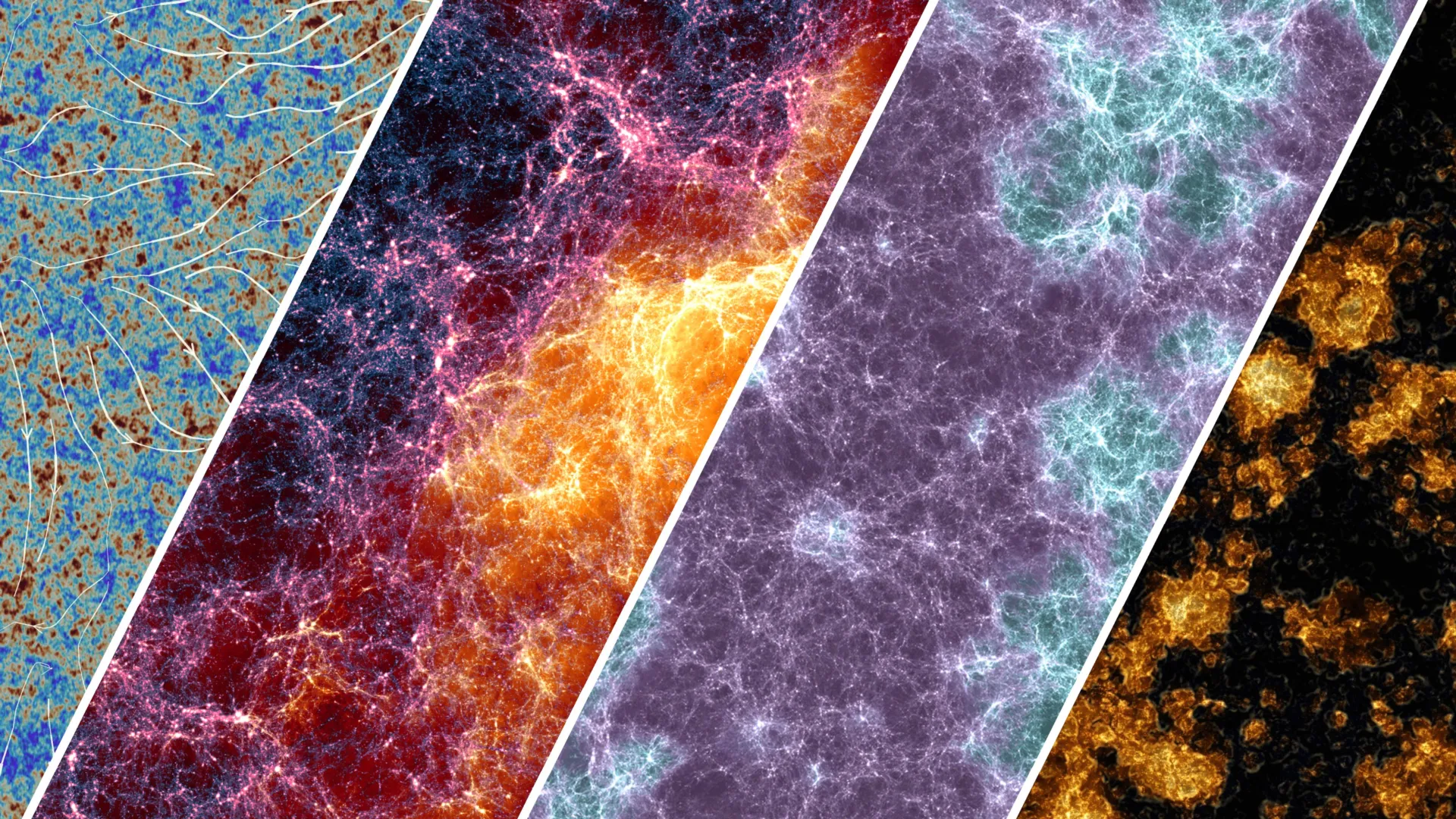
Researchers at MIT, Harvard University, and other institutions have developed Lumina, a large-scale computer simulation that models the evolution of the early universe during one of its most transformative periods. The simulation reconstructs cosmic history across a region spanning approximately 1.6 billion light-years and follows 2 billion years of development, documenting how galaxies formed, radiation dispersed through space, and the universe transitioned from opacity to transparency. The research was published in the Monthly Notices of the Royal Astronomical Society and provides detailed insights into events that occurred billions of years before the solar system formed.
The simulation captures two major transformations in the early cosmos. Hydrogen re-ionization began as the first stars and galaxies generated ultraviolet radiation that stripped electrons from neutral hydrogen atoms, gradually making the universe more transparent to this light. Helium re-ionization required more energetic radiation and appears to have been driven primarily by actively feeding supermassive black holes, while early stars and galaxies were responsible for ionizing hydrogen. Lumina is notable as the first simulation to model both processes simultaneously, offering a more comprehensive understanding of how the early universe evolved.
The simulation contains approximately half a trillion individual elements, including dark matter particles and gas cells, representing roughly 30 times the resolution of IllustrisTNG, an earlier simulation developed by some of the same team. Lumina covers a volume 100 times larger than previous leading simulations while maintaining comparable detail in galaxy formation. Creating this model required processing power equivalent to more than 100,000 CPU cores and around 15,000 GPUs on Frontier, one of the world’s most powerful supercomputers located at Oak Ridge National Laboratory in Tennessee.
The simulation begins approximately 45 million years after the Big Bang and allows researchers to explore the virtual universe at multiple scales, from cosmic distances down to individual galaxies. By tracking how radiation appeared and interacted with matter throughout cosmic time, Lumina provides scientists with a tool to investigate how the universe transitioned from its dark age to becoming illuminated by the first stars. The researchers are making the simulation available to other scientists, enabling comparisons between Lumina’s predictions and observations from existing and future telescopes to refine understanding of early cosmic structures.
Article Attribution | Read More at Article Source
Article summary produced by Claude AI