

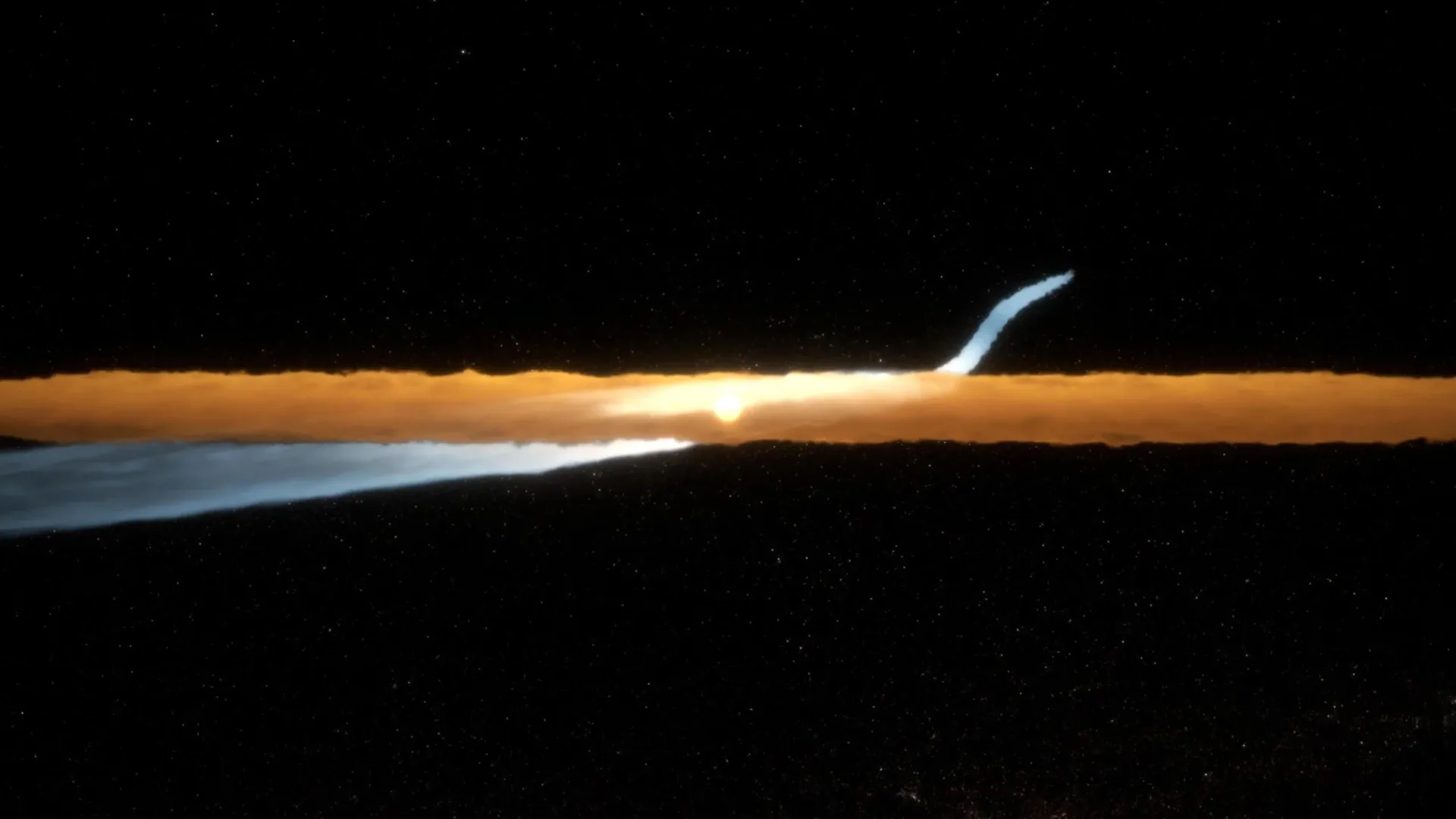
A massive cosmic structure spanning approximately 93 billion miles has caught the attention of astronomers studying planetary system formation. Located about 63 light-years from Earth in the constellation Pictor, the feature known as the “Cat’s Tail” orbits Beta Pictoris, a young star system that provides insights into the early development of planets like those in our own solar system. University of Arizona researchers led by doctoral student Arin Avsar have now observed the structure in visible light using NASA’s Hubble Space Telescope, combining those observations with data collected over more than 14 years to produce new findings published in The Astrophysical Journal Letters.
The Cat’s Tail is theorized to be debris from a collision between massive bodies comparable in size to Pluto. The structure had previously been detected only through infrared observations from the James Webb Space Telescope, remaining invisible at shorter visible wavelengths until now. Scientists believe the carbon-based composition of the material explains why it proved difficult to detect in visible light, as such organic compounds absorb rather than reflect visible wavelengths, making the structure appear extremely dark.
Analysis reveals the Cat’s Tail consists of surprisingly small dust particles, each measuring only about a micron across, yet possessing unusual porosity and low density. The particles appear “fluffy” with significant internal voids rather than being solid and compact. Researchers propose that the extreme velocities involved in the hypothetical collision may have vaporized carbon material, which then recondensed into porous particles as temperatures decreased, though the exact mechanism remains unclear.
The research also refined understanding of the structure’s three-dimensional orientation within space. Rather than extending 1,000 astronomical units behind the star as previously suggested, evidence indicates the Cat’s Tail may extend primarily sideways relative to Earth’s perspective, with minimal depth. These findings provide astronomers with valuable observations of processes that shaped planetary systems billions of years ago, offering comparative insights into how our own solar system developed during its tumultuous early stages.
Article Attribution | Read More at Article Source
Article summary produced by Claude AI