

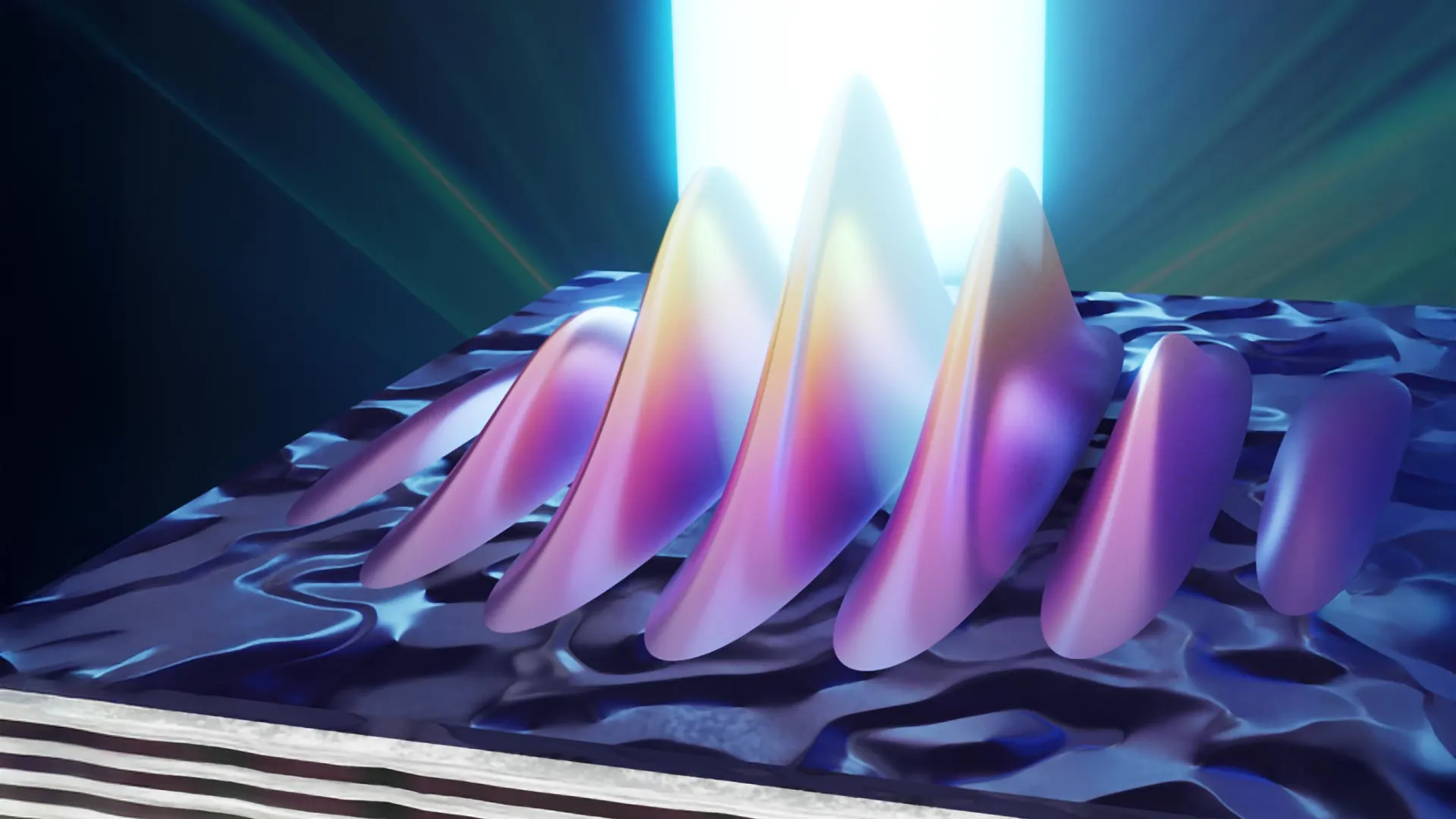
An international research consortium has demonstrated a novel quantum state known as a supersolid that combines properties typically associated with solids and liquids. The achievement represents a significant advance in making exotic quantum phenomena accessible under more practical conditions, as the experiment operated near room temperature rather than requiring cooling to near absolute zero.
Supersolids exhibit the ordered internal structure characteristic of crystals while simultaneously displaying the frictionless flow properties of superfluids, a phenomenon predicted by physicists in the 1960s but not experimentally confirmed until 2017. Previous observations relied on ultracold atomic Bose-Einstein condensates, which required sophisticated equipment to achieve temperatures extremely close to absolute zero. The new approach, developed by researchers from the University of Warsaw, the Military University of Technology, IBM Research Zurich, and the French National Centre for Scientific Research, employed a fundamentally different strategy using hybrid particles called exciton polaritons that form when light and matter couple within a tiny optical chamber.
The research team constructed an optical microcavity containing a specially engineered liquid crystal covered with an organic semiconductor. This configuration allowed the light and matter to interact strongly enough to produce the desired quantum effects without extreme cooling, with the system operating at temperatures approaching 60°C. The evidence for the supersolid state emerged through distinctive patterns in the light emitted by the sample. Upon transitioning into the supersolid phase, the researchers observed regularly spaced bright fringes indicating that the particle condensate had developed a repeating variation in density, a hallmark of crystalline structures.
The experiment also revealed spontaneous symmetry breaking, a phenomenon where a quantum system capable of existing in multiple equivalent states selects one particular configuration. Each laser pulse produced bright fringes in different positions as the system repeatedly chose among several possible arrangements. Additionally, the condensate displayed a persistent spin helix, representing a repeating variation in the polarization of emitted light. These observations demonstrated two simultaneous forms of order, one in light intensity and another in polarization.
The research faced a significant practical challenge: the organic semiconductor gradually reacted with the liquid crystal, limiting each experimental sample’s useful lifetime to only a few hours. This constraint necessitated meticulous advance planning of measurement sequences. The findings, published in Science Advances, could advance technologies ranging from optical computing to highly sensitive sensors by enabling investigation of exotic quantum behavior under more accessible conditions.
Article Attribution | Read More at Article Source
Article summary produced by Claude AI