

Scientists have developed a novel approach to one of quantum computing’s fundamental challenges: measuring quantum information without destroying it. Quantum bits, or qubits, exist in delicate superposition states that collapse when directly measured, potentially erasing stored information. Traditional solutions involve quantum nondemolition techniques that use auxiliary qubits as intermediaries to transfer and measure information indirectly. While effective, these methods require additional preparation, equipment, and increasingly complex procedures as qubit numbers grow.
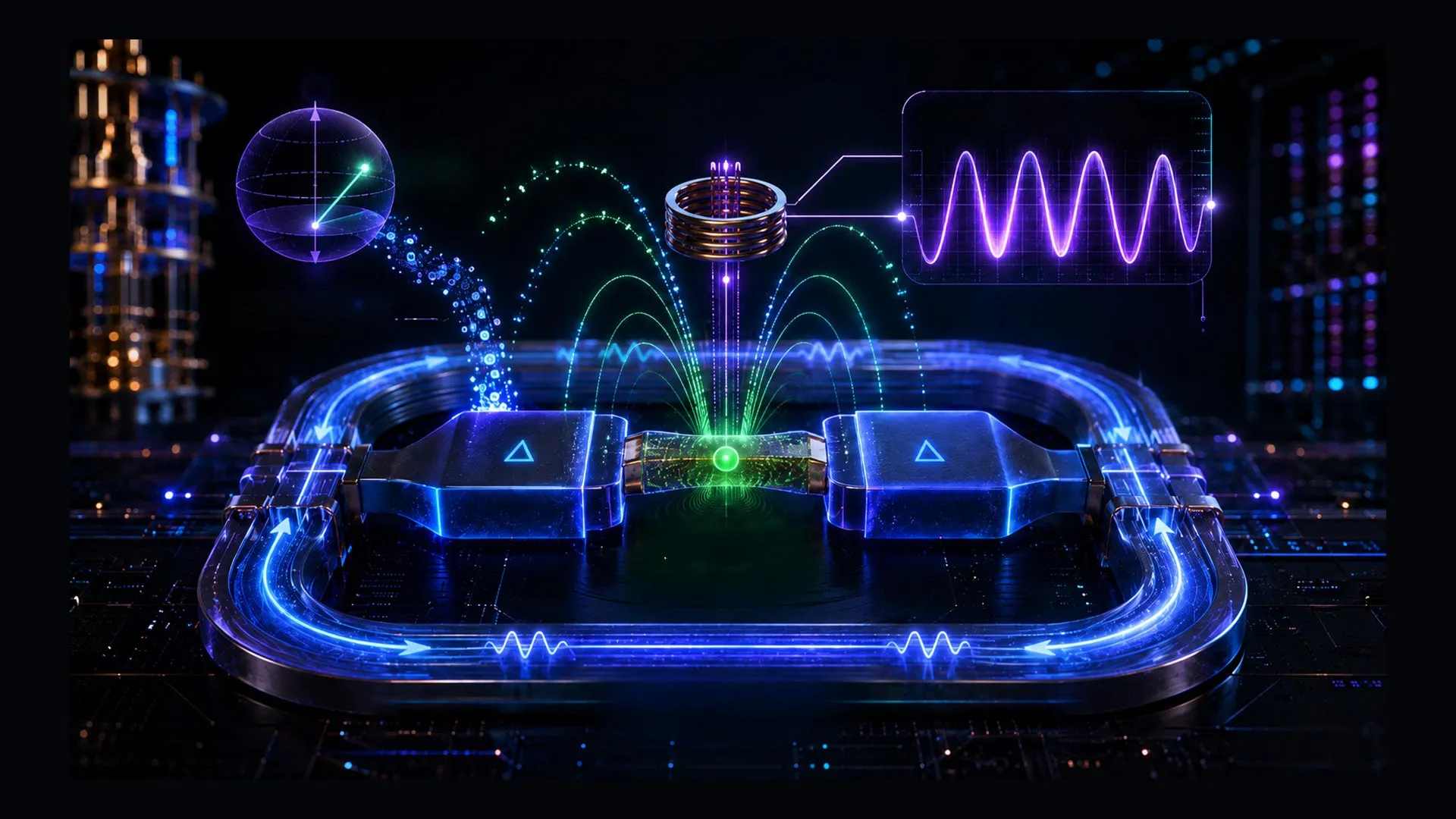
The new technique, published in Physical Review B Letters and led by researchers from the University of São Paulo and Beijing Institute of Technology, focuses on a special type of qubit called an Andreev qubit. This qubit generates an oscillating electrical supercurrent as a natural consequence of its quantum behavior. Rather than measuring the qubit directly or employing auxiliary systems, scientists can monitor this self-generated current to determine the qubit’s state while preserving the quantum information it contains.
Andreev qubits derive their name from a quantum phenomenon discovered in 1964 at the boundary between normal materials and superconductors. In the researchers’ design, the qubit consists of a nanoscale quantum dot made from indium arsenide nanowire positioned between two superconducting materials. When the qubit exists in a superposition, the supercurrent flowing through this system develops time-varying components that arise from quantum interference between different states.
The oscillations in the supercurrent encode information about the qubit’s quantum state through multiple channels. The steady component and amplitude of oscillations reveal how much each basic state contributes to the superposition, while the timing of oscillations indicates the phase relationship between quantum components. Mathematically, this corresponds to two angles on a Bloch sphere that fully characterize the qubit’s state.
If experimentally validated, this approach could significantly simplify quantum computing hardware and reduce the overhead required for measurement operations, potentially accelerating the practical development of quantum computing systems.
Article Attribution | Read More at Article Source
Article summary produced by Claude AI