

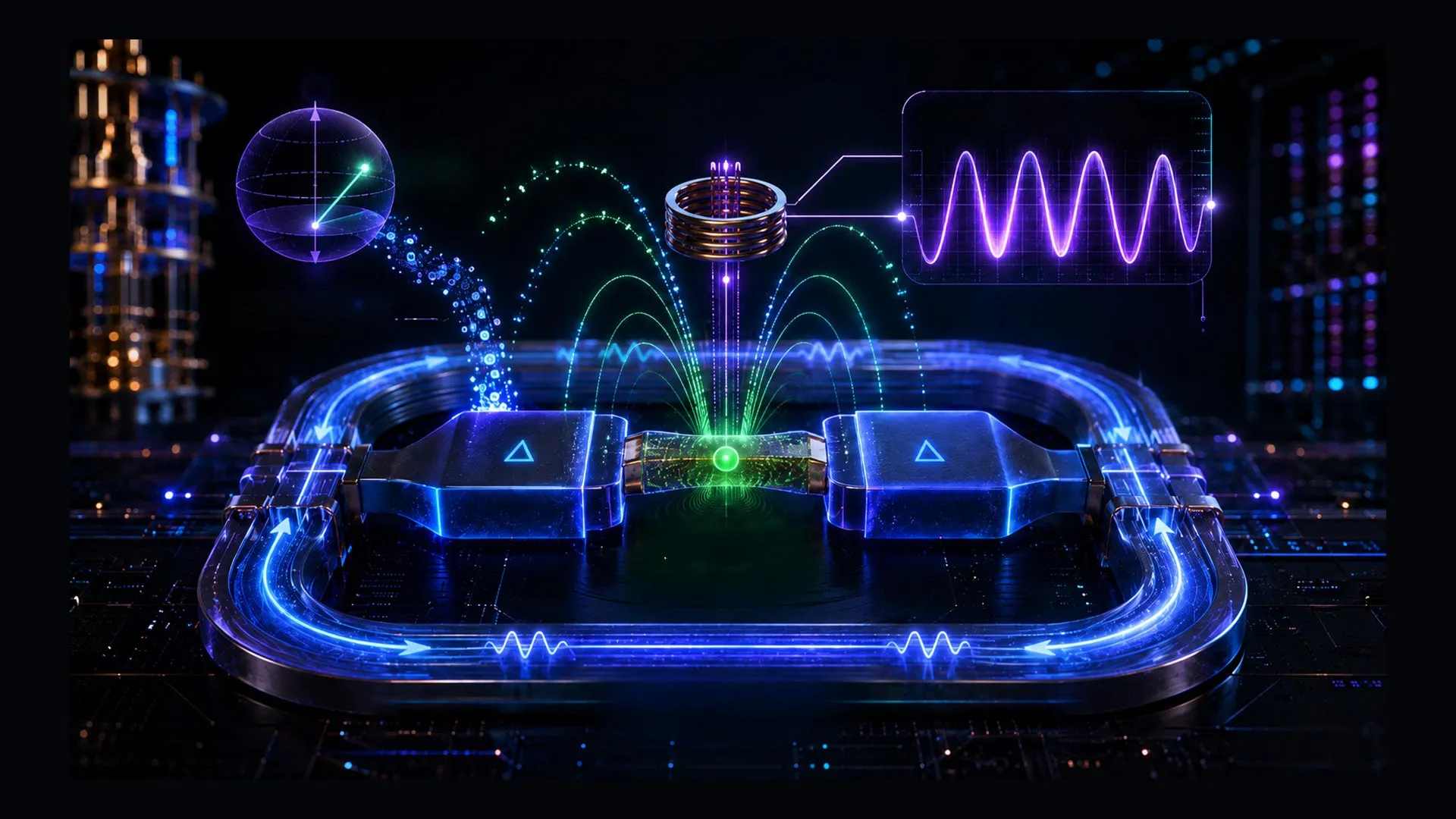
Scientists have identified a new approach to address a fundamental challenge in quantum computing: how to measure quantum information without disrupting or destroying it. The research, published in Physical Review B Letters and led by José Carlos Egues at the University of São Paulo and Yugui Yao at the Beijing Institute of Technology, focuses on a novel measurement technique using Andreev qubits.
Quantum bits differ fundamentally from classical computer bits in their ability to exist in superpositions, simultaneously representing both 0 and 1 states. This property underlies quantum computing’s potential power but introduces a critical vulnerability. Any attempt to directly measure a qubit’s state causes the superposition to collapse, destroying the quantum information it contains. To mitigate this problem, physicists have developed quantum nondemolition measurement techniques that typically employ auxiliary quantum systems, called ancillas, to act as intermediaries. While effective, these approaches require preparing additional qubits, establishing connections between systems, transferring information, and performing multiple measurements—processes that become increasingly complex and resource-intensive as quantum systems scale.
The new research proposes a fundamentally different strategy. Rather than relying on auxiliary systems, the technique exploits properties intrinsic to Andreev qubits, which are based on quantum states formed at the boundary between superconducting materials. The researchers discovered that when an Andreev qubit exists in a superposition, it generates a supercurrent—an electrical current that flows without resistance—containing oscillating components. These fluctuations arise from quantum interference between the different states composing the superposition.
Crucially, the oscillation patterns are not random but contain encoded information about the qubit’s quantum state. The steady component and amplitude of supercurrent oscillations reveal the relative contributions of the basic states, while the oscillation timing encodes information about the phase relationship between quantum components. By monitoring these electrical signals, scientists may determine a qubit’s state without directly measuring it or significantly disturbing the quantum information it carries.
If experimentally validated, this approach could substantially simplify quantum computing by eliminating the need for ancilla qubits in certain measurement protocols, reducing both the complexity and resources required for quantum information readout.
Article Attribution | Read More at Article Source
Article summary produced by Claude AI