

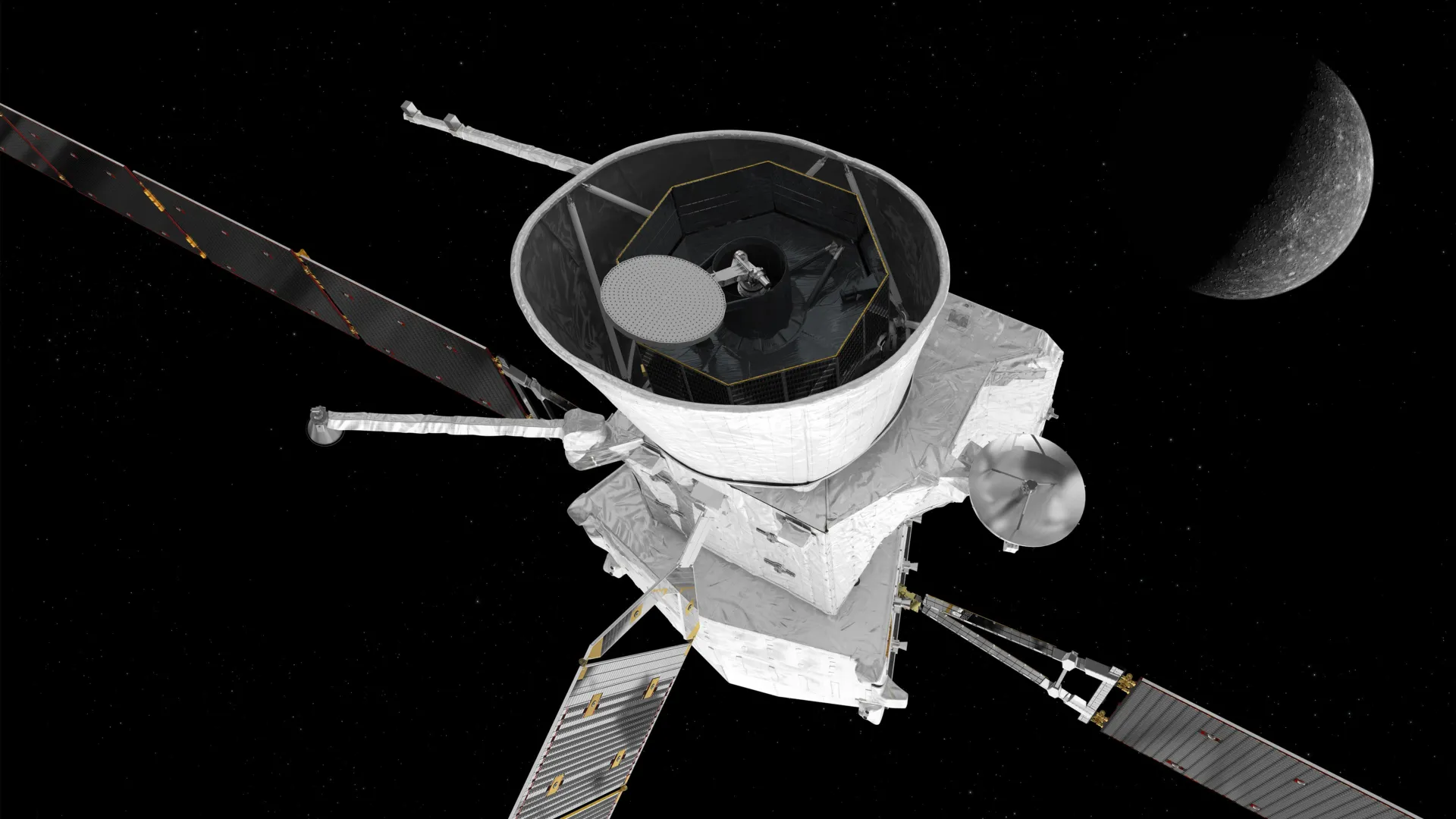
The Mercury Imaging X-ray Spectrometer (MIXS), developed by the University of Leicester and traveling aboard the European Space Agency and Japan Aerospace Exploration Agency’s BepiColombo mission, has completed its initial observations and performance tests. The instrument successfully detected X-rays from the Crab Nebula, located approximately 6,500 light-years from Earth, during observations conducted on September 11 and 12. This milestone comes as BepiColombo prepares to enter orbit around Mercury on November 21.
The telescope had spent eight years traversing space, covering a distance of 10 billion kilometers. Following the separation of the Mercury Transfer Module in September, MIXS gained an unobstructed view of space, allowing scientists to conduct the critical testing required before the spacecraft’s arrival at its destination. The team selected the Crab Nebula as a reference target because it produces a strong, predictable X-ray signal, making it ideal for testing the instrument’s performance capabilities.
Results from the testing phase have exceeded expectations. The instrument demonstrated angular resolution that was slightly sharper than measurements recorded during laboratory tests in 2015, before the mission launched. Scientists found no interference from stray visible light in the images, and while cosmic ray effects were observed, they are well understood and can be filtered during data processing. The detector exhibited no signs of radiation damage after its extended exposure to the space environment. Some effects remain under investigation, and engineers plan to conduct optimization procedures during the Mercury commissioning phase.
MIXS will serve a critical function aboard BepiColombo by identifying the chemical composition of Mercury’s surface through fluorescent X-ray detection. When solar X-rays strike rocks on the planet’s surface, atoms within the material emit characteristic X-rays that allow scientists to map elemental composition without collecting physical samples. The instrument represents the first imaging X-ray telescope to operate on a planetary science mission and is the only UK-led scientific instrument aboard BepiColombo. Its observations are expected to provide unprecedented insights into Mercury’s geological history and characteristics.
Article Attribution | Read More at Article Source
Article summary produced by Claude AI