

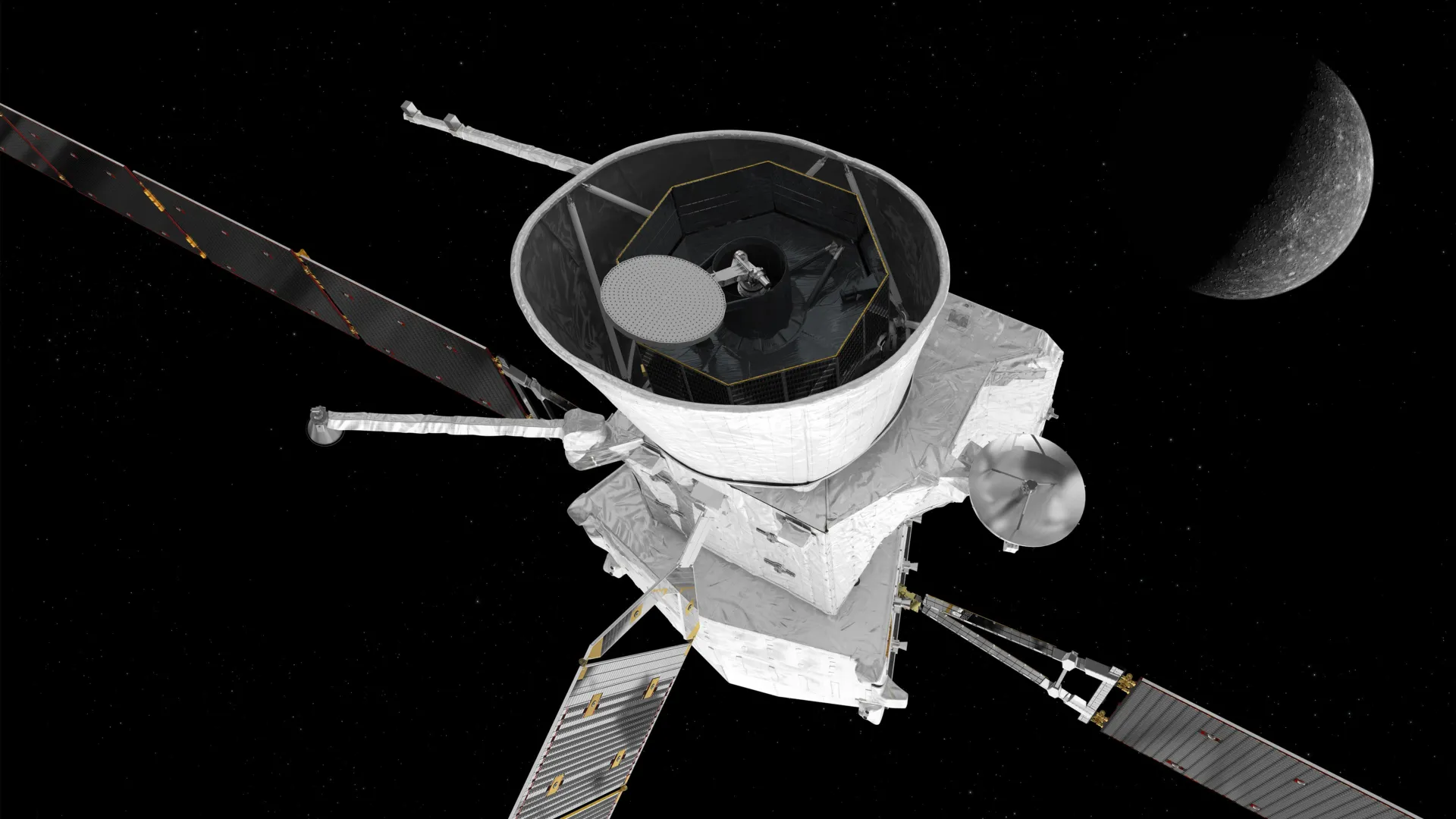
A pioneering X-ray telescope developed by the University of Leicester has completed its first successful observations in space after traveling 10 billion kilometers over eight years. The Mercury Imaging X-ray Spectrometer (MIXS) detected X-rays from the Crab Nebula, a distant cosmic object located approximately 6,500 light-years from Earth, achieving an important validation milestone for the joint European Space Agency and Japan Aerospace Exploration Agency BepiColombo mission. The instrument’s view of space became unobstructed in September following separation of the Mercury Transfer Module from the two science orbiters, allowing the first critical tests to proceed.
Scientists selected the Crab Nebula as the target for initial testing because its well-studied remnant produces a strong, predictable X-ray signal suitable for assessing telescope performance. During observations conducted on September 11 and 12, the spacecraft made 55 controlled orientation changes over 39 hours to collect comprehensive data. Measurements revealed that MIXS achieved slightly sharper angular resolution than recorded during laboratory tests in 2015, a particularly encouraging finding given the instrument’s eight-year journey through space.
According to Professor Emma Bunce, Principal Investigator for MIXS at the University of Leicester, the results represent a significant achievement for the international team. The instrument exhibits no interference from stray visible light and shows no signs of radiation damage after its extended exposure to the space environment. While some effects remain under study, engineers anticipate minor optimization procedures during the Mercury commissioning phase to prepare MIXS for its scientific mission.
BepiColombo is designed to investigate Mercury in unprecedented detail as one of the least explored rocky planets in the solar system. MIXS will help create a global elemental map of Mercury’s surface by detecting fluorescent X-rays emitted when solar radiation strikes rocks. The instrument represents the first imaging X-ray telescope to operate on a planetary science mission and is the only UK-led scientific instrument aboard BepiColombo, receiving support from the UK Space Agency.
Article Attribution | Read More at Article Source
Article summary produced by Claude AI