

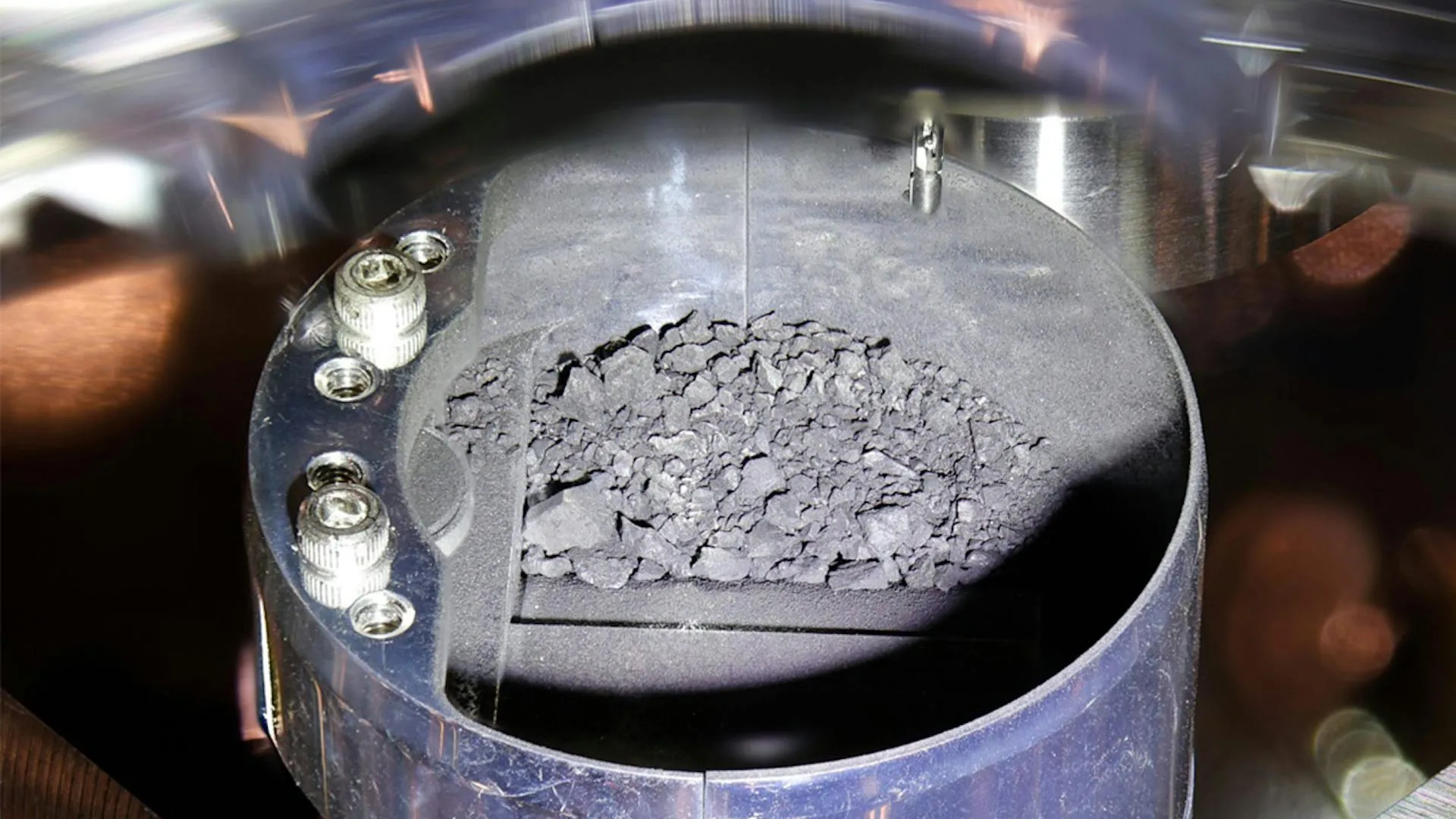
An international team of Japanese scientists has confirmed the presence of all five nucleobases in pristine asteroid material collected from Ryugu by Japan’s Hayabusa2 mission, according to findings published in Nature Astronomy. The five nucleobases—adenine, guanine, cytosine, thymine, and uracil—are nitrogen-containing organic molecules that serve as the fundamental units of genetic information. When combined with sugars and phosphates, they form nucleotides, the building blocks necessary for DNA and RNA to function.
The Hayabusa2 mission returned 5.4 grams of asteroid material in 2020, which researchers analyzed using ultra-clean laboratory conditions to prevent contamination. Scientists extracted organic molecules using water and hydrochloric acid, then purified them for detection. The team identified all five nucleobases in the two Ryugu samples analyzed, present in roughly comparable quantities. This discovery complements previous findings from other space rocks, including meteorites that fell in Australia and France decades ago, as well as samples obtained from NASA’s mission to asteroid Bennu earlier this year.
The results support the hypothesis that genetic material components may have originated in space and subsequently been delivered to early Earth. Carbon-rich asteroids throughout the Solar System appear to contain diverse prebiotic chemistry, though the specific molecular composition varies depending on each asteroid’s chemical environment and history. Notable differences exist among the asteroids studied—the Murchison meteorite is enriched in purines, while Bennu and Orgueil contain higher concentrations of pyrimidines, potentially influenced by ammonia’s role in nucleobase formation.
Asteroids such as Ryugu represent remnants of the early Solar System, capable of preserving materials largely unchanged for approximately 4.5 billion years. Because the Ryugu samples were collected directly in space and shielded from Earth’s atmospheric and biological contamination, they provide particularly clear evidence of ancient Solar System chemistry. These findings suggest that life’s molecular precursors may have formed widely throughout the early Solar System, fundamentally connecting the origin of life on Earth to broader cosmic chemical processes.
Article Attribution | Read More at Article Source
Article summary produced by Claude AI