

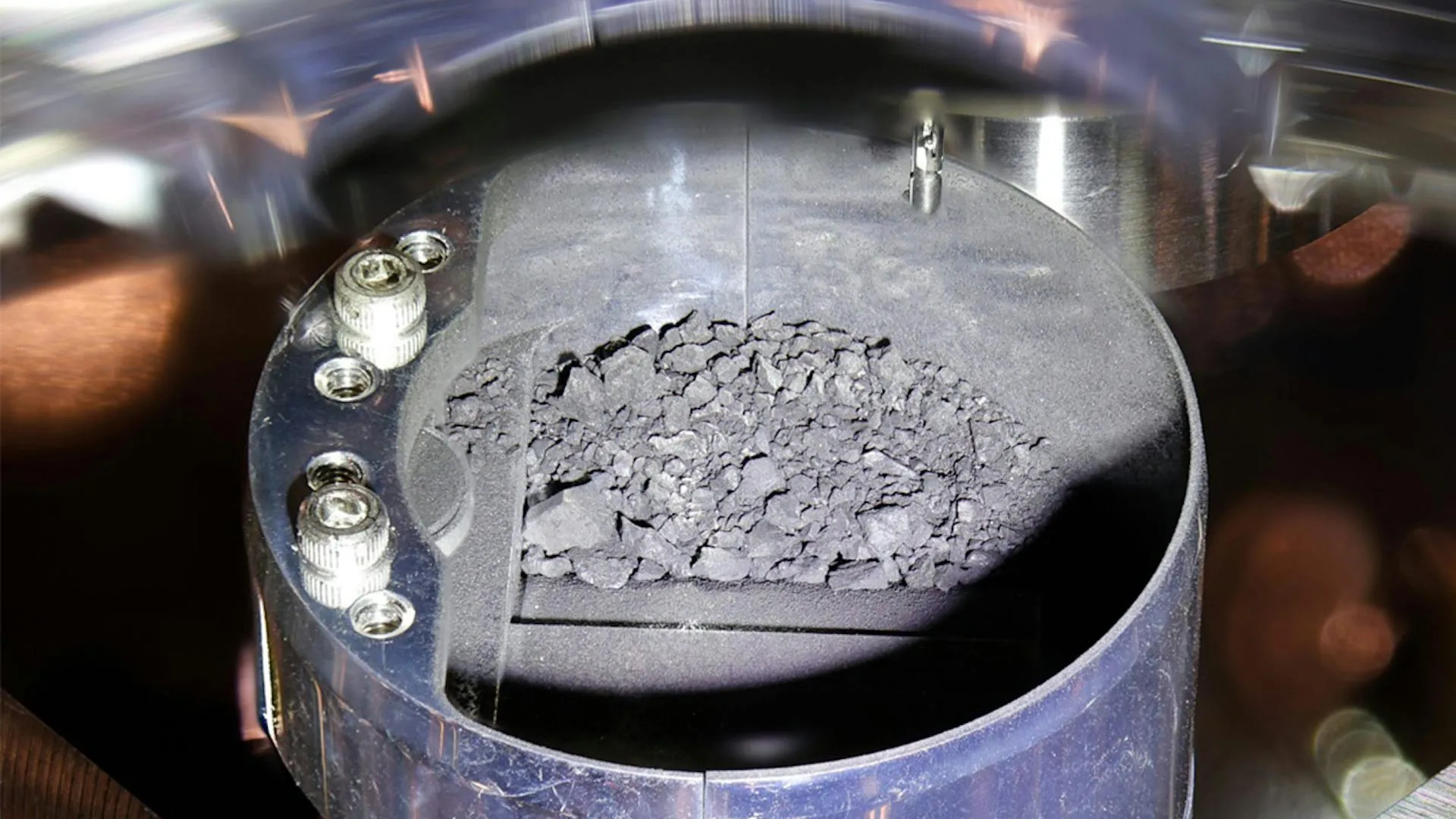
An international research team has confirmed the presence of all five nucleobases in material collected from asteroid Ryugu, according to findings published in Nature Astronomy. The discovery builds on earlier work from 2023 that identified one nucleobase, uracil, in the same samples. Nucleobases are nitrogen-containing organic molecules that form the fundamental units of genetic information, combining with sugars and phosphates to create nucleotides.
The Ryugu samples were returned to Earth in 2020 by Japan Aerospace Exploration Agency’s Hayabusa2 mission. Researchers conducted their analysis using ultra-clean laboratory conditions to prevent contamination of the pristine material. The team extracted organic molecules using specialized chemical processes and identified all five nucleobases—adenine, guanine, cytosine, thymine, and uracil—in roughly similar concentrations across two samples analyzed.
These findings align with previous discoveries in other space materials. Meteorites that fell to Earth in earlier decades, including the Murchison meteorite from 1969 and the Orgueil meteorite from 1864, have similarly yielded nucleobases and other organic compounds. Recent NASA analysis of material from asteroid Bennu also revealed the presence of all five nucleobases, further corroborating the pattern.
The results suggest that the molecular building blocks of life may have formed in space and subsequently been delivered to the early Earth through asteroid impacts. However, researchers noted chemical variations among different asteroids. For example, the Murchison meteorite shows enrichment in purines, while Bennu and Orgueil contain higher concentrations of pyrimidines. Scientists believe these differences may stem from variations in chemical environments and the influence of ammonia during formation.
The preservation of Ryugu’s samples over approximately 4.5 billion years provides researchers with relatively uncontaminated insights into early Solar System chemistry. The discovery indicates that carbon-rich asteroids throughout the Solar System contain prebiotic chemistry that may have played a crucial role in the emergence of life on Earth.
Article Attribution | Read More at Article Source
Article summary produced by Claude AI