

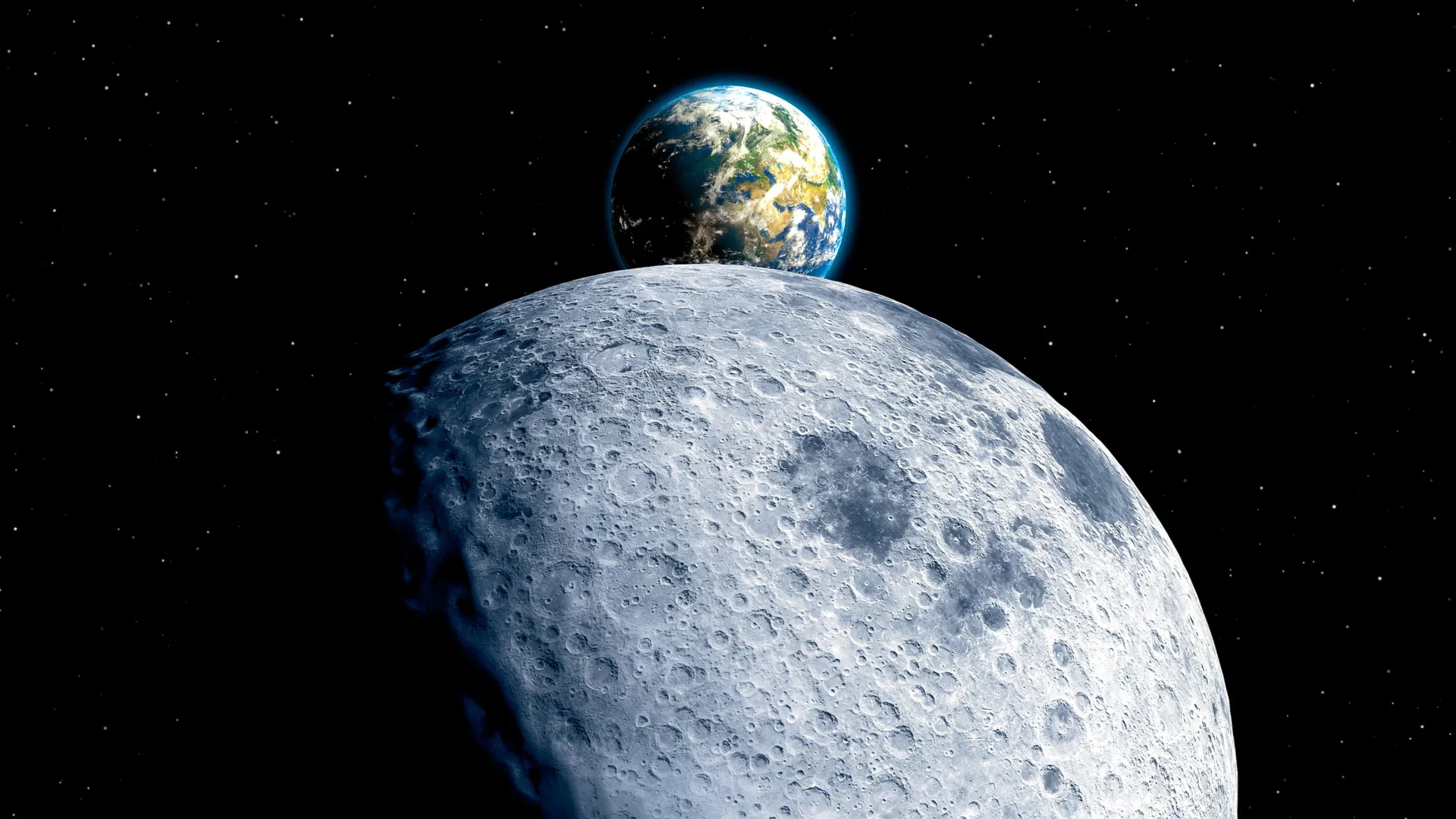
New research examining lunar rocks collected from the Moon’s far side is providing fresh insights into the violent early history of the Solar System and challenging long-standing scientific theories about how asteroid impacts shaped the Moon and planets.
The study analyzed ancient rocks to investigate the frequency and timing of asteroid collisions over billions of years. Rather than supporting the established view that the Moon experienced one intense bombardment period, the evidence indicates that asteroid impacts occurred at gradually decreasing rates over an extended timespan spanning more than three billion years. Researchers identified impact events dating from approximately 4.33 billion to 1.13 billion years ago, revealing a pattern of progressive decline in collision frequency.
The Moon serves as a unique scientific resource for understanding the early Solar System because its surface has preserved evidence of ancient impacts that has been destroyed on Earth through erosion, volcanic activity, and plate tectonics. The far side of the Moon is particularly valuable because it has been less affected by later geological processes, maintaining a cleaner record of the earliest impacts. According to researchers at Curtin University’s School of Earth and Planetary Sciences and John de Laeter Centre, samples from the lunar far side allow direct comparison with the near side for the first time, providing unprecedented opportunities to study this distant past.
The implications of these findings extend to understanding Earth’s early history. Since the Moon and Earth formed together and experienced comparable impact events, lunar bombardment records offer critical information about the conditions that existed during Earth’s earliest stages. The research helps scientists understand how asteroid impacts may have influenced planetary evolution and the emergence of life.
The research was conducted by the State Key Laboratory of Deep Earth Processes and Resources at the Guangzhou Institute of Geochemistry, Chinese Academy of Sciences, and was published in Science Advances. The study was made possible through China’s Chang’e-6 mission, which achieved the first successful return of samples from the Moon’s far side.
Article Attribution | Read More at Article Source
Article summary produced by Claude AI