

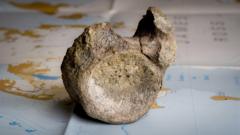
A tail vertebra originally collected on James Ross Island in 1985 has been formally identified as the first dinosaur fossil ever discovered in Antarctica, according to researchers at the British Antarctic Survey and Natural History Museum. The specimen had been stored in a geology collection for decades after its initial recovery, as the team that found it was uncertain of its classification and suspected it might belong to a marine reptile instead.
Dr. Mark Evans, the collections manager at the British Antarctic Survey, recently identified the fossil while reviewing thousands of specimens in storage. He recognized distinctive anatomical features characteristic of Titanosaurs and consulted Prof. Paul Barrett from the Natural History Museum for confirmation. Barrett identified the bone as a tail vertebra from a Titanosaur, a group of massive sauropod dinosaurs that ranks among the largest terrestrial animals ever to exist.
Based on the size of the recovered bone, paleontologists estimate the Antarctic specimen measured approximately 23 feet in length, considerably smaller than the largest known Titanosaurs, which exceeded 115 feet long and weighed around 60 tonnes. Scientists cannot yet determine whether this particular individual was a juvenile or represented a genuinely small adult species. The dinosaur inhabited Antarctica approximately 82 million years ago during the Late Cretaceous Period, when the continent featured a warm climate covered in forests rather than its current frozen landscape.
The discovery provides valuable information about ancient Antarctic ecosystems and the diverse fauna that inhabited the region before modern ice sheets developed. While other dinosaur fossils have been found in Antarctica since 1985, the fossil record remains sparse due to challenging working conditions and the extensive ice coverage obscuring geological layers. Research findings on this specimen have been published in the journal Acta Palaeontologica Polonica.
Article Attribution | Read More at Article Source
Article summary produced by Claude AI