

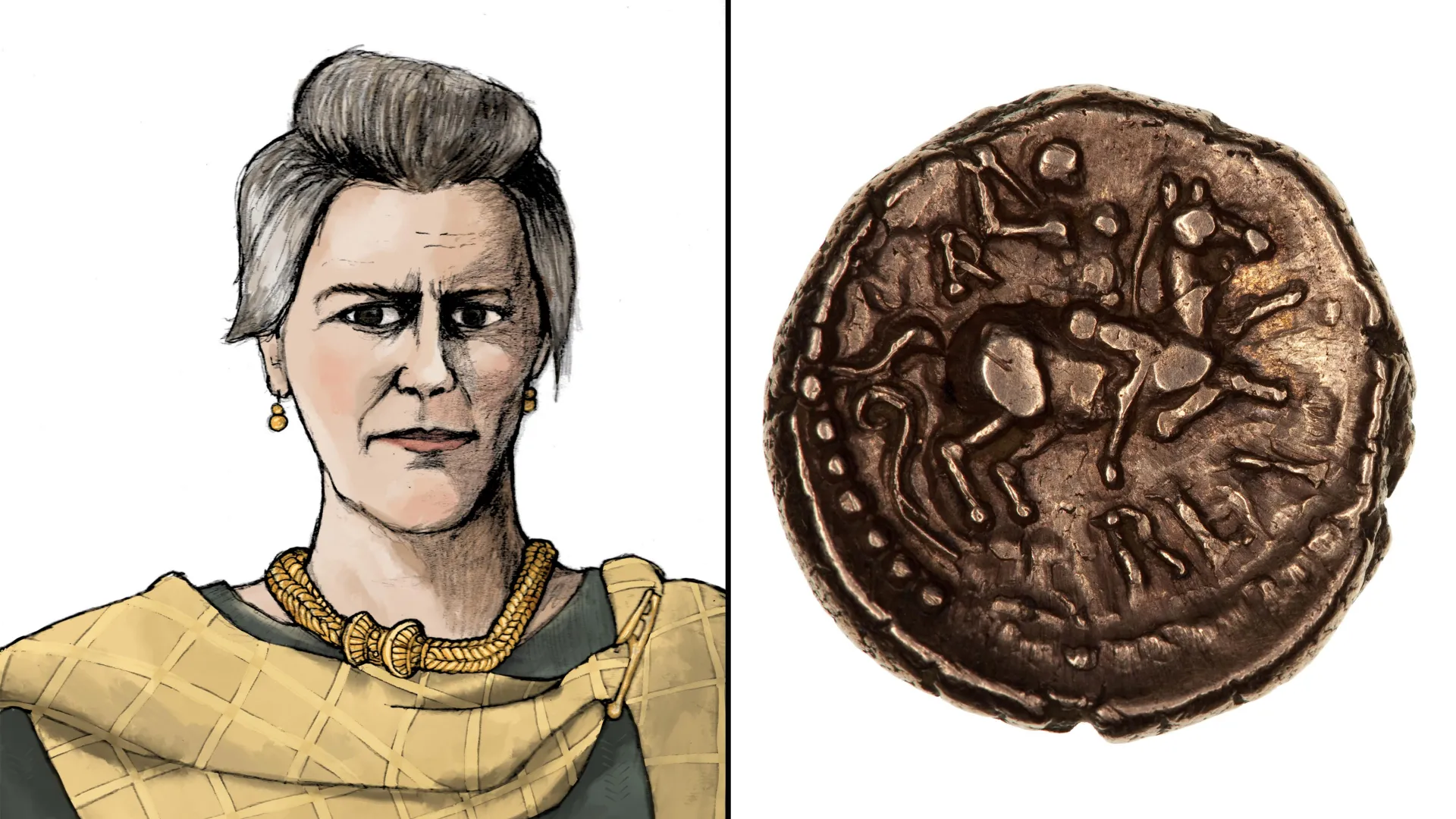
New archaeological research conducted at Bournemouth University challenges the traditional historical assumption that Verica, a prominent Iron Age British ruler, was male. Verica governed the Atrebates, a powerful tribe controlling territory across present-day Hampshire and West Sussex. Around AD 40, Verica was deposed and fled to Rome, where the exiled leader appealed to Emperor Claudius. According to Roman historian Cassius Dio, this appeal motivated Claudius to launch his invasion of Britain in AD 43.
Dr. Miles Russell, Director of Archaeological Fieldwork at Bournemouth University, argues that 19th-century classical historians misidentified Verica as male due to their patriarchal perspectives. Russell identifies multiple lines of evidence supporting a female identification. The name Verica itself ends in the letter “a,” a common feature of female names from that era, paralleling other prominent female rulers of the period such as Cartimandua and Boudica. Additionally, coins minted during Verica’s reign depict a slender, bare-breasted figure with feminine characteristics riding horseback, contrasting sharply with the masculine warriors shown on coins produced by other Iron Age British leaders.
While Verica’s coins bear the Latin title “rex,” traditionally translated as “king,” Russell emphasizes that this designation was not gender-specific in Roman practice. Both male and female rulers received this title, with Cleopatra of Egypt serving as a prominent historical example. The Latin inscription on Verica’s coins indicates the ruler exercised authority with explicit Roman imperial approval.
Russell contends that Verica’s historical significance extends beyond gender identification. He suggests that Roman historians, influenced by prevailing biases about Emperor Claudius being easily swayed by women, may have diminished Verica’s actual role. Rather than merely persuading Claudius through influence, Verica likely served as a valuable political and military strategist, providing tactical intelligence and practical support that ensured the invasion’s success. The conquest offered Claudius an opportunity to establish himself as an effective military leader, while Verica’s deposition supplied political justification for intervention.
Russell raises the possibility that without Verica’s exile and subsequent appeal to Rome, the invasion might never have occurred. This research builds on earlier Bournemouth University studies indicating women held significant positions within Iron Age British society, suggesting a need to reassess female influence in both community structures and political decisions that shaped the region’s development during this period.
Article Attribution | Read More at Article Source
Article summary produced by Claude AI