

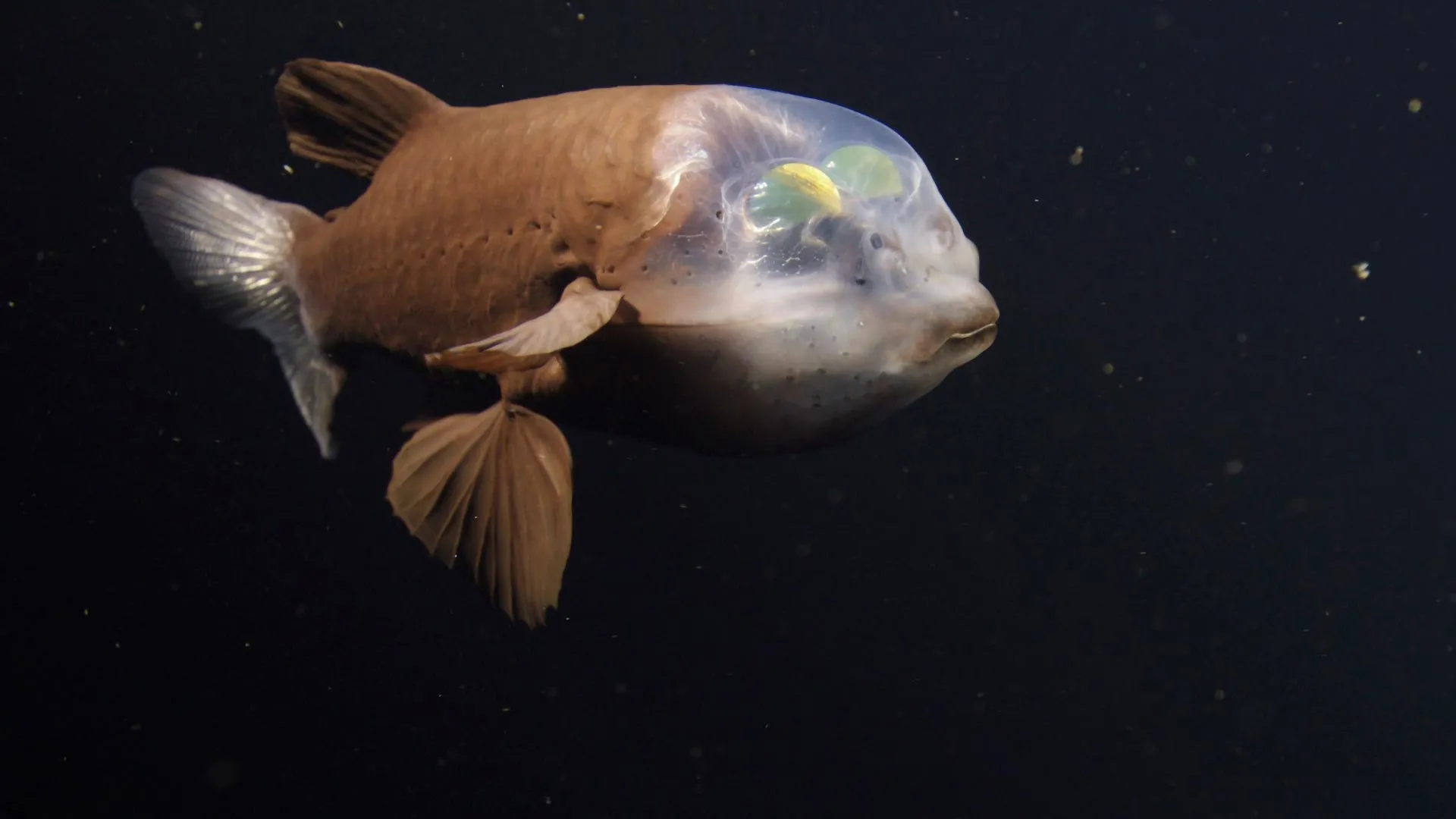
Scientists at the Monterey Bay Aquarium Research Institute documented an encounter with a barreleye fish during a research expedition approximately 90 kilometers offshore. The sighting occurred at a depth of roughly 600 meters while the team was operating a remotely operated vehicle called Doc Ricketts. This marked only the eleventh documented observation of Macropinna microstoma by MBARI researchers over the course of their nearly four decades of ocean exploration.
The expedition, known as Diving Deep for Delicate Drifters, was primarily focused on studying gelatinous marine organisms including jellyfish and comb jellies. The barreleye appeared unexpectedly as the ROV was returning to the surface at the conclusion of the day’s operations. Research Specialist Shannon Johnson alerted the pilots to the presence of the unusual fish, prompting them to halt the vehicle’s ascent. When news of the sighting spread, scientists and crew members moved to the control room to observe the remarkable animal, extending the discovery into an extended viewing session.
The barreleye’s distinctive transparent head contains tubular eyes that typically orient upward to detect silhouettes of potential prey in the ocean’s dimly lit midwater zone. The fish’s eyes possess the ability to rotate within the transparent dome covering its head, allowing it to track and pursue food sources. This specialized anatomy enables the barreleye to remain relatively stationary while hunting, using its large fins for stability and precise positioning. The transparent covering also protects the fish’s sensitive eyes when it feeds on small crustaceans sheltering within the tentacles of deep-sea siphonophores.
The research team spent approximately 20 minutes observing the barreleye and recorded high-resolution 4K footage using the ROV’s advanced camera systems. The encounter represents significant milestones for the institute, including its first 4K documentation of this species and its first barreleye observation from the newly commissioned research vessel David Packard. Over approximately 40 years of operation, MBARI has conducted roughly 7,000 remotely operated vehicle dives and accumulated more than 41,000 hours of deep-sea video footage, making the rarity of barreleye encounters particularly noteworthy for the scientific community.
Article Attribution | Read More at Article Source
Article summary produced by Claude AI