

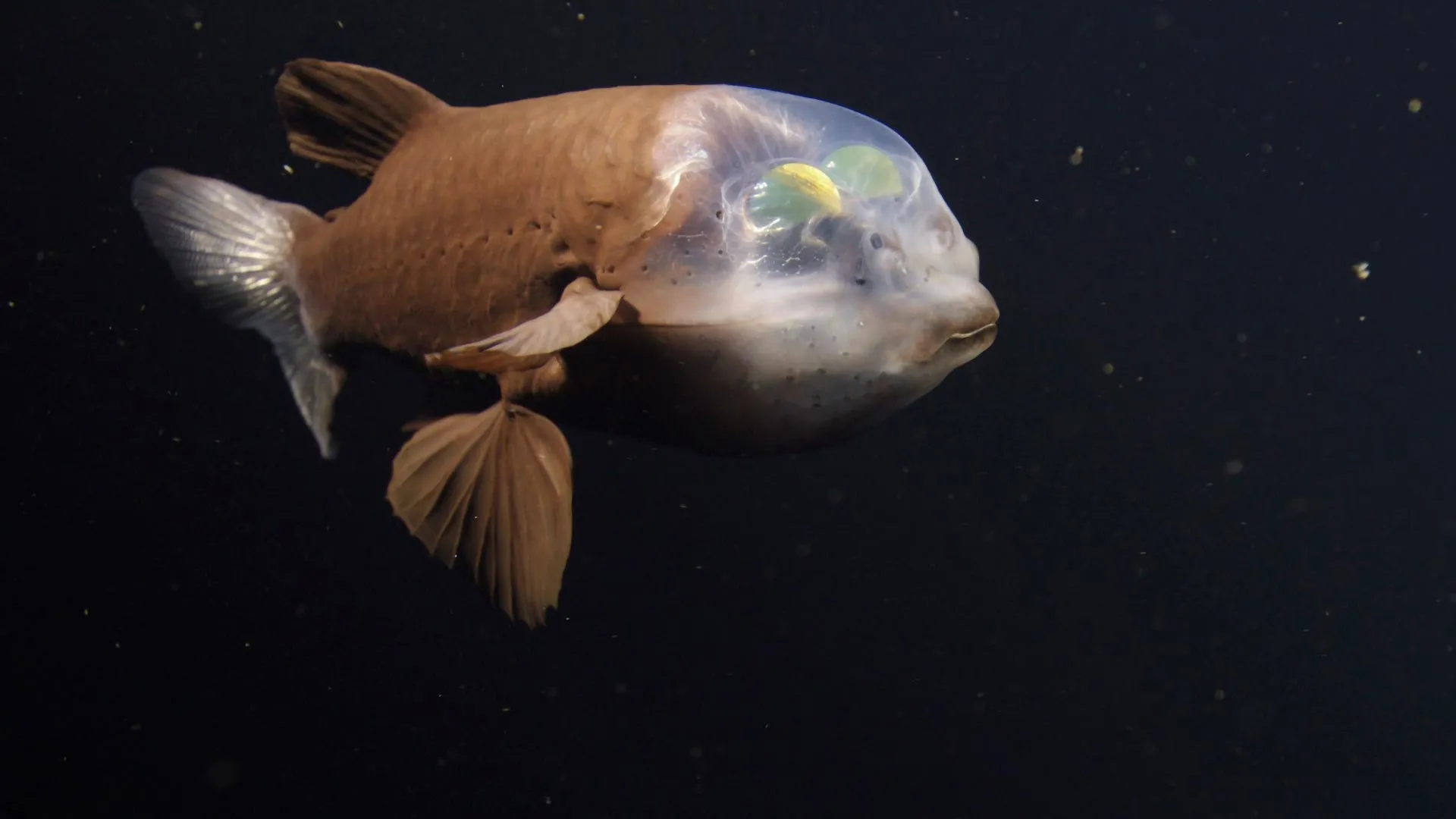
Researchers from the Monterey Bay Aquarium Research Institute spotted a barreleye fish during an expedition in the Pacific Ocean roughly 90 kilometers offshore, marking only the eleventh documented encounter with this elusive species in nearly four decades of ocean exploration by the institute. The fish was observed at a depth of approximately 600 meters using the remotely operated vehicle Doc Ricketts. The discovery occurred during the “Diving Deep for Delicate Drifters” expedition, which focused primarily on investigating gelatinous marine animals such as jellyfish and comb jellies. The barreleye appeared as operations were concluding for the day, prompting the research team to redirect their attention to document the unexpected visitor.
The barreleye possesses distinctive anatomical features that enable it to thrive in the ocean’s twilight zone, a dimly lit region where locating food presents significant challenges. The fish’s most notable characteristic is its transparent head, which houses tubular eyes capable of rotating within a gelatinous dome of tissue. This unusual adaptation allows the barreleye to maintain visual contact with potential prey as it maneuvers to capture it. The fish typically remains nearly motionless in the water, supported by large fins that provide stability and precise movement control, while its eyes point upward to detect faint silhouettes of passing animals. The transparent covering also protects the fish’s sensitive eyes when feeding on small crustaceans trapped among the stinging tentacles of deep-sea siphonophores.
Scientists documented approximately 20 minutes of observation during this encounter, utilizing the high-resolution 4K camera aboard Doc Ricketts to record detailed views of the fish’s anatomy and movements. Researchers adjusted the vehicle’s lighting to enhance visibility of the transparent head structure, and the ROV pilot captured additional footage with a virtual reality camera to create 3D stereo imagery. These high-quality recordings represent both the institute’s first 4K footage of this species and the first observation from the new research vessel David Packard.
The rarity of the sighting is underscored by MBARI’s extensive exploration history. Over nearly 40 years, the institute has completed approximately 7,000 remotely operated vehicle dives and accumulated more than 41,000 hours of deep-sea video footage. The previous documented encounter with a barreleye occurred in 2021. The expedition was supported by the David and Lucile Packard Foundation’s ongoing commitment to the institute’s research initiatives.
Article Attribution | Read More at Article Source
Article summary produced by Claude AI