

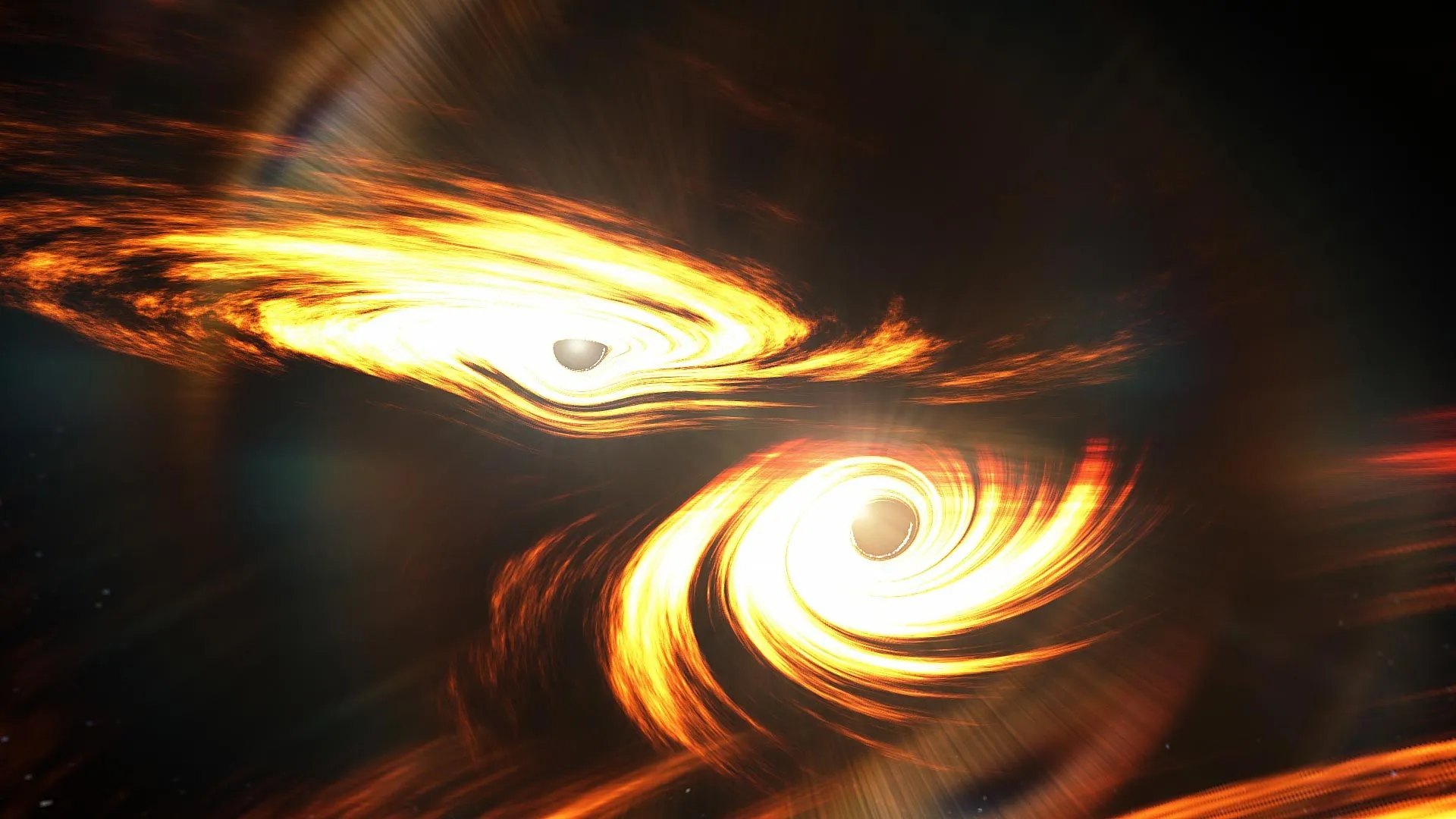
A team of physicists from Penn State has identified a potential connection between black hole mergers and fundamental thermodynamic principles, according to research published in Physical Review Letters. The study suggests that the properties of black holes formed from collisions may be predicted using entropy maximization, a concept drawn from thermodynamics rather than through the computationally intensive methods traditionally required.
When two black holes orbit each other and eventually merge, they release enormous energy that distorts spacetime and generates gravitational waves detectable by instruments on Earth. Scientists typically analyze these waves to determine the characteristics of the resulting black hole, but this process usually demands supercomputer resources to solve the intricate equations of Einstein’s general relativity. The new research proposes that thermodynamic principles could provide a more straightforward approach to making these predictions.
Entropy, a central concept in thermodynamics, describes the number of possible microscopic arrangements consistent with a system’s observable state. Physical systems naturally tend toward higher entropy configurations because disordered states have far more possible arrangements than ordered ones. The researchers found that after accounting for energy and angular momentum carried away by gravitational waves, the final black hole from a merger appears to settle into a state that maximizes entropy.
To test their hypothesis, the team examined hypothetical rotating black holes representing potential merger outcomes and tracked how the mass and angular momentum of colliding black holes corresponded to these states. The state with the highest entropy closely aligned with outcomes independently calculated using sophisticated numerical relativity simulations. This correspondence suggests that black hole mergers follow predictable rules similar to those governing more familiar physical systems like gases, potentially simplifying how scientists forecast collision results.
Article Attribution | Read More at Article Source
Article summary produced by Claude AI