

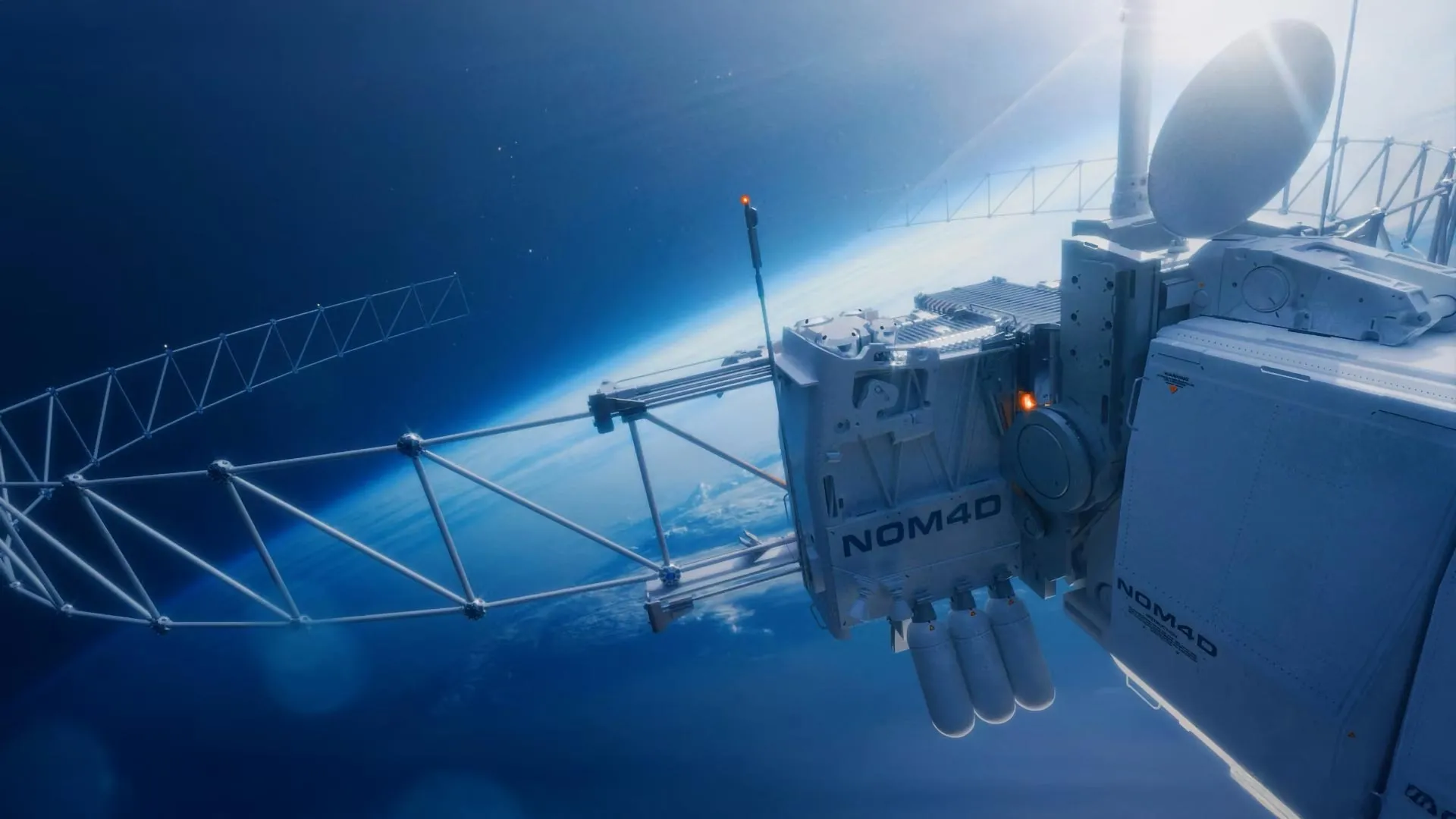
Researchers at the California Institute of Technology have achieved a milestone by deploying a robotic system that autonomously constructed part of a structure in space, marking the first demonstration of its kind. The effort was funded by the Defense Advanced Research Projects Agency and conducted as part of the Novel Orbital and Moon Manufacturing, Materials, and Mass-efficient Design program, which seeks to develop in-space manufacturing and assembly capabilities. The robotic system, called the Autonomous In-Space Tensioned Reflector Assembly, spent six months in orbit assembling components of a reflector antenna while stationed in low Earth orbit.
The robotic arm retrieved structural tubes and connecting joints from storage dispensers, joining them into repeating sections that formed a larger framework known as a truss. The antenna design incorporated composite fiber tubes, aluminum connectors, and a reflective surface made from Kapton polymer film. While technical challenges and scheduling constraints prevented completion of the entire antenna structure, the robot successfully constructed an initial section, providing proof that autonomous assembly methods can function reliably in the space environment. The mission launched in March 2026 aboard a SpaceX vehicle that carried the payload into low Earth orbit.
Development of the space hardware required an intensive effort, with the team manufacturing, testing, and preparing the equipment in less than twelve months for delivery to the hosting company. The successful demonstration represents the third phase of the research program, following earlier stages that included concept development, engineering design, and laboratory verification on Earth. Only two projects advanced to this orbital phase, with the other effort being conducted by the University of Illinois Urbana-Champaign using equipment attached to the International Space Station.
The ability to assemble large structures directly in space could transform multiple fields including astronomy, communications, and space-based energy systems. Current approaches to launching large spacecraft components face constraints due to the limited interior volume of rocket fairings. By transporting materials to orbit for on-site assembly rather than pre-assembling everything on Earth, engineers could potentially construct structures measuring hundreds of meters or even kilometers in scale. DARPA program officials indicated that such capabilities could enable unprecedented expansion in the size and complexity of orbital infrastructure systems.
Article Attribution | Read More at Article Source
Article summary produced by Claude AI