

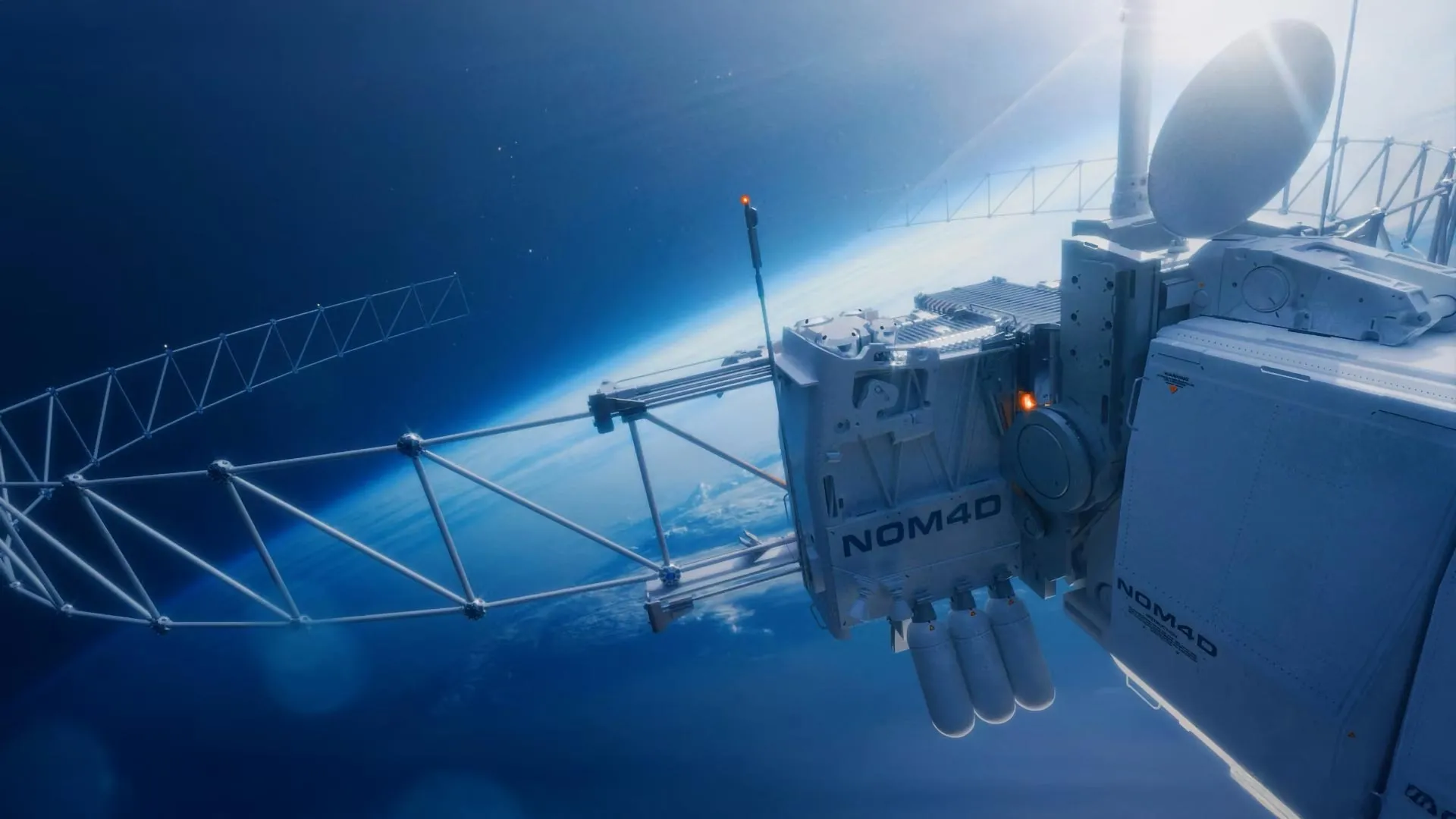
Researchers at the California Institute of Technology have achieved a milestone by demonstrating autonomous robotic assembly in space. The robotic system, funded by the Defense Advanced Research Projects Agency (DARPA) as part of the Novel Orbital and Moon Manufacturing, Materials, and Mass-efficient Design program, successfully constructed structural sections in orbit without human intervention. The system uses an automated arm to retrieve tubes and connecting joints from storage dispensers and joins them into repeating structural sections called bays that form larger frameworks known as trusses.
The demonstration, called the Autonomous In-Space Tensioned Reflector Assembly (ASTRA), spent six months in orbit working to construct a reflector antenna measuring 1.4 meters across. The antenna design incorporates composite fiber tubes, aluminum connectors, and a reflective surface made from Kapton polymer film. Although the team encountered technical difficulties and scheduling constraints that prevented completion of the entire antenna, the robot successfully assembled an initial section, proving the construction method can function in the space environment. The payload launched on March 30, 2026, aboard a SpaceX Transporter-16 mission traveling to low Earth orbit via Momentus Inc.’s Vigoride 7 vehicle.
The ability to assemble large structures directly in space could transform multiple fields including astronomy, communications, and space-based energy systems. Current spacecraft design is limited by the confined space within a rocket’s protective fairing during launch. Robotic construction offers an alternative to either folding structures compactly for launch or having astronauts manually assemble components in orbit. Instead, engineers could transport raw materials into space and assemble complete systems there, potentially enabling structures hundreds of meters or even kilometers in scale—far exceeding what conventional spacecraft can achieve today.
CALTECH’s ASTRA experiment represents the third phase of DARPA’s research program, following earlier stages that developed the construction concept, engineered the design, and verified operations in Earth-based laboratory tests. The project was one of only two selected to advance to the orbital demonstration phase. The second project, led by the University of Illinois Urbana-Champaign, will investigate hardening carbon tubes in space using a module attached to the International Space Station, providing an alternative manufacturing approach.
Article Attribution | Read More at Article Source
Article summary produced by Claude AI