

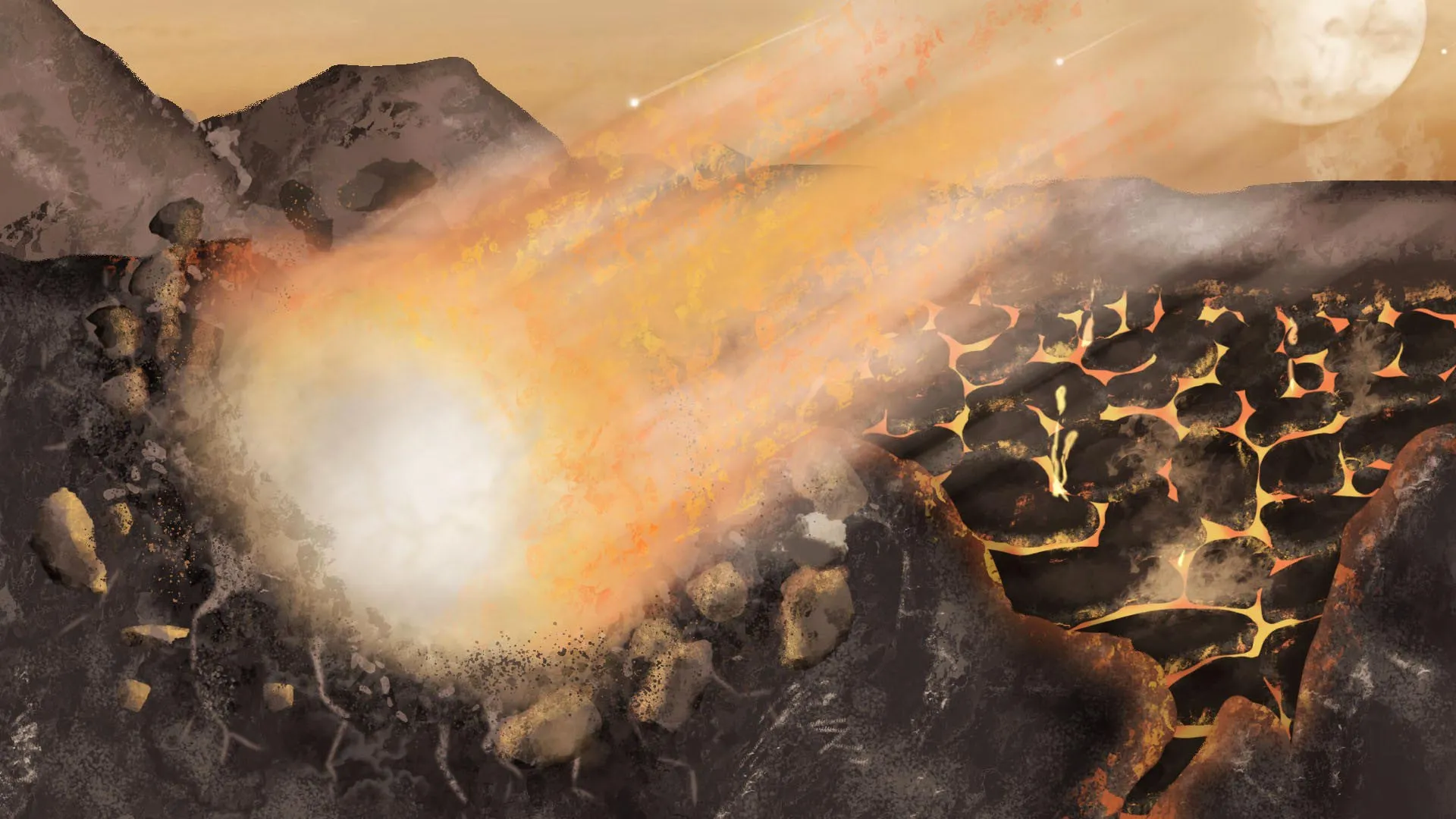
A study led by the University of Cambridge challenges the long-standing hypothesis that comets delivered the chemical building blocks necessary for life to Earth. Using advanced computer simulations, researchers found that the extreme speeds and angles at which comets typically approach Earth would destroy delicate organic molecules rather than preserve them during impact. The findings, published in Scientific Reports, indicate that successful delivery of prebiotic compounds by comets would have been extraordinarily rare, contradicting decades of scientific theorizing about the role of these icy objects in life’s origins.
Researchers focused their analysis on hydrogen cyanide (HCN), a compound commonly found in comets that contains carbon and nitrogen and can participate in chemical reactions producing complex organic substances. The simulations revealed multiple obstacles to successful delivery. Even when hydrogen cyanide survived a comet’s arrival, the impact would need to deposit sufficient quantities in a single location to support meaningful chemical reactions—an exceptionally uncommon occurrence. Additionally, comet impacts were most frequent during Earth’s earliest history but declined sharply over the planet’s first 500 million years, leaving only a handful of potential opportunities for favorable conditions.
Further complications arise from the dispersal and dilution of any successfully delivered molecules. Hydrogen cyanide or other prebiotic compounds deposited on Earth’s surface would likely disperse rapidly, leaving insufficient time for the chemical reactions associated with life’s origins to proceed. For the comet theory to be viable, multiple unlikely events would need to coincide: impact at precisely the right speed and angle, molecular preservation, adequate concentration in a suitable location, and initiation of important chemical processes before dispersal.
With comets appearing unlikely as a delivery mechanism, the study raises questions about alternative sources for life’s chemical precursors. Asteroid impacts, which occurred far more frequently on early Earth than comets, could have created conditions supporting the formation of prebiotic molecules through collision-associated chemistry. Alternatively, Earth itself may have generated these compounds through natural chemical processes operating on the young planet, eliminating the need for organic material arriving from space. The research does not establish how life ultimately began but suggests multiple pathways through which the necessary raw materials could have become available.
Article Attribution | Read More at Article Source
Article summary produced by Claude AI