

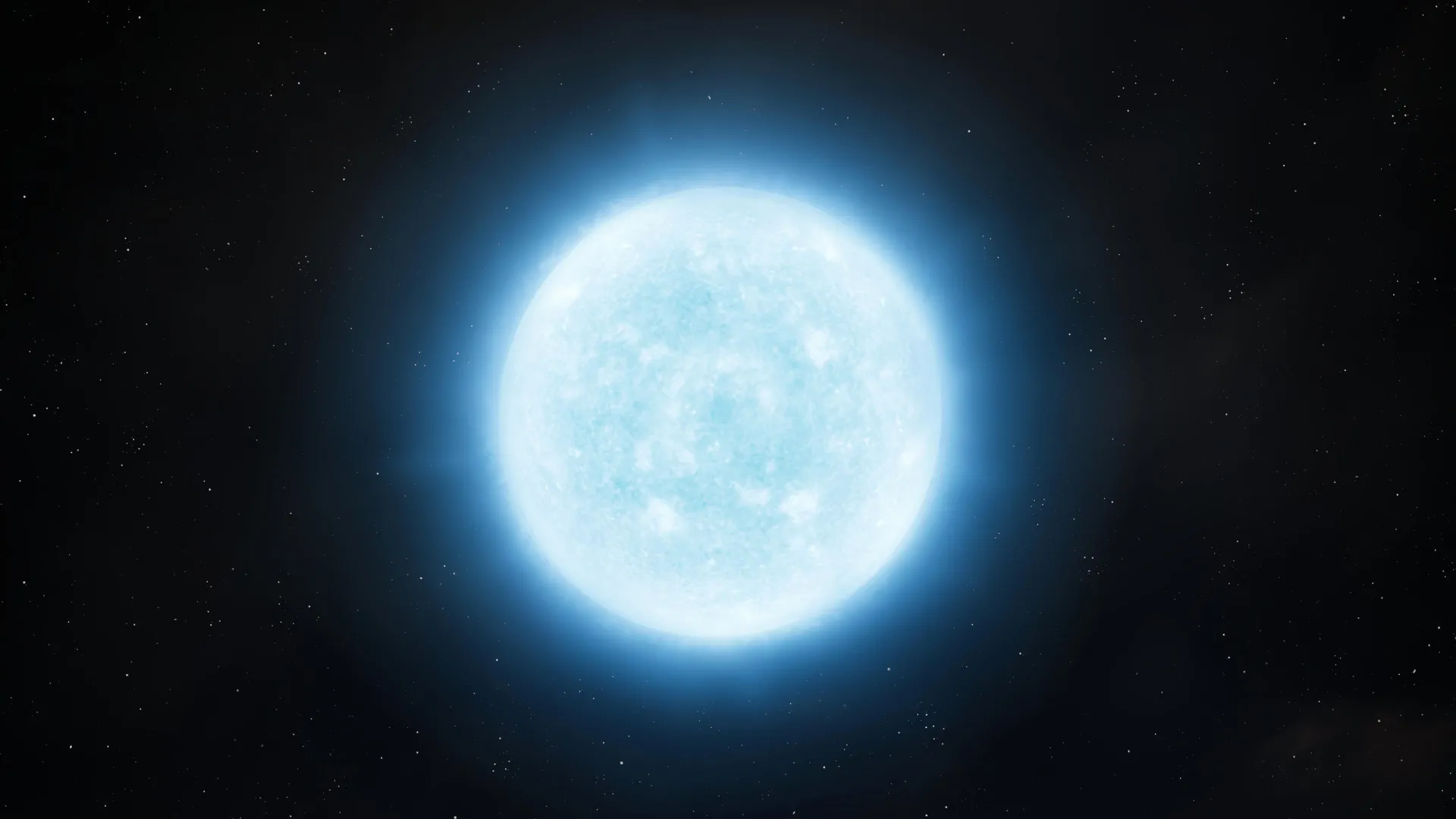
Researchers from the Indian Institute of Science and collaborators have conducted computer simulations suggesting that white dwarfs—the dense cores remaining after certain stars exhaust their fuel—may grow significantly more massive than the long-standing Chandrasekhar limit of approximately 1.4 solar masses. According to the new findings, white dwarfs with sufficiently strong internal magnetic fields could potentially reach masses of around 2.4 times the Sun’s mass, substantially exceeding the conventional threshold. The Chandrasekhar limit has historically been understood as a critical boundary beyond which carbon-oxygen white dwarfs would ignite and trigger Type Ia supernovae explosions.
The theoretical possibility of white dwarfs surpassing the Chandrasekhar limit has been explored by physicists for decades, and astronomers have observed unusually bright Type Ia supernovae that may indicate white dwarfs reaching masses as high as 2.8 solar masses. However, demonstrating that such objects could theoretically exist represented only part of the puzzle. The research team focused on the more fundamental question of whether ordinary stars could actually evolve into these exceptionally massive white dwarfs through natural processes.
To address this challenge, the researchers modified a stellar evolution simulation program to account for magnetic fields and cooling processes in white dwarfs. Their modeling followed stars from their main-sequence phase, when they fuse hydrogen, through their later evolutionary stages and final states as dead stellar remnants. The team also modeled scenarios where white dwarfs gradually accumulate material from companion stars in binary systems through a process known as accretion.
The simulations revealed an unexpected mechanism: even relatively weak initial magnetic fields become increasingly powerful as white dwarfs accumulate matter and contract under their own gravity. This compression strengthens the internal magnetic field, generating additional pressure that helps counteract gravitational forces and allows the white dwarf to support greater mass than conventional models predict. One simulation demonstrated that a carbon-oxygen white dwarf could accumulate material and reach approximately 2.4 solar masses when magnetic effects were included, compared to roughly 1.4 solar masses without those effects.
The findings may have far-reaching implications for cosmology, as Type Ia supernovae serve as critical tools for measuring cosmic distances and studying the universe’s expansion. The traditional understanding of the Chandrasekhar limit has provided a fundamental framework for interpreting these explosions, and the new results suggest that framework may require revision based on the role of magnetic fields in stellar evolution.
Article Attribution | Read More at Article Source
Article summary produced by Claude AI