

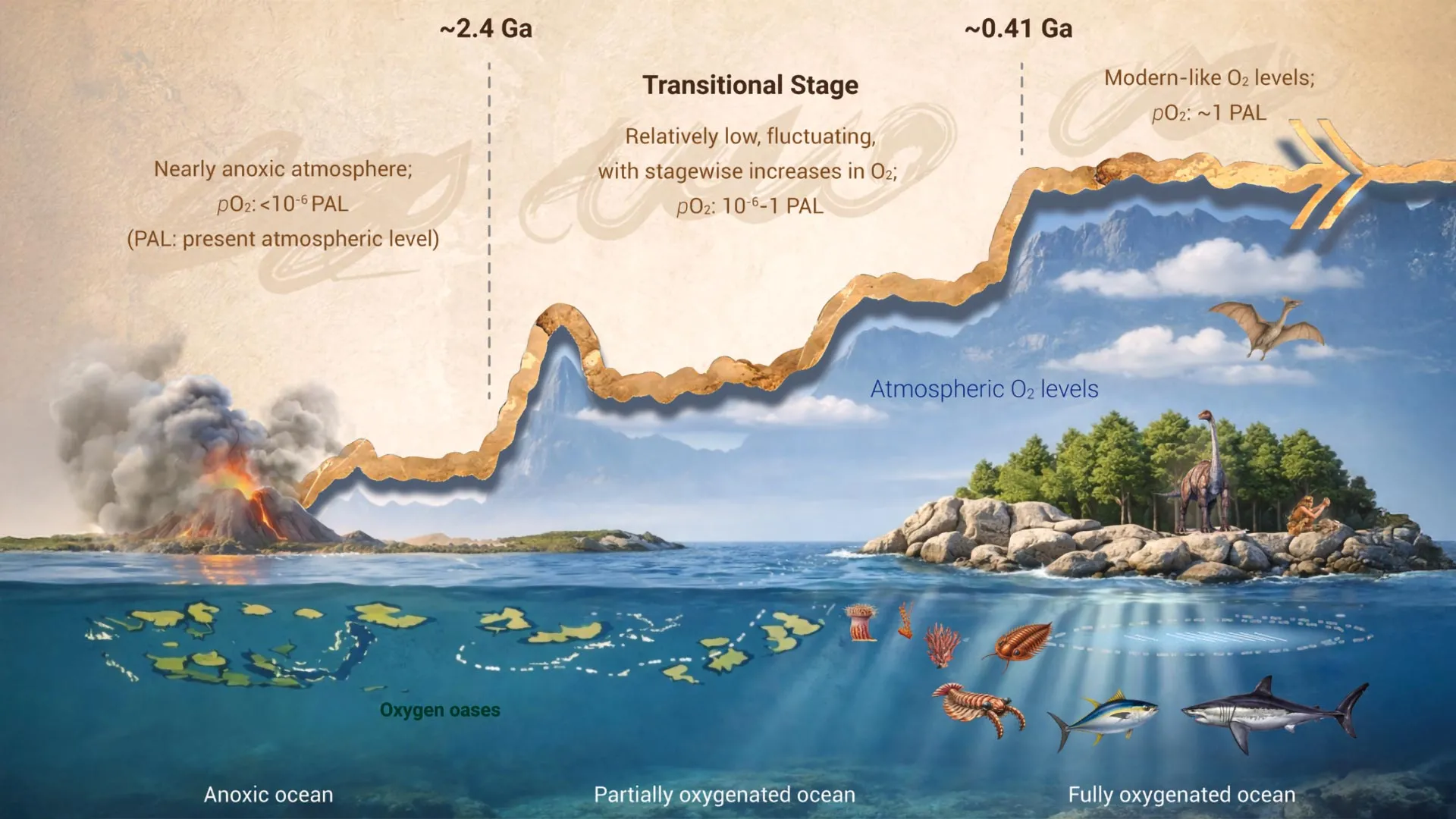
Geochemists from Chengdu University of Technology have presented a revised timeline of Earth’s oxygen history that challenges conventional scientific understanding. Rather than relying on ocean chemistry measurements, the researchers examined chemical evidence preserved in ancient rocks that more directly reflects atmospheric conditions.
The analysis identifies three major atmospheric oxygen increases: the first during the Great Oxidation Event between 2.4 billion and 2.1 billion years ago, when oxygen rose from minimal levels to between 0.1% and 10% of modern concentrations; the second occurring approximately 1.3 billion to 1.0 billion years ago; and the third between 440 million and 410 million years ago. The researchers used sulfate signatures in sedimentary rocks as their primary evidence, as these compounds preserve distinctive chemical fingerprints produced by atmospheric oxygen, ozone, and carbon dioxide reactions.
According to this interpretation, well-known oceanic oxygenation events previously dated to 800-500 million years ago and 420-360 million years ago actually represent delayed responses to atmospheric changes. The deep ocean did not become fully oxygenated until approximately 410 million years ago, with some transitions involving gaps of roughly 600 million years between atmospheric and oceanic oxygen increases. The researchers note that charcoal first appears in the geological record around 420 million years ago, requiring atmospheric oxygen concentrations of approximately three-quarters of modern levels.
The findings reveal that oxygen-rich pockets existed in certain ocean areas as early as 3 billion years ago, produced by photosynthetic microorganisms, long before the atmosphere or most oceans became oxygenated. Additionally, the analysis demonstrates that atmospheric and oceanic oxygen levels could move in opposite directions over shorter timescales, as ocean reactions consuming organic carbon and sulfide could deplete atmospheric oxygen even as ocean levels rose.
These revisions suggest that oxygen’s role in enabling complex life evolution differed from previously understood. Rather than acting as a single trigger, rising oxygen gradually made new environments accessible during the Proterozoic, with higher levels only becoming a major force for biological complexity after the third atmospheric increase. The researchers acknowledge uncertainties remain regarding absolute oxygen concentrations and the completeness of the isotope record.
Article Attribution | Read More at Article Source
Article summary produced by Claude AI