

Researchers from Chengdu University of Technology have proposed a revised timeline for Earth’s atmospheric oxygen accumulation, challenging conventional understanding of how the planet transitioned from an oxygen-poor to oxygen-rich environment. Their work, published in The Innovation, relies on chemical evidence from ancient rocks rather than traditional ocean sediment measurements.
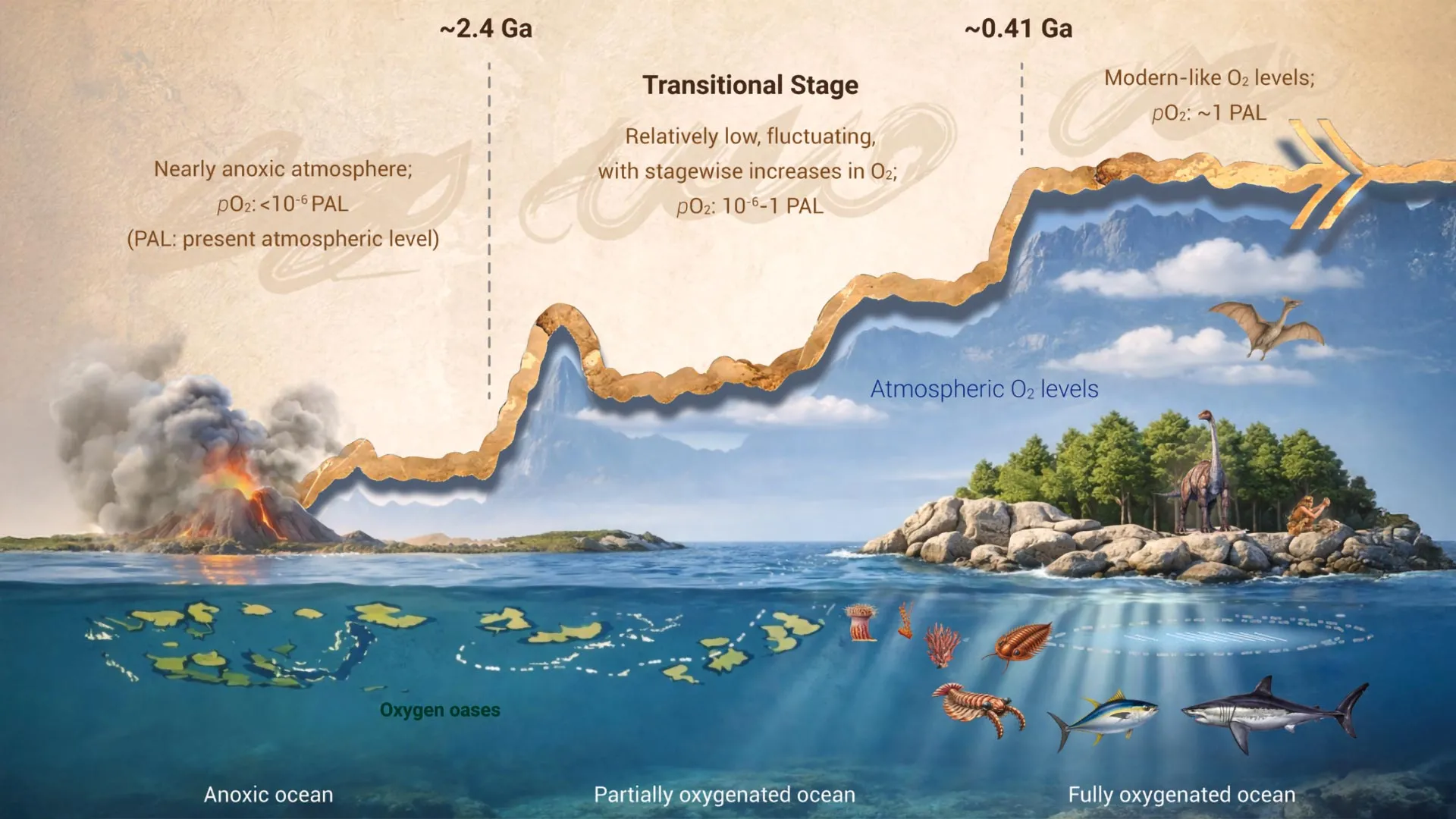
The research identifies three major atmospheric oxygen increases: the Great Oxidation Event between 2.4 billion and 2.1 billion years ago, a second increase approximately 1.3 billion to 1.0 billion years ago, and a third between 440 million and 410 million years ago. Each brought atmospheric oxygen from minimal levels to progressively higher concentrations. The scientists used sulfate preserved in sedimentary rocks to track these changes, examining isotope signatures that reflect atmospheric conditions more directly than ocean chemistry alone.
According to the analysis, Earth’s well-known Neoproterozoic and Paleozoic oxygenation events primarily reflect delayed changes in ocean oxygen levels rather than atmospheric increases. The oceans responded roughly 200 million years after the second atmospheric increase and approximately 30 million years after the third. This prolonged lag meant that despite major atmospheric changes, the deep ocean did not become fully oxygenated until around 410 million years ago. The researchers note that atmospheric and oceanic oxygen can move in opposite directions on shorter timescales, as newly introduced oceanic oxygen reacts with accumulated organic matter.
The findings reveal that oxygenated environments first appeared as isolated pockets in Earth’s oceans as early as 3 billion years ago during the Archean, created by photosynthetic microorganisms despite minimal atmospheric oxygen. These oxygen-rich oases gradually became more widespread as atmospheric oxygen levels rose and atmospheric oxygen absorption into seawater became the dominant mechanism for ocean oxygenation.
The research also reframes the relationship between oxygen and complex life evolution. Rather than oxygen acting as a single trigger, it initially provided opportunities for biological innovation during the Proterozoic. Only after the third major atmospheric increase did higher oxygen levels strongly support greater biological complexity, enabling larger animals and more active predators. The researchers acknowledge uncertainties in the isotope record and note that absolute atmospheric oxygen concentrations after 1 billion years ago remain challenging to establish, though the analysis suggests a fundamental revision to understanding how Earth became oxygen-rich.
Article Attribution | Read More at Article Source
Article summary produced by Claude AI