

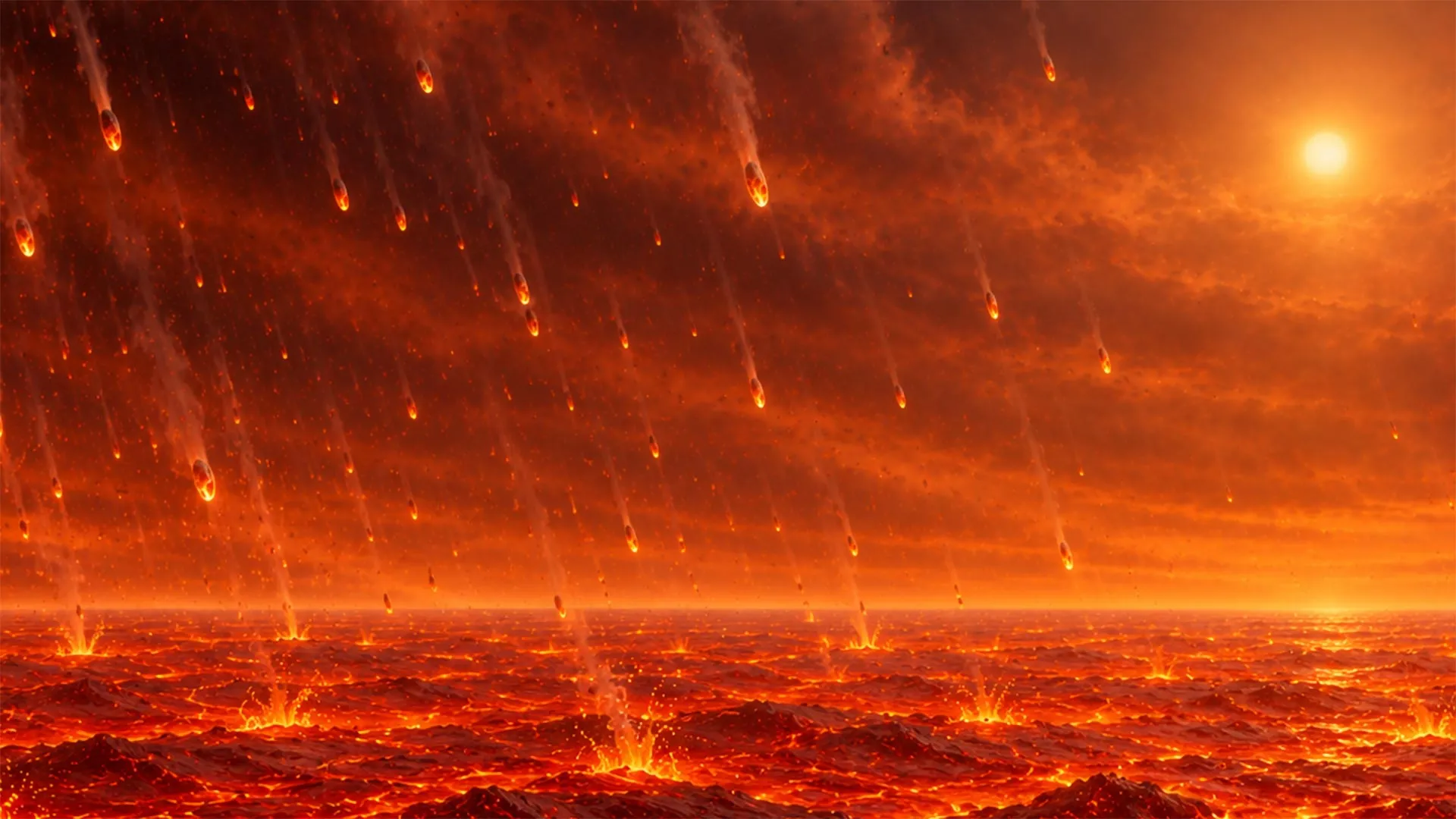
Scientists at The University of New Mexico have published findings in Nature Geoscience proposing that Earth produced a significant portion of its water internally during planetary formation. The study, led by graduate student Susmita Garai and Professor Zachary Sharp, challenges the long-standing theory that water arrived primarily through comets and meteorites from distant regions of the early solar system.
The research examines a chemical process occurring during Earth’s early formation when rocky pebbles fell through a hydrogen-rich atmosphere at extreme temperatures and pressures. Under these conditions, hydrogen gas reacted with iron oxide contained in silicate rocks, converting the iron oxide into metallic iron while releasing water vapor. Laboratory experiments conducted at temperatures between 1,200 and 1,400 degrees Celsius demonstrated that this reaction occurs efficiently, with nearly 80 percent of iron oxide being transformed when exposed to flowing hydrogen gas over 15 minutes to three hours. Control experiments using helium instead of hydrogen produced no comparable results, confirming hydrogen’s essential role in the reaction.
When the researchers extrapolated their experimental findings to conditions believed to exist during Earth’s earliest period of formation, their calculations suggested the mechanism could have generated hundreds of oceans’ worth of water. This represents a significantly larger quantity than the researchers anticipated when they began their work. The findings indicate that Earth’s intense, hydrogen-rich atmosphere during its accumulation phase may have actively contributed to water production rather than the planet being entirely dependent on external delivery mechanisms.
The implications extend to other planets throughout the universe. If rocky planets forming around distant stars develop similarly hot, hydrogen-rich atmospheres during their accretion phases, they might also generate substantial water quantities through equivalent chemical processes. This discovery could substantially increase scientific estimates regarding the prevalence of water-bearing, potentially habitable worlds in the cosmos. The research also supports growing scientific interest in pebble accretion as an explanation for planetary formation mechanisms.
Article Attribution | Read More at Article Source
Article summary produced by Claude AI