

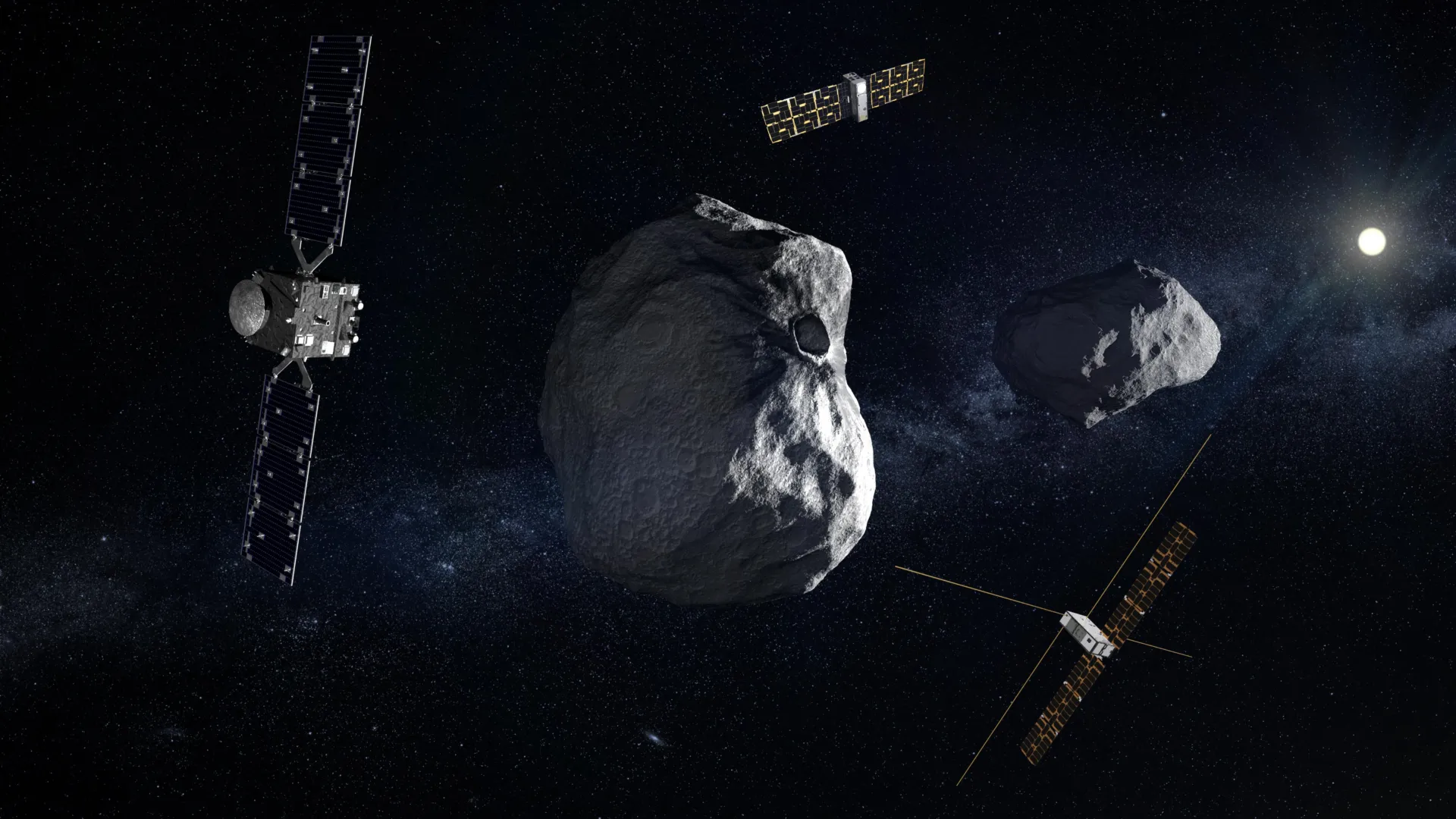
The European Space Agency’s Hera spacecraft has completed its journey to the Didymos asteroid system, positioning itself approximately 25 to 30 kilometers from the two asteroids. The mission aims to provide detailed scientific observations of asteroids Didymos and its smaller companion Dimorphos, which was deliberately struck by NASA’s DART spacecraft in 2022 during humanity’s first intentional asteroid deflection experiment.
The spacecraft’s current operational phase, termed the “early characterization phase,” focuses on obtaining comprehensive data about the asteroid pair and their environment. Mission scientists are particularly interested in understanding how Dimorphos responded to the kinetic impact, as previous impact models had suggested multiple possible outcomes. The observations will reveal whether the collision created a large crater or significantly reshaped the asteroid’s overall structure.
Navigating near such small celestial bodies presents unique challenges due to their extremely weak gravitational fields. Didymos measures approximately 780 meters across with gravity roughly 40,000 times weaker than Earth’s, while Dimorphos spans 151 meters with gravity about 200,000 times weaker. Rather than following conventional circular orbits, Hera travels in rectangular patterns around the asteroids’ shared center of gravity at approximately 12 centimeters per second. The spacecraft executes course corrections at alternating intervals, firing thrusters to change direction by 90 degrees while traveling in nearly straight trajectories.
Following the initial observation phase, Hera is scheduled to transition to a “detailed characterization phase” next month, moving closer to the asteroids and adopting more complex flight paths. The mission control team, operating from ESA’s ESOC center in Darmstadt, Germany, maintains daily contact with the spacecraft despite its distance of approximately 196.5 million kilometers from Earth. Additional investigations will include the deployment of two small CubeSats to gather closer measurements, with operations eventually progressing to landing phases. The mission’s findings are expected to significantly advance understanding of kinetic impact methods for planetary defense and inform future strategies for redirecting potentially hazardous asteroids.
Article Attribution | Read More at Article Source
Article summary produced by Claude AI