

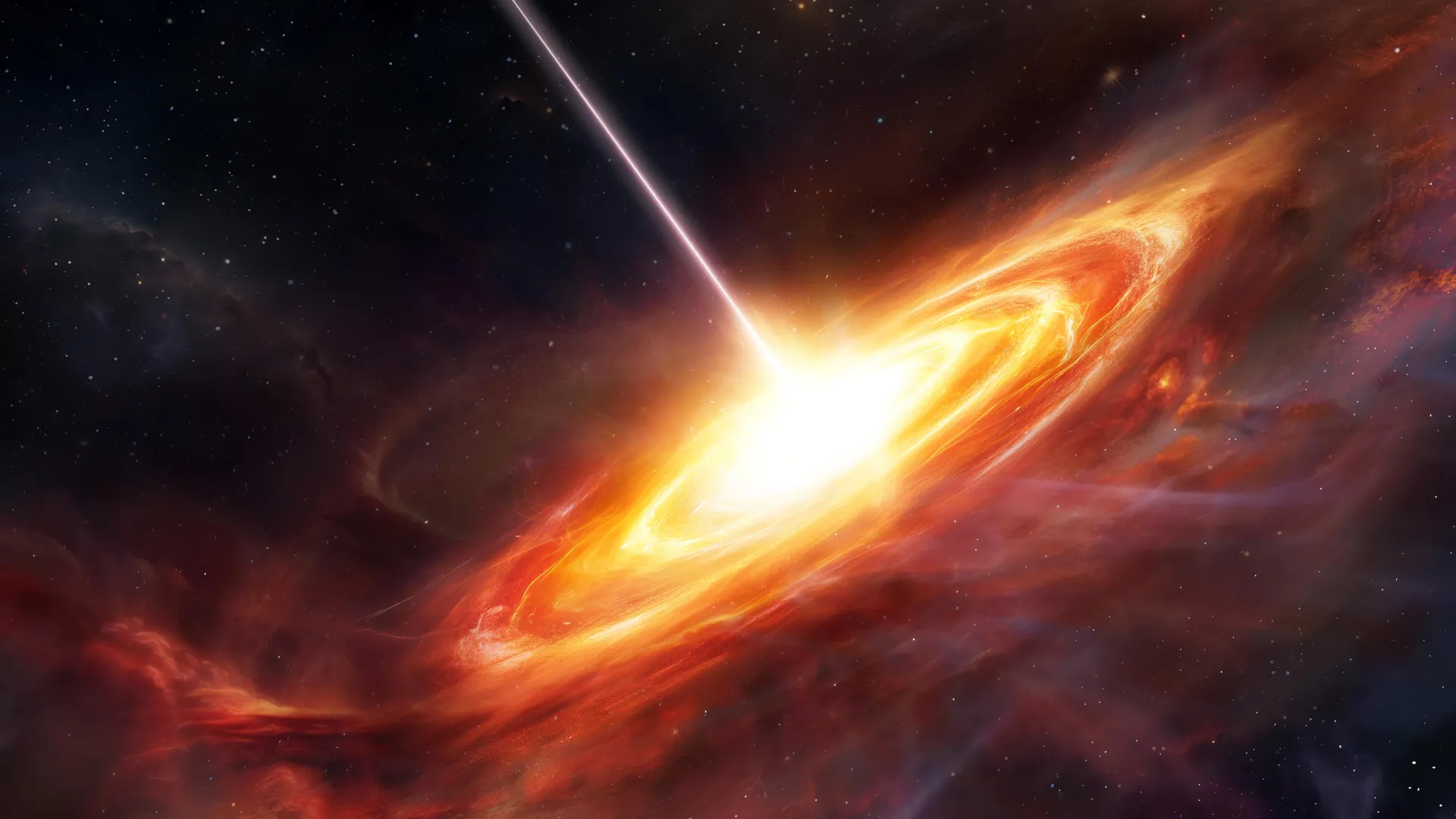
The European Space Agency’s Euclid space telescope has identified 31 exceptionally distant quasars, marking a significant advancement in the study of the early Universe. Among these discoveries are two objects that have set new records as the earliest quasars ever observed. These brilliant galactic nuclei, powered by supermassive black holes, were emitting light equivalent to a trillion Suns when the cosmos was approximately 670 million years old, representing roughly 5% of its current age.
Quasars represent among the brightest objects known to astronomy and emerge during specific phases in a galaxy’s evolution when massive quantities of material spiral into a central supermassive black hole. This process releases enormous energy, causing the galactic core to outshine the remainder of the galaxy by hundreds or thousands of times. Astronomers have pursued the detection of early-Universe quasars for decades due to their potential to illuminate the formation mechanisms of the first galaxies and supermassive black holes. However, such discoveries pose substantial technical challenges, as relatively few galaxies had grown sufficiently large to harbor these objects at such early cosmic epochs, and their light signals reaching Earth today remain exceptionally faint.
Since its launch in 2023, Euclid has fundamentally transformed this research domain. The telescope’s capacity to survey expansive sky regions and detect faint objects has already yielded an unprecedented collection of quasars from the early Universe. Among the 31 newly identified objects, 12 possess a redshift of 7 or greater, placing them within the Universe’s first 770 million years. The two most significant discoveries, designated EUCL J172902.75+641018.1 with a redshift of 7.77 and EUCL J125308.55+705432.3 with a redshift of 7.69, now represent the earliest known quasars, surpassing the previous record established in 2021.
The discovery rate itself underscores the telescope’s transformative impact. What required more than a decade to accomplish previously—identifying roughly ten quasars with high redshifts—Euclid has exceeded in a single year. Detailed observations of one of these quasars revealed it resides within a galaxy actively forming stars at remarkable rates, providing insights into the environments surrounding early supermassive black holes and their relationship to galaxy formation. These findings occur during the epoch of reionization, a critical period when the Universe transitioned from a cold, dark state into one shaped by energetic radiation, fundamentally establishing conditions that continue to characterize the cosmos today.
Article Attribution | Read More at Article Source
Article summary produced by Claude AI