

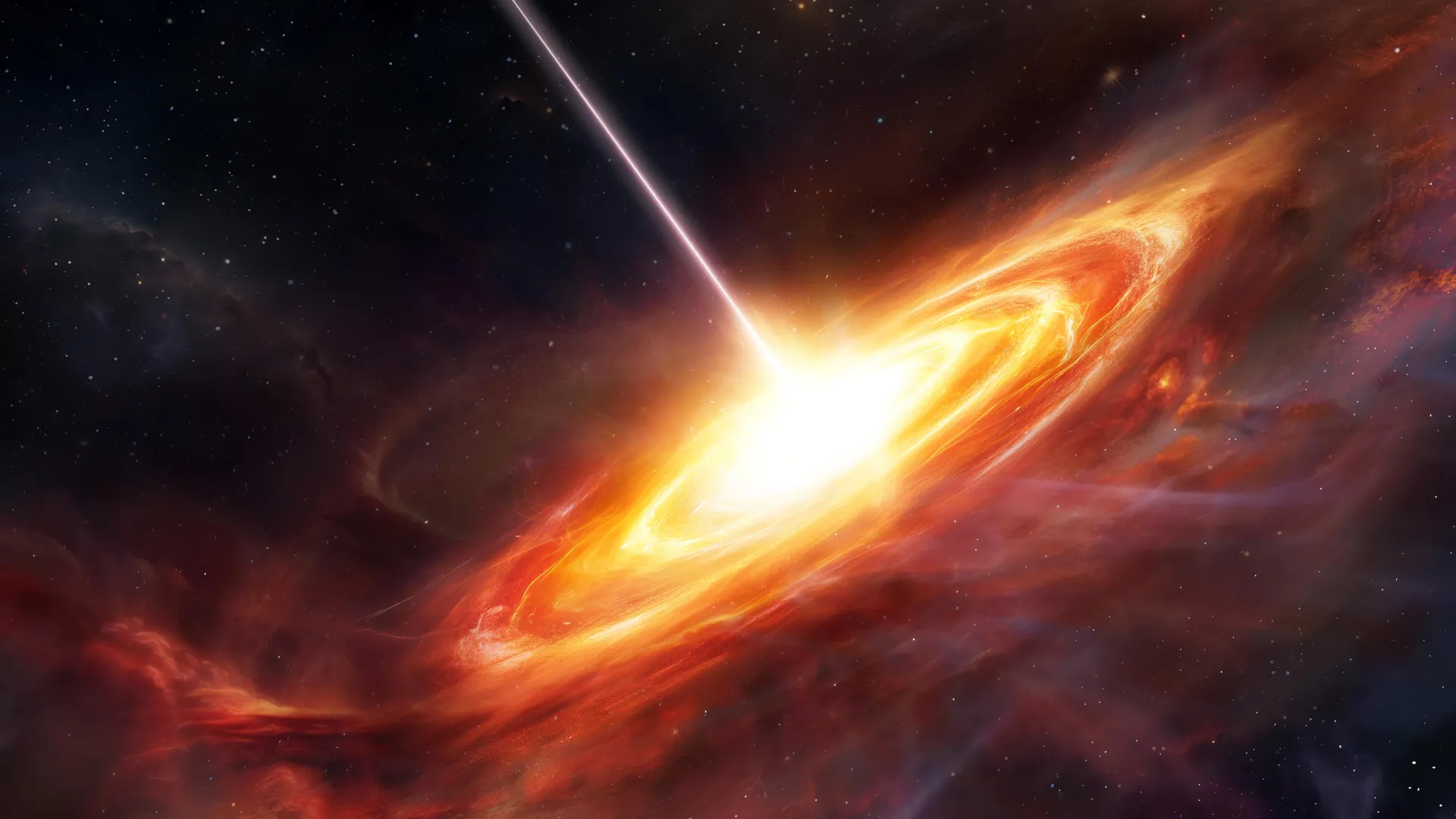
The European Space Agency’s Euclid space telescope has identified 31 exceptionally distant quasars, marking a significant breakthrough in understanding the universe’s earliest galaxies. Two of these discoveries set new records as the most ancient quasars ever detected, with redshifts of 7.77 and 7.69 respectively. These objects were already emitting light comparable to a trillion suns when the universe was merely 670 million years old, representing approximately 5 percent of the cosmos’s current age.
Quasars are among the brightest objects in space, powered by supermassive black holes at galactic centers. They occur during brief periods when enormous quantities of gas spiral toward these black holes, releasing extraordinary energy and causing galactic cores to outshine their surroundings by hundreds or thousands of times. Locating quasars from the universe’s infancy has proven challenging for astronomers, as few galaxies had developed sufficiently to host such objects at that early stage, and the light reaching Earth today is extremely faint. This makes distinguishing them from closer stars difficult.
Euclid, launched in 2023, has transformed quasar research through its ability to survey vast sky regions and detect faint objects. Its discovery of 12 quasars with redshifts of 7 or higher represents a dramatic acceleration in research that previously required over a decade to identify approximately 10 such objects. The telescope’s combination of expansive coverage area, imaging sharpness, and space-based infrared capabilities has enabled identification of not only the brightest ancient quasars but also fainter examples that previous surveys missed.
These discoveries provide crucial insights into early cosmic history. One recently studied quasar sits within a galaxy actively forming new stars at tremendous rates, offering researchers a window into conditions surrounding early supermassive black holes and how first-generation galaxies evolved alongside them. The ancient quasars exist within the epoch of reionization, a transformative period when radiation from energetic sources heated and ionized the universe’s primordial gas, establishing conditions that shaped the cosmos observed today.
Article Attribution | Read More at Article Source
Article summary produced by Claude AI