

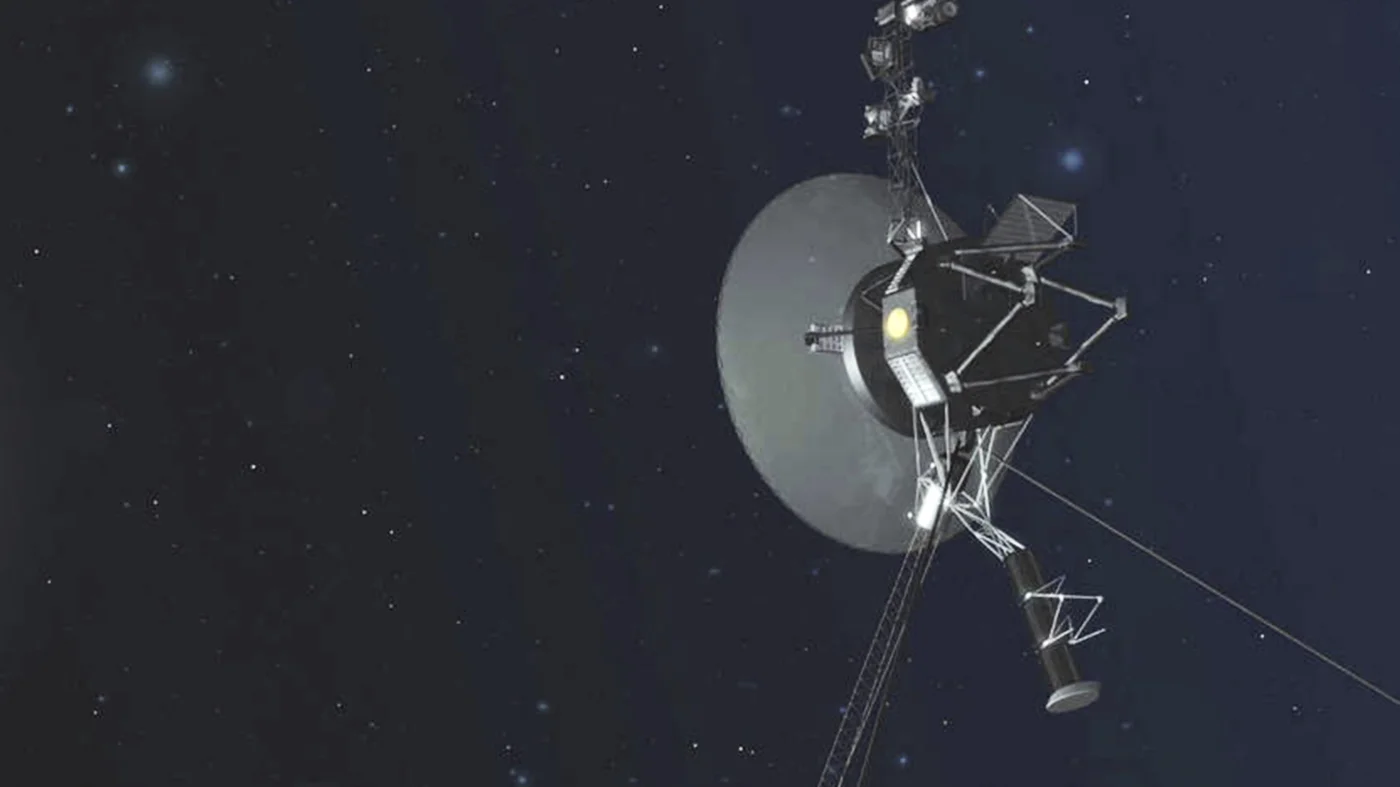
NASA’s Voyager 1 probe is scheduled to reach a significant distance milestone on Wednesday, achieving what the agency calls “light-day status.” A light-day represents the distance that light travels over 24 hours, approximately 16 billion miles. The spacecraft, which launched on Sept. 5, 1977, will reach this distance at an estimated time of 5:16 a.m. ET after traveling for nearly 50 years.
To mark the occasion, NASA is organizing a public participation event called “Shine Bright for Voyager’s Light-Day,” inviting citizens to transmit the spacecraft’s call sign V-G-R in morse code using flashlights or phone lights on Tuesday night. The agency has described this as a symbolic celebration of the probe’s unprecedented journey.
Voyager 1 holds the distinction of being the most distant human-made object ever launched into space. During its mission, the spacecraft conducted significant scientific observations, including flybys of Jupiter and Saturn, discovering a faint ring system on Jupiter in 1979 and capturing detailed imagery of Saturn’s rings and moons in 1980. On Feb. 17, 1998, Voyager 1 surpassed Pioneer 10 to become humanity’s most distant spacecraft.
The probe crossed into interstellar space in 2012, joining its twin Voyager 2 as the only spacecraft to have ventured beyond the heliosphere—the protective magnetic region surrounding the solar system. Its ongoing interstellar mission continues to measure magnetic fields, particles, and plasma waves in the space beyond the sun’s influence. Earlier this year, NASA deactivated the Low-energy Charged Particles experiment to conserve power and extend the spacecraft’s operational lifespan. Currently, two science instruments remain functional: a magnetometer and a plasma wave detector.
Voyager 1 carries the Golden Record, a gold-plated time capsule intended as a message to potential extraterrestrial civilizations. The record contains 115 images, natural sounds including animals and weather phenomena, greetings in 35 languages, and playback instructions.
Article Attribution | Read More at Article Source
Article summary produced by Claude AI