

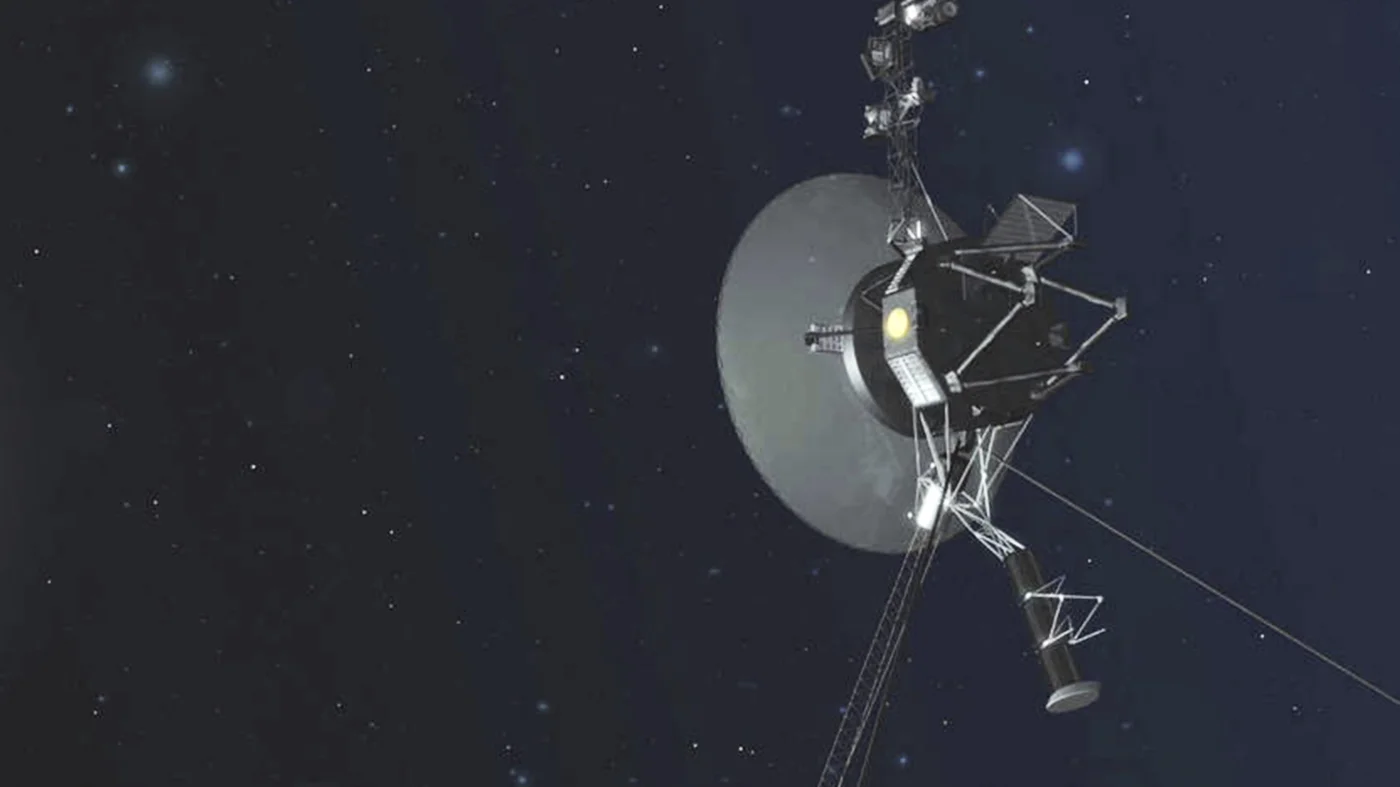
NASA’s Voyager 1 is approaching a significant distance milestone on Wednesday, when it will be positioned one light-day away from Earth. A light-day represents the distance that light travels in a 24-hour period, measuring more than 16 billion miles. The space agency is marking the occasion with a public celebration called “Shine Bright for Voyager’s Light-Day,” inviting people to transmit the spacecraft’s call sign V-G-R in morse code using flashlights or other light sources.
Voyager 1 has maintained its position as humanity’s most distant spacecraft since 1998, when it surpassed Pioneer 10. The probe launched on September 5, 1977, and has been operational for nearly 50 years. During its early mission phases, the spacecraft conducted significant scientific observations, including flybys of Jupiter in 1979 and Saturn in 1980, where it discovered faint ring systems and captured detailed imagery of planetary moons.
The spacecraft crossed into interstellar space in 2012 and continues to conduct scientific measurements beyond the heliosphere, the sun’s protective shield. Its ongoing mission involves charting magnetic fields, particles, and plasma waves in the interstellar environment. To extend its operational lifespan, NASA deactivated the Low-energy Charged Particles experiment earlier this year, though two science instruments measuring magnetic fields and plasma waves remain functional.
Voyager 1 also carries the Golden Record, an interstellar communication artifact containing 115 images, natural sounds, and spoken greetings in 35 languages, along with instructions on how to access the information. The spacecraft’s estimated arrival at light-day status is calculated for 5:16 a.m. ET on Wednesday.
Article Attribution | Read More at Article Source
Article summary produced by Claude AI