

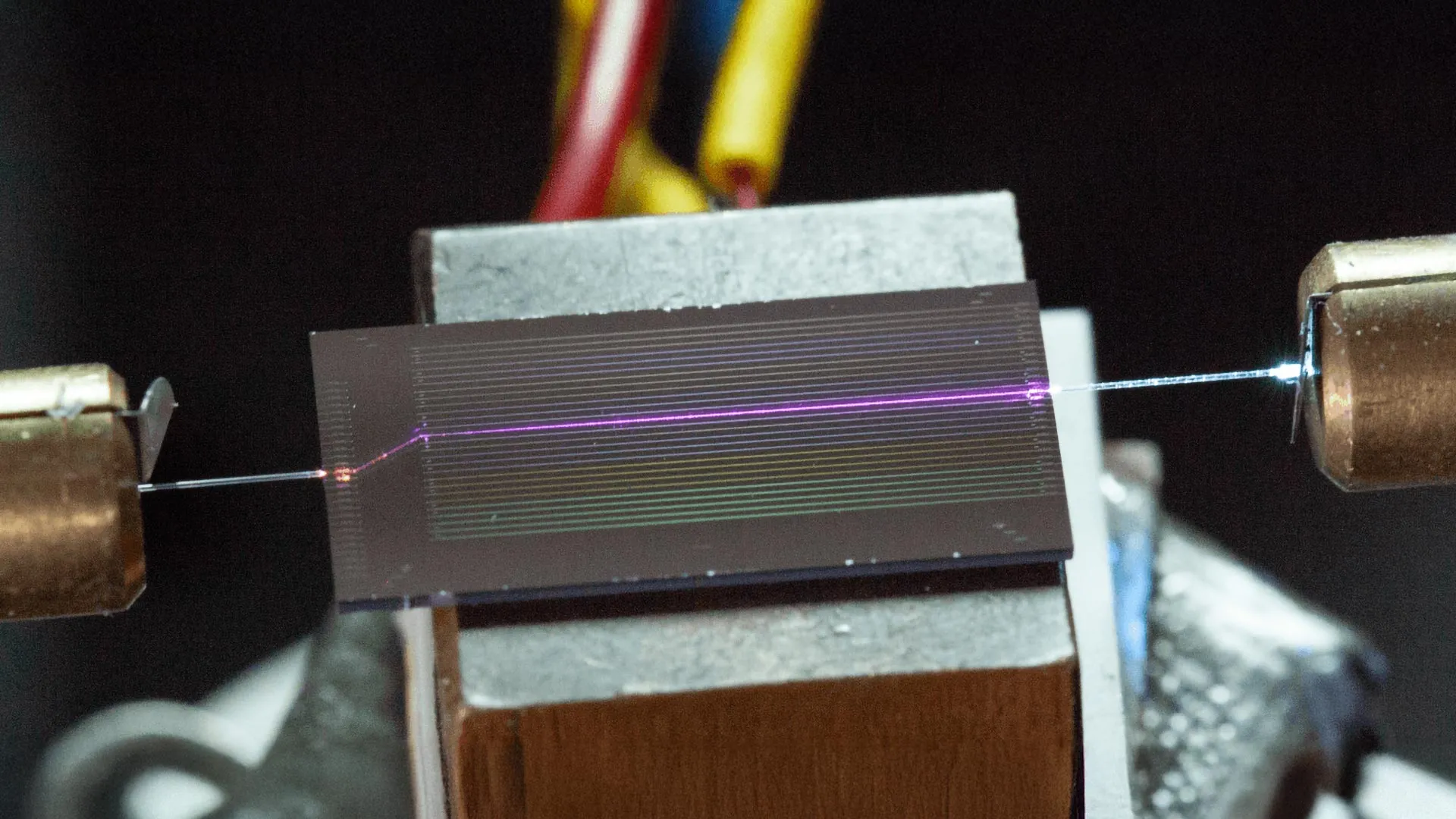
Researchers at Harvard University have demonstrated a significant advancement in ultraviolet light generation on photonic chips, addressing a long-standing engineering challenge. The achievement could have far-reaching implications for quantum computing, atomic clock technology, and environmental monitoring applications.
The fundamental challenge in developing compact UV sources has involved the rapid degradation of ultraviolet light as it travels through optical waveguides—the microscopic channels that transport light across chips. Previous attempts to shrink UV light sources have struggled with this inherent limitation, restricting practical applications. The Harvard team, led by Marko Lončar at the Electrical Engineering department, overcame this obstacle by generating UV light from red light within the chip itself using a process called frequency upconversion. The researchers selected thin-film lithium niobate, a material already well-established in photonics research, as their platform. The device converts pairs of red light photons into single ultraviolet photons with higher energy within the lithium niobate crystal.
The key innovation involved a novel fabrication technique called sidewall poling. Rather than the conventional approach of positioning electrodes above the material surface, the team placed precisely patterned metal structures alongside the waveguides. This arrangement allowed them to reverse the orientation of crystal domains throughout the entire cross-section of the waveguide, dramatically improving conversion efficiency. The technique requires approximately 50-nanometer accuracy during fabrication and enabled researchers to fine-tune spacing of reversed crystal regions along the device.
The resulting device produced 4.2 milliwatts of ultraviolet power at a 390-nanometer wavelength—roughly 120 times the output of previous comparable thin-film lithium niobate devices. This substantial improvement transforms a scientifically feasible concept into a practically viable technology. The advancement holds particular promise for trapped-ion quantum computers, which rely on specific ultraviolet wavelengths to manipulate electrically charged atoms for quantum information processing. The technology also offers potential applications in ultra-precise atomic clocks and environmental sensing systems for monitoring atmospheric pollutants and greenhouse gases. The research was published in Nature Communications.
Article Attribution | Read More at Article Source
Article summary produced by Claude AI