

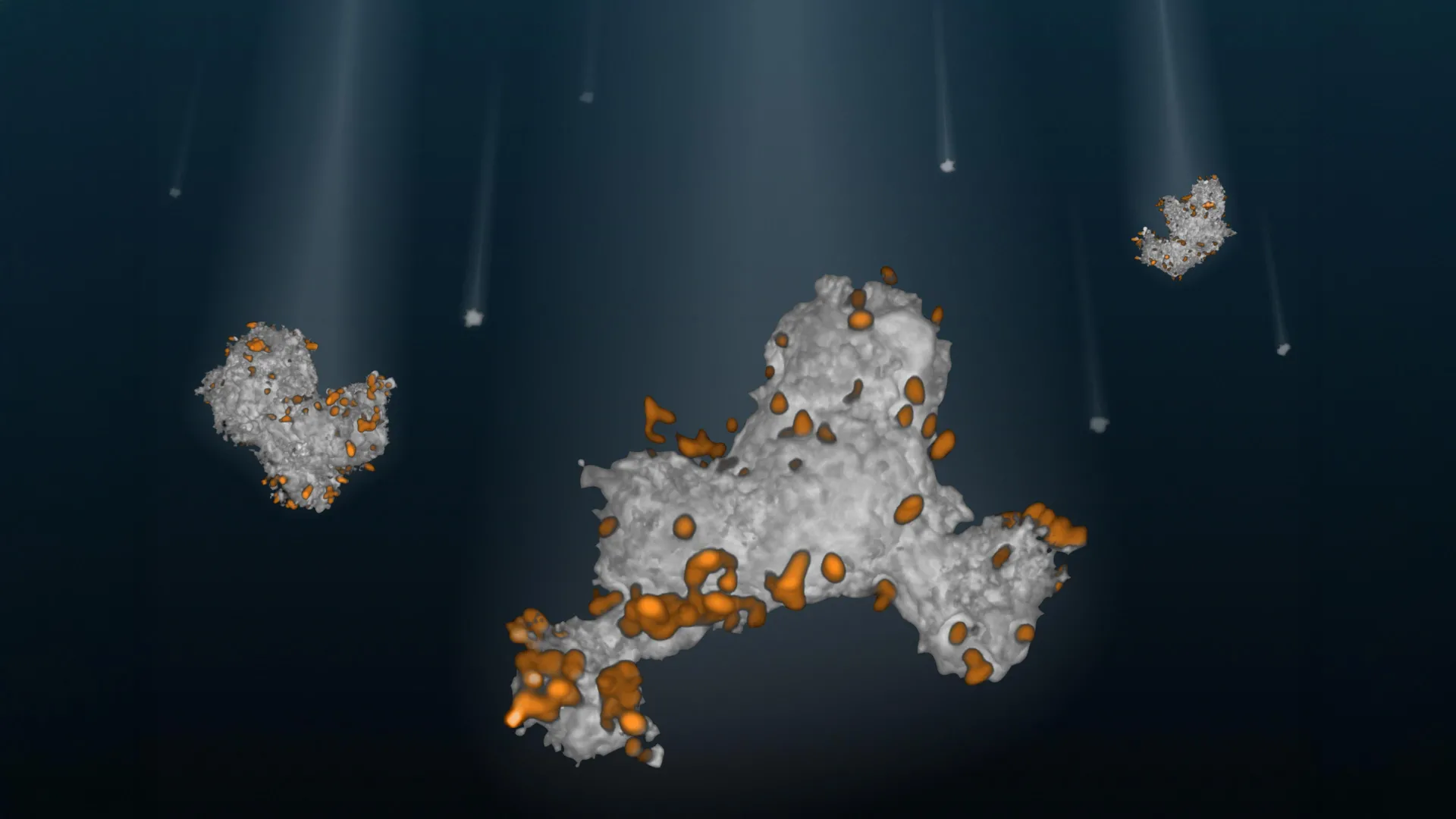
Scientists from UC San Diego’s Scripps Institution of Oceanography and the University of Lincoln have made a significant discovery about how marine snow—the constant rainfall of organic matter and debris that sinks through the ocean—transports carbon to the depths. Their research, published in October, reveals that the physical consistency of these particles plays a critical role in determining how much carbon reaches the deep ocean where it can be stored for centuries or longer.
Marine snow comprises microscopic clumps of dead organisms, mucus, animal waste, and other materials that drift downward through seawater. Scientists estimate this process removes more than 10 gigatons of carbon from surface waters annually, yet only about two gigatons ultimately reaches depths capable of long-term storage. The gap between these figures has long puzzled researchers studying Earth’s carbon cycle. The newly published findings suggest that particle viscosity—the thickness and stickiness of marine snow—is a crucial factor determining how far particles sink before bacteria break them apart.
The research project began in 2021 when researcher Bryce Inman and colleagues attempted to observe how bacteria interact with the microscopic structure of marine snow. For four years, multiple attempts to develop an observation technique proved unsuccessful until 2025, when the team successfully combined 3D confocal microscopy with specially designed fluorescent molecules. This breakthrough allowed scientists to examine individual marine snow particles and watch living bacteria move through and interact with them in unprecedented detail.
The imaging revealed that bacteria preferentially colonize less viscous, outer portions of particles while struggling to penetrate denser, stickier interior regions. This structural difference significantly affects particle degradation rates. Laboratory experiments demonstrated that highly viscous particles resist bacterial breakdown longer and can descend to greater depths before fragmenting, potentially delivering six times more carbon to the deep ocean compared to less viscous particles.
Beyond marine snow, the research has broader implications for understanding how bacteria interact with mucus in diverse environments including coral reefs, kelp forests, plant root systems, and animal digestive tracts. The newly developed imaging technology provides researchers with a tool to examine previously invisible microscopic environments, opening new avenues for investigating bacterial behavior across multiple biological systems.
Article Attribution | Read More at Article Source
Article summary produced by Claude AI