

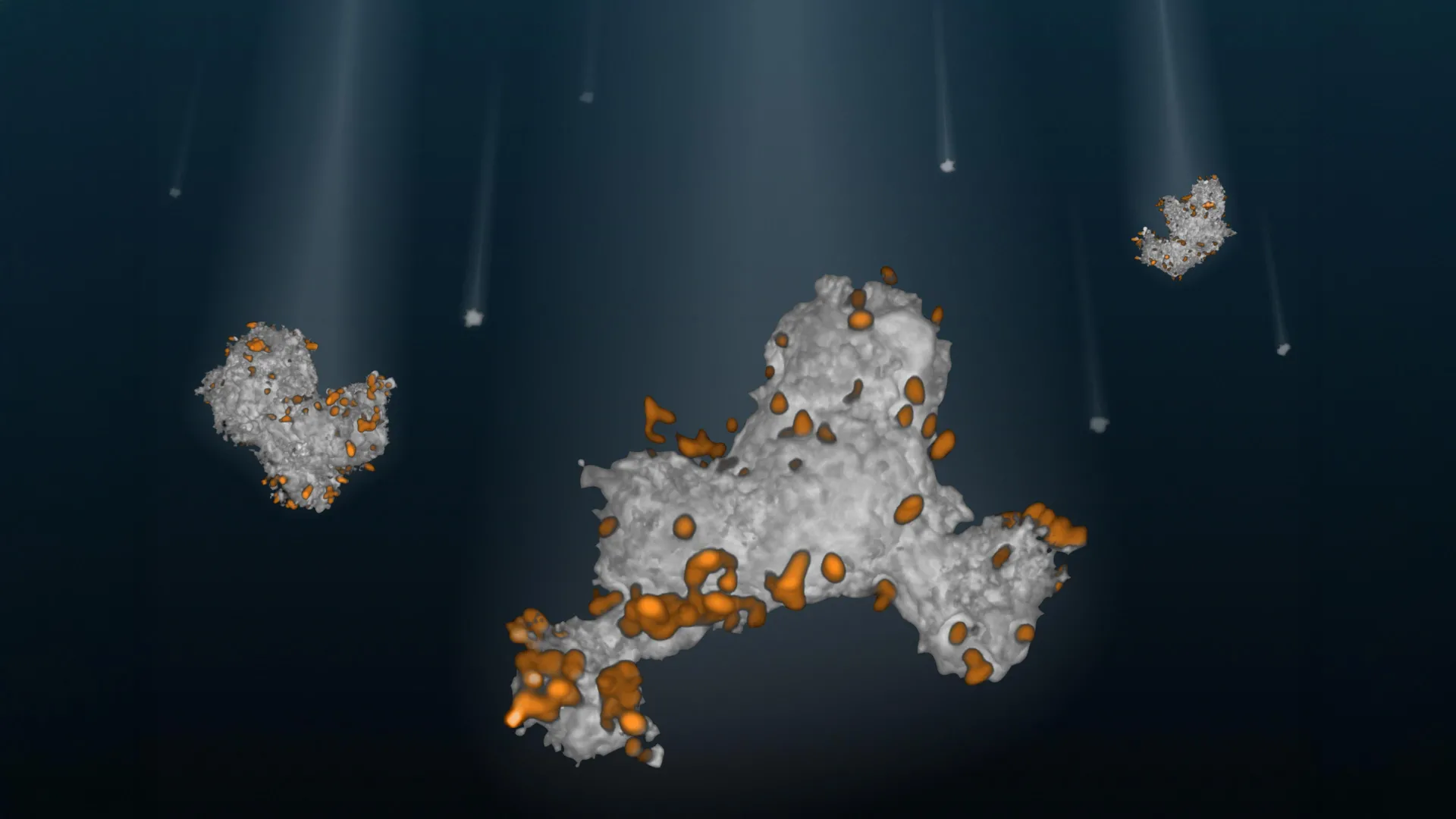
Scientists at UC San Diego’s Scripps Institution of Oceanography and the University of Lincoln have discovered that the viscosity of marine snow—the constant precipitation of organic debris and dead organisms that falls through the ocean—plays a crucial role in determining how much carbon reaches the deep sea. Their findings, published October 8 in the journal Science, indicate that particles with greater stickiness can deliver more than six times as much carbon to deep ocean depths compared to less viscous particles.
Marine snow consists of tiny clumps containing mucus, animal feces, silt, and plankton remains that sink from surface waters, removing more than 10 gigatons of carbon annually. However, only about 2 gigatons of that carbon reaches the deep ocean where it can remain stored for centuries or millennia. The research identifies viscosity as a previously overlooked factor explaining this discrepancy. Bacteria feed on marine snow as it descends, breaking down the material and reducing the amount of carbon that reaches deeper layers. The new work reveals that less viscous regions on particle surfaces are easily colonized by bacteria, while denser, stickier interior sections resist bacterial penetration for longer periods.
The research team, led by Bryce Inman, spent four years developing technology to observe bacterial interactions with marine snow at microscopic scales. Their breakthrough, completed in 2025, combined 3D confocal microscopy with specially designed fluorescent molecules, allowing direct observation of how bacteria move through and interact with particle structures. Laboratory experiments showed that highly viscous particles resist bacterial degradation longer and descend to greater depths before fragmenting.
Beyond ocean carbon dynamics, the findings have broader implications for understanding how bacteria interact with mucus in other environments, including coral reefs, kelp forests, plant root systems, and human digestive health. The imaging technology reveals that mucus contains complex internal structures previously invisible at bacterial scales, opening new research opportunities across multiple biological systems.
Article Attribution | Read More at Article Source
Article summary produced by Claude AI