

Neutrinos are among the most elusive particles in physics, traveling through the universe and passing through Earth with minimal interaction. These elementary particles exist in three varieties and possess extraordinarily small mass while carrying no electric charge. Their weak interactions with matter make them exceptionally difficult to detect, yet approximately 100 billion neutrinos pass through every square centimeter of human bodies each second, entirely unnoticed. Despite these challenges, neutrinos serve as valuable messengers from extreme cosmic environments that would otherwise remain inaccessible to scientific observation.
The history of neutrino research extends back to the 1930s when physicist Wolfgang Pauli theorized their existence to explain missing energy in radioactive decay. For decades, neutrinos remained undetectable until a breakthrough in 1956 when physicists successfully confirmed their reality. The field has proven significant enough to contribute to five Nobel Prizes in Physics, with the most recent award recognizing physicist Francis Halzen for his decisive contributions to neutrino detection and discoveries of high-energy cosmic neutrinos.
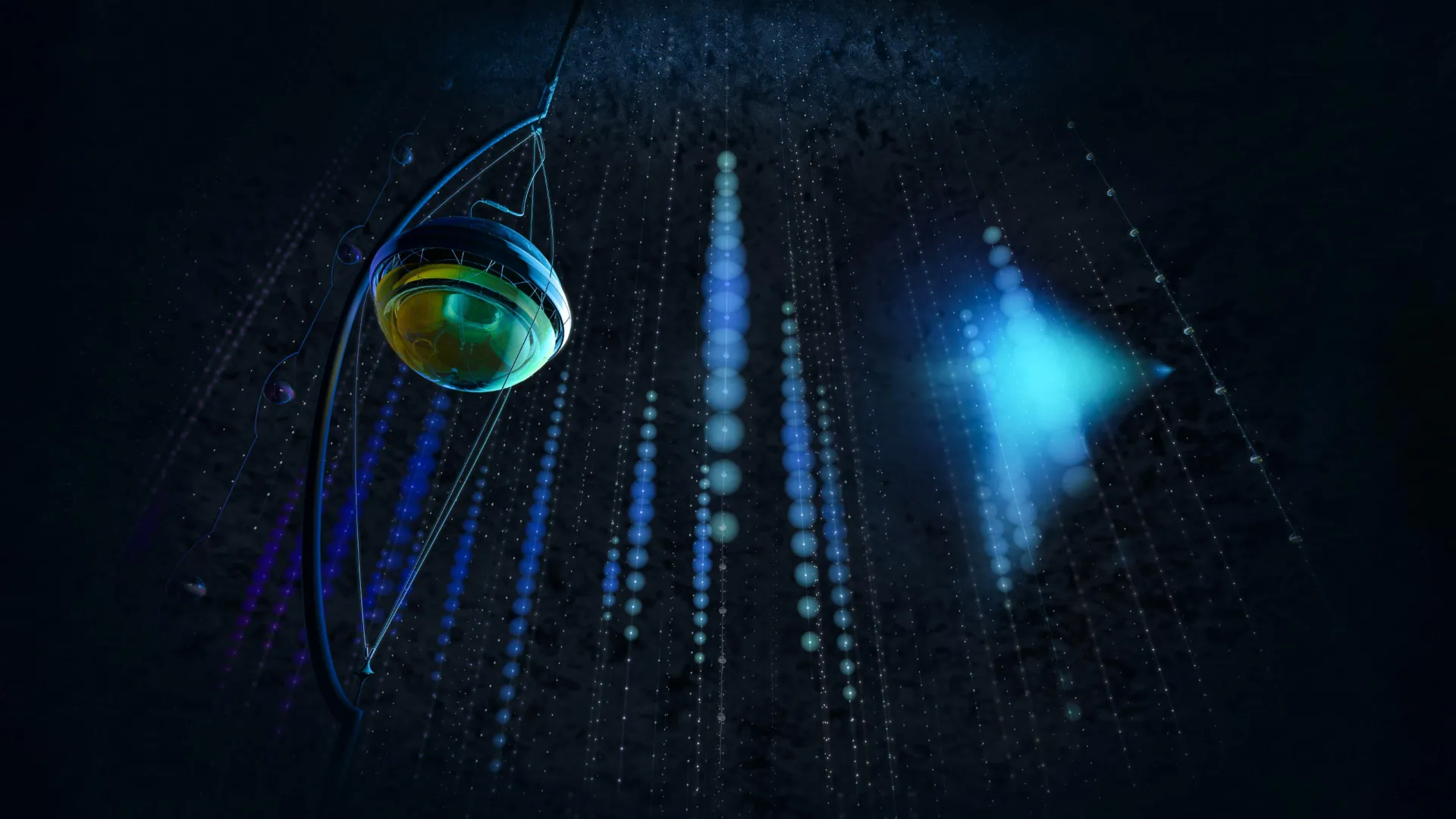
In the 1990s, Halzen envisioned using Antarctica’s unique environment as an ideal location for large-scale neutrino observation. This concept led to the construction of the IceCube Neutrino Observatory, a massive scientific instrument embedded within approximately one cubic kilometer of Antarctic ice. The facility employs long strings of sensitive light detectors positioned deep below the surface, where exceptionally clear ice provides an ideal medium for observing Cherenkov radiation. This blue light is produced when high-energy neutrinos interact with ice particles, creating charged particles that travel faster than light moves through the material.
IceCube has proven particularly valuable for studying rare, exceptionally energetic neutrinos arriving from distant cosmic sources. These ultra-high-energy particles are detected only a few dozen times annually, yet they carry tremendous scientific importance. Some cosmic neutrinos detected by IceCube possess approximately 10 billion times the energy of typical solar neutrinos, while similar experiments have recorded particles with even greater energy levels. The origins and physical mechanisms accelerating these particles remain poorly understood, making their continued study essential for advancing cosmic physics knowledge.
Article Attribution | Read More at Article Source
Article summary produced by Claude AI