

Neutrinos are among the universe’s most elusive particles, traveling through matter with minimal interaction and passing through Earth and human bodies in vast quantities. These ghostlike elementary particles exist in three varieties and possess extraordinarily small mass while lacking electric charge. Despite their abundance—estimated at roughly 10 to the 89th power in the universe—detecting them remains extraordinarily challenging because they interact with other matter through the weak force, which is approximately 20 orders of magnitude weaker than electromagnetism.
The history of neutrino detection spans nearly a century. Physicist Wolfgang Pauli proposed their existence during the 1930s to explain missing energy in radioactive decay, though he acknowledged the theoretical particle might be impossible to detect. The breakthrough came in 1956 when physicists Clyde Cowan and Frederick Reines successfully detected neutrinos through an experiment called Project Poltergeist. However, observing the rarest and most energetic neutrinos arriving from space required even more sophisticated technology.
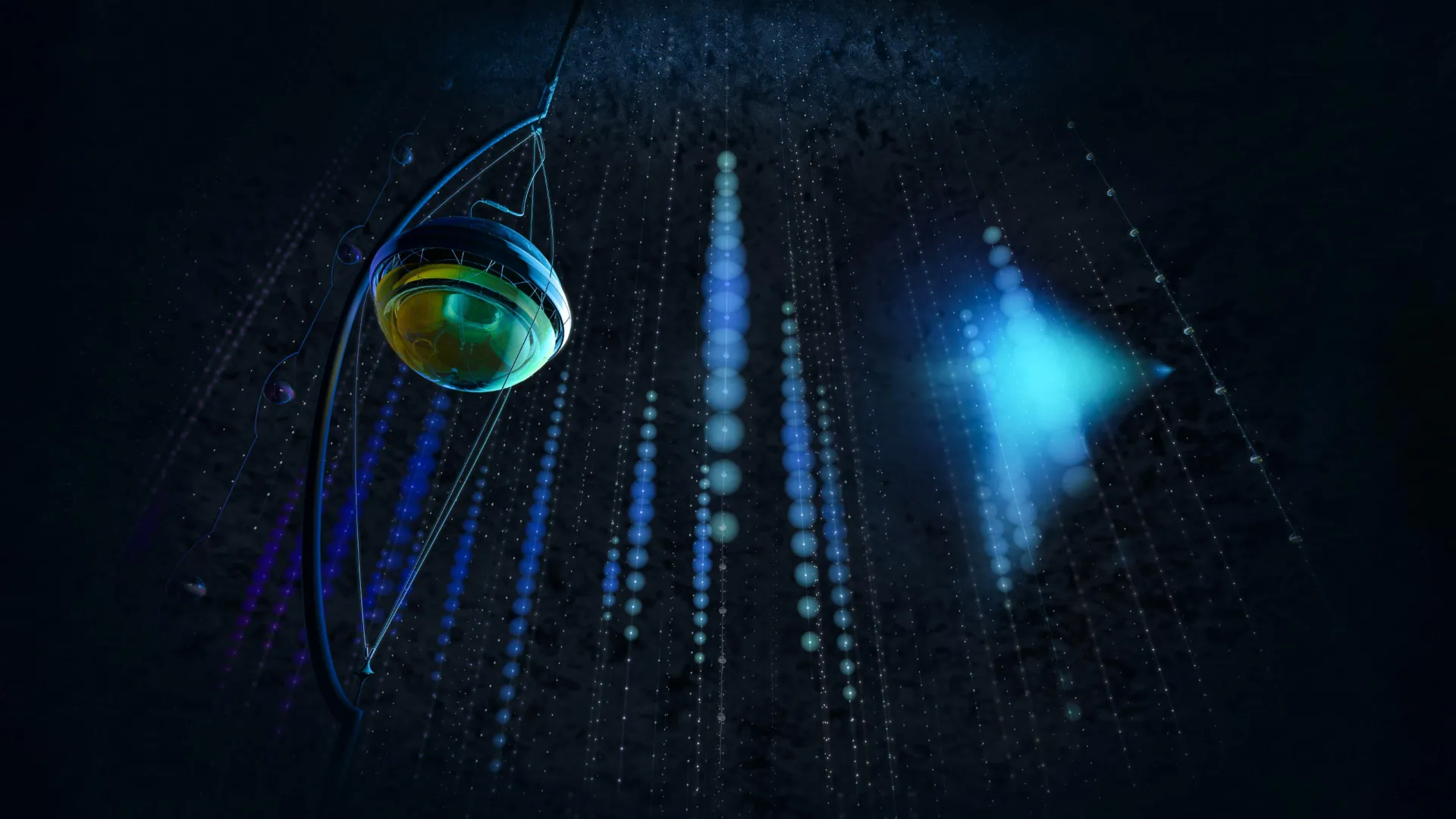
Physicist Francis Halzen’s recognition that Antarctic ice could serve as a natural detection medium led to the construction of the IceCube Neutrino Observatory, embedded within roughly one cubic kilometer of ice at the South Pole. The facility uses sensitive light detectors called photomultiplier tubes to capture blue flashes of Cherenkov radiation produced when neutrinos interact with ice particles. By analyzing these light patterns, researchers can determine a neutrino’s energy and the direction from which it originated.
IceCube has made remarkable discoveries regarding ultra-high-energy cosmic neutrinos, which are extremely rare but scientifically significant. These particles carry energies roughly 10 billion times greater than typical neutrinos from the Sun, with some detected by similar experiments reaching even higher energy levels. These extraordinary cosmic messengers originate from distant sources and result from physical processes that remain poorly understood, making their detection crucial for advancing knowledge of the universe’s most extreme environments.
Article Attribution | Read More at Article Source
Article summary produced by Claude AI